
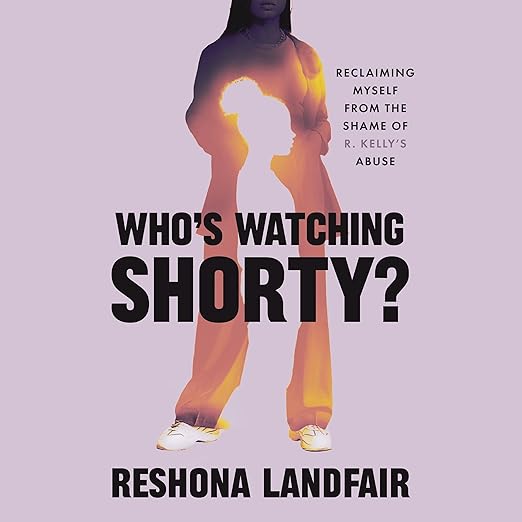
Quick Take
- Performance: Author and reader are the same person, and on a memoir built around testimony given under a pseudonym, that identity is the product decision rather than a bonus.
- What it covers: Child exploitation and the adults who looked away, celebrity as protection, reclaiming a name after years as a court pseudonym.
- Feel: Direct, angry, difficult to set down for reasons that are not comfortable.
- Our call: Essential if you followed the case and never heard from the person at its center, punishing if you wanted anything lighter.
Jane Doe was the name on the court document, and for years it was the only name attached to the fourteen-year-old in the video that ended in racketeering and sex-trafficking convictions and a thirty-year sentence. This audiobook is where that arrangement ends. Reshona Landfair wrote the memoir and holds the reading credit herself, seven hours and forty-nine minutes of testimony delivered by the person it belongs to. Legacy Lit released it in February 2026, and the written responses collected since are, for the most part, not book reviews at all.
What She Lost Included Her Own Voice
The argument is not really about R. Kelly. It is about everybody else. Family, music business executives, social services, law enforcement: the description names them all as people who should have stepped in and looked away instead, blinded by fame and celebrity. That is the account Landfair says has never been told, and it is harder to tell than the crime itself, because it requires naming ordinary adults doing ordinary nothing rather than pointing at one man.
Nicholas McCane, writing at five stars in late February 2026, supplies the context the memoir assumes you already carry. The account describes growing up in Chicago, where in 2001 R. Kelly was less a star than a civic fixture, then describes buying bootleg CDs and DVDs, hearing about the leaked tape, expecting another celebrity sex tape, watching it, and registering that the person on screen was a child rather than a woman. Recognition arriving that late, and that publicly, is the precise failure the book was written about.
Byline and reading credit name the same person, which on most memoirs is a pleasant touch and on this one is the entire proposition. The description is explicit that what she lost included her voice. Choosing audio means the account reaches you with the decisions about emphasis still belonging to the person the events happened to, rather than to a performer interpreting her at one remove. Print delivers the words. A reading like this one delivers who is saying them.
To Know How She Felt, in Her Voice
One five-star note filed in early March 2026 comes from a former classmate. It recalls meeting Reshona in sixth grade, being introduced to R. Kelly as her godfather, and understanding none of it until police arrived at the high school to interview students after the tape surfaced. The line I keep returning to is the wish, held for years, to know how she felt, in her words, in her voice. For a reader who wants exactly that, from somebody who was in the building, this format is the strongest case anyone could make.
Three questions organize the account, and the description states them without hedging: what it was like to be a teenager, emotionally still a child, caught in that orbit; why she believed he loved her given how badly he treated her; why she kept the secrets as long as she did. Those are the questions survivors get asked constantly and almost never get to answer at length. A memoir has room for real answers. A trial does not, and a trial is where most people met this story.
Under eight hours is brief for a life this complicated, and the compression works in the book's favor. Landfair is not building a case, since the convictions already exist. What the book does instead is fill in the interior of a story the public consumed as evidence. It moves, and it moves without the padding that celebrity-adjacent memoirs usually carry, because the sequence of events is already fixed and the ending is already public.
Filed Beside Thrillers and Celebrity Gossip
A four-star response from February 2026 is the most useful warning on the page. It reports pride in the telling and, in the same sentence, being uncomfortable and angry enough to slam the book down before going back to finish. Take that literally. The subject is the sexual exploitation of a child, described by the person it happened to, and the description does not soften what the video contained. Audio removes the option of skimming, which is worth knowing in advance.
Count the written responses against the rating tally and something worth noticing appears. The page carries 171 ratings and five written accounts, and all five landed between February 5 and March 5, 2026, inside the first five weeks on sale. Two of the five are personal testimony rather than assessment: a school classmate and a Chicago resident who watched the tape circulate. That is a launch-window pool weighted toward people with a stake in it, and a thin basis for a purchase decision either way.
Shelving is the other oddity. The title sits under biographies and memoirs, which is correct, and simultaneously under mystery, thriller and suspense, which is not, with a category tag reading Entertainment and Celebrities. A survivor's account of trafficking filed beside thrillers and celebrity gossip is a classification problem with real consequences: it puts the book in front of people shopping for entertainment and hides it from people looking for testimony.
A Placeholder Name Becomes a Whole Life
Readers who followed the trial and felt the coverage stopped short of the person at its center are the obvious audience, and one February 2026 account points to a second group. It describes the book prompting reflection on choices made from then to now, opening wounds that had gone unidentified, and clarifying situations the reader had been inside without recognizing them. Survivors of coercion find their own material here, which is a different use entirely than true-crime curiosity.
Anyone approaching the R. Kelly case as spectacle should look somewhere else, and so should anyone unable to sit with a first-person account of child sexual abuse for the length of a full memoir with no distance built in. Nothing in the description suggests a lurid treatment. The material is simply what it is, and a recording removes the small mercies a printed page allows: skipping ahead, reading with your eyes half closed, setting it down mid-sentence and not picking it up again for a week.
Landfair testified as a placeholder name on a long court document, and the point of the memoir is that the placeholder had a school, a personality, a whole life that people remembered decades later. Putting her own voice on the recording finishes an argument the title starts. It asks who was watching, and then answers by letting the person who was being watched do the talking.
Does the audiobook handle the explicit material with restraint?
A five-star account from February 2026 addresses this directly, saying the intimate details, while not salacious, were explained with decorum. That matches what the description promises: an insider's view rather than a recounting of the video. The events remain graphic in substance even where the telling stays measured.
Is this a true-crime reconstruction of the R. Kelly trial?
No. Nothing on the page promises investigative reporting, legal procedure or courtroom reconstruction. The convictions and the sentence are stated as background, and the book is written from inside the experience instead. Anyone wanting the prosecution's case, the timeline or the evidence chain will need a different title.
How much does the audiobook assume you already know about the case?
Less than you might expect. The description lays out the essentials, the video, the testimony given as Jane Doe, the convictions and the thirty-year sentence, before the memoir begins. Because the writing works from the inside outward, the public timeline stays background and never becomes homework.
Does the listing carry a formal content warning?
It does not. No advisory appears anywhere on the product page, though the description states the subject matter plainly enough that nobody should be caught out. Given that the narrator is describing her own abuse as a minor, assume the whole recording carries that weight rather than isolated chapters.







