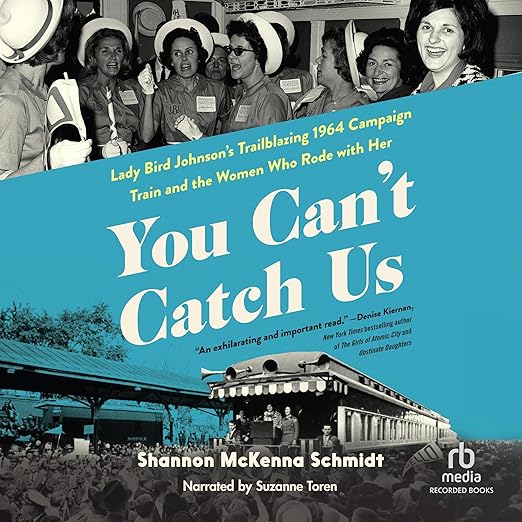
The Most Ambitious Campaign a Spouse Ever Ran
Nineteen train cars rolled out of Washington on October 6, 1964, carrying Lady Bird Johnson into a region that resented her husband's civil rights record, and this audiobook rides along for all four days. You Can't Catch Us reconstructs the Lady Bird Special, a 1,682-mile whistle-stop campaign tour through the South that Shannon McKenna Schmidt, author of The First Lady of WWII, calls the most ambitious campaign effort ever undertaken by a president's spouse. Lady Bird, proud of her own southern heritage, chose to make the trip herself specifically because she believed she could reach voters her husband's civil rights positions had alienated, and the book follows her from Washington to New Orleans as she does exactly that.
What distinguishes this account from a straightforward campaign history is its attention to the women who made the tour function: staffers, advance planners, and the daughters, Lynda and Luci, who joined different legs of the journey. Schmidt frames the trip as a women-led operation in an era when that framing itself was politically risky, and the book treats that organizational story with the same weight as Lady Bird's own speeches and handshakes. The result reads as much as a study in campaign logistics and women's political labor as it does a portrait of Lady Bird herself.
Toren Keeps the Tension Without the Melodrama
Narrator Suzanne Toren captures what one reviewer describes as feeling like a member of the Lady Bird Special's own team, a quality that matters for a book built around sustained forward motion, a literal train moving through hostile territory for four straight days. That momentum comes through in Toren's pacing, which keeps the tension of Lady Bird's physical safety, real given the hostility Schmidt documents, present without tipping into melodrama. Listeners get both the historical stakes and the human tension of a First Lady making speeches in towns where her husband's name drew open resentment.
Schmidt's research clearly extends beyond the trip itself into its lasting significance: the book positions the Lady Bird Special as a genuine turning point in expanding women's role in American political campaigning, not just a colorful historical footnote. Listeners interested in the broader arc connecting 1960s political history to later developments in women's political participation will find that throughline handled with more specificity than a simple feel-good framing would suggest, grounded in the actual mechanics of what Lady Bird and her team accomplished over four demanding days on the road.
Schmidt situates the Lady Bird Special within a longer history of political spouses navigating campaigns on their own terms, drawing an implicit line forward to later political spouses who took on independent campaign roles, without overstating the connection or turning the book into a broader thesis it does not need. That restraint keeps the focus tight on 1964 specifically, which serves the narrative better than a more sprawling comparative history would have, while still giving listeners enough context to understand why historians consider this specific tour a genuine turning point rather than a footnote.
Readers of campaign-trail journalism will recognize echoes of Theodore White's Making of the President series in Schmidt's attention to logistics and behind-the-scenes maneuvering, though You Can't Catch Us narrows that wide-angle approach down to a single first lady's four days rather than an entire national campaign. That narrower aperture lets Schmidt include the kind of granular, human-scale detail, which stops drew hostile crowds, which staffers improvised solutions on the fly, that a broader campaign history covering the whole 1964 race would have had to compress or cut entirely.
A Single-Event History Rather Than a Full Biography
At just under ten hours, this is a tightly focused single-event history rather than a full Lady Bird Johnson biography, and listeners expecting comprehensive coverage of her entire life and White House tenure should adjust expectations. The synopsis and structure both signal this clearly: the 1964 tour is the subject, with biographical context folding in around it rather than the reverse. Listeners wanting the fuller picture of Lady Bird's life, environmental advocacy, later White House years, will need a different, broader biography alongside this one.
The book also assumes a baseline familiarity with the 1964 election and the civil rights context driving southern resistance to Lyndon Johnson, though it provides enough grounding that unfamiliar listeners will not be lost. One reviewer notes bringing prior political background to the listen and still learning substantial new detail, suggesting the book rewards both newcomers and readers already familiar with the broader historical moment without over-explaining for either audience specifically along the way.
The book largely celebrates its subject without becoming hagiography; Schmidt is willing to note the moments Lady Bird's team miscalculated a stop's reception or misjudged local sentiment, which keeps the account feeling like real campaign history rather than pure commemoration. Listeners wanting a more critical assessment of the broader Johnson civil rights legacy specifically should know that isn't this book's project; the focus stays tightly on the tour itself and the women who executed it, not a referendum on the administration's policies more broadly.
A Well-Narrated Account of an Overlooked Moment
This audiobook suits listeners interested in women's political history, campaign strategy, or civil rights-era southern politics, especially anyone who wants a tightly focused account of a single, underexamined historical episode rather than a sprawling biography. Fans of Schmidt's earlier work, The First Lady of WWII, will recognize a similar approach here: a specific historical episode used to illuminate a broader argument about women's overlooked political contributions.
Skip it if you want a comprehensive Lady Bird Johnson biography covering her full life and legacy; this is deliberately narrower in scope. Listeners uninterested in campaign history specifically may also find the granular four-day structure more detailed than they need. For anyone drawn to a vivid, well-narrated account of an overlooked moment in women's political history, though, this delivers exactly what its focused scope promises from start to finish.
- Narration: Suzanne Toren's pacing keeps the four-day train tour's momentum and real physical tension present without tipping into melodrama.
- Themes: Women's political labor, civil rights-era southern resistance, campaign history
- Mood: Vivid, historically grounded, quietly tense
- Verdict: A tightly focused, well-narrated account of an overlooked campaign moment, best for listeners wanting depth on one event rather than a full biography.
Does this audiobook require prior knowledge of the 1964 presidential election?
No, though some familiarity helps. Schmidt provides enough political context around Lyndon Johnson's civil rights record and the southern backlash to it that newcomers won't be lost.
How does this compare to Shannon McKenna Schmidt's earlier book, The First Lady of WWII?
It uses a similar approach: a specific, underexamined historical episode used to illuminate a larger argument about women's overlooked political and wartime contributions.
Does the audiobook cover the civil rights tensions Lady Bird faced in the South directly?
Yes, directly. The synopsis and narrative both center on the real hostility Lady Bird encountered touring a region resistant to her husband's civil rights positions.
Is this audiobook about Lady Bird Johnson's whole life or just this one campaign trip?
Just the trip, deliberately. This is a tightly focused account of the four-day Lady Bird Special tour rather than a comprehensive biography of her full life.