Quick Take
- Narration: Adam Boyce delivers the guided meditation with consistent calm throughout, though listeners familiar with Dispenza’s original CD release may find the creator’s own voice guides the practice differently.
- Themes: Neuroplasticity and belief change, open-focus meditation, present-moment consciousness and identity
- Mood: Still, inward, and deeply repetitive by deliberate design throughout its full hour
- Verdict: A specialized guided meditation practice rather than a conventional audiobook, know what you are getting before you begin, and ideally read the companion book first.
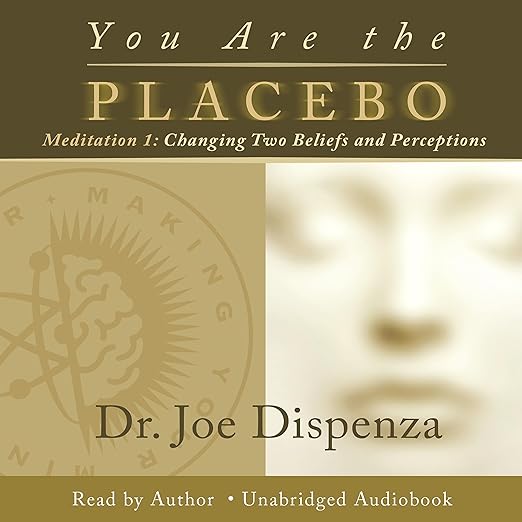
I want to be direct about what this audiobook actually is, because the standard metadata does not fully prepare you for the experience. At one hour and eight minutes, You Are the Placebo is not a condensed version of Dr. Joe Dispenza’s book of the same name. It is a standalone guided meditation, supported by subtle ambient sound design, structured around the practice of identifying two beliefs or perceptions you want to change and then rehearsing the internal state that corresponds to having already changed them. If you arrive expecting an audiobook summary or a lecture about the neuroscience of placebo effects, you will be disoriented within the first ten minutes and increasingly frustrated. If you arrive expecting a guided meditation practice from one of the most prominent voices in the contemporary mind-body space, you will find exactly that delivered with care and intentionality.
This distinction matters enormously for how you evaluate the experience and what practical value you extract from it. Dispenza’s written work on neuroplasticity, consciousness, and the documented science behind placebo effects runs to hundreds of pages. This audio is the practice component stripped of its theoretical scaffolding and designed to be used alongside the companion book rather than in place of it. The book provides the why and the what. This recording provides the how in the most literal and experiential sense possible for someone ready to use the practice.
The Open-Focus Approach and What It Demands
Dispenza’s method here centers on what he describes as moving beyond the familiar body-mind and the identity tied to your environment and your particular position in time. The induction moves listeners from ordinary waking awareness down through progressively deeper states, and the repetition of certain phrases, including the word space, is entirely intentional and functionally deliberate. One reviewer with direct meditation experience addresses the complaints about this repetition specifically: it is a technique to get you out of beta and into alpha and theta. That explanation is accurate within the framework of how brainwave entrainment meditation practices are designed and why they use repetition the way they consistently do.
How effectively the practice works depends substantially on your existing relationship with meditation and with Dispenza’s specific approach. Listeners who already practice regularly and have familiarity with open-focus or theta-state induction techniques report moving into the intended states relatively quickly and finding the practice immediately valuable. Those new to meditation may find the hour-long duration demanding before they have built the sustained attentional capacity the practice genuinely requires to deliver its intended effect.
The Sound Design That Supports the Work
The subtle ambient sound design integrated into the meditation is one of its genuine assets and not an afterthought. This is not background music competing with the voice guidance or filling silence for the sake of it. It is integrated specifically to support the state transitions Dispenza is working to induce rather than to decorate an otherwise bare recording. Several reviewers note positive experiences with Barry Goldstein’s musical work on related Dispenza recordings, and this production shares that careful approach to the relationship between sound and internal state.
The practical recommendations from experienced listeners to use headphones and a dark, undisturbed room are genuine prerequisites rather than precious overcaution. This is meditative content designed to facilitate specific internal states that ambient noise, visual distraction, and divided attention will prevent. One listener described remaining in a meditative state for an additional thirty minutes after a technical interruption in their recording equipment, choosing not to return to ordinary awareness before resuming. That specific experience says something real about the depth of state the recording can produce for prepared and receptive listeners.
What the Practice Is Actually Asking You to Do
The core activity of the meditation is twofold: identify two specific beliefs or perceptions you are genuinely ready to change, and then rehearse the internal state associated with having already made those changes from the inside out. Dispenza’s theoretical framework holds that the body cannot distinguish between a vividly rehearsed internal experience and an actual external one, and that sustained rehearsal of a new internal state can produce measurable neurological change over time. Whether you accept that framework fully or partially or skeptically, the practice of consciously identifying beliefs you want to shift and spending focused attention on what the alternative feels like from the inside is useful independent of the metaphysical claims surrounding it.
Context, Preparation, and Honest Expectations
The 4.3 rating across 450 reviews reflects a community of practitioners who engage with this recording repeatedly as part of an ongoing practice rather than a general audience evaluating it as a standalone product. The lower ratings consistently come from listeners who arrived without the context the companion book provides or without existing meditation experience. If you are curious about Dispenza’s approach, start with the written book. Build the conceptual framework. Return to this recording when you understand what you are doing and why the practice was structured the way it was. Used with that preparation, this is a tool with a specific and well-defined function. Used without it, it is an unusual and somewhat baffling hour that will leave most listeners no different than when they started.
Dispenza has released multiple meditation recordings in this format, including Blessing of the Energy Centers and Changing Beliefs and Perceptions, and long-term practitioners often rotate between them. This particular recording is designed as an entry-level practice for the placebo-effect framework specifically, making it a sensible starting point for new practitioners once they have the conceptual background from the written work in place.
Frequently Asked Questions
Is this the same as the You Are the Placebo book by Dr. Joe Dispenza, or is it entirely separate content?
It is entirely separate content. This audiobook is a one-hour guided meditation practice, not an audio version of the full written book. The written book provides the scientific and philosophical framework. This recording delivers the meditation exercise itself. Both are typically used together as complementary elements of Dispenza’s full teaching approach.
Do I need any prior meditation experience to use this recording effectively?
Some existing experience with meditation is genuinely helpful. The induction is designed to move listeners into alpha and theta brainwave states over the session’s course, which can be difficult for those new to sustained meditative attention. Listeners with established meditation habits report entering the intended states more readily and finding the practice more immediately valuable.
Why does the recording repeat the word ‘space’ so frequently throughout the meditation?
The repetition is entirely intentional and technically purposeful. Multiple reviewers with meditation experience confirm this, noting that the repetition is designed to facilitate the transition from ordinary waking beta states into the deeper alpha and theta states where Dispenza’s belief-change rehearsal is intended to occur effectively.
Is the narration by Adam Boyce or by Dr. Dispenza himself?
The current Audible listing features Adam Boyce as narrator. The original CD release featured Dr. Dispenza guiding his own practice, and some reviewers specifically recommend seeking out that version for the authenticity of hearing the creator guide his own meditation. Both versions cover the same content and structure throughout.