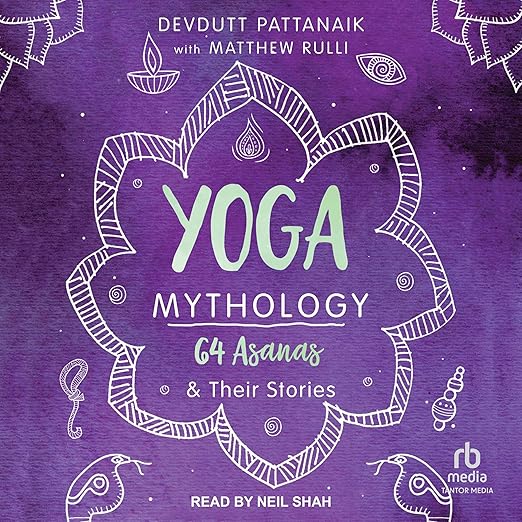
Quick Take
- Narration: Neil Shah’s Sanskrit pronunciation is widely praised as beautiful and authentic, lending genuine cultural weight to each asana story.
- Themes: Hindu mythology and asana origins, Indic philosophy, the intersection of the physical and spiritual in yoga
- Mood: Contemplative and educational, with occasional moments of genuine mythological wonder
- Verdict: Yoga practitioners curious about the deeper roots of their practice will find real value here, though those seeking narrative storytelling over mythology surveys may be disappointed.
I picked up Yoga Mythology during a long weekend when I had been planning to revisit some foundational texts on Hindu mythology. I practice yoga regularly but had always kept the physical and the philosophical separate in my mind, treating the postures as exercise and the philosophy as a separate study. Devdutt Pattanaik, the prolific Indian mythologist behind dozens of books on Hindu, Buddhist, and Jain lore, argues that this separation is itself a kind of cultural loss, and after nearly seven hours with this audiobook, I found it hard to disagree entirely.
The premise is precise and genuinely useful: Pattanaik walks through sixty-four common asanas, tracing each one back to the mythological figures, creatures, and cosmic concepts that inspired their names. The dog pose connects to Shiva, the cobra pose to shape-shifting beings who dwell beneath the earth, the eagle pose to Garuda. Whether you practice these poses weekly or have never set foot on a mat, the underlying stories are fascinating territory.
Our Take on Yoga Mythology
What Pattanaik does well is the framing. He opens by arguing that modern yoga instruction has systematically stripped away what he calls the Indic worldview, a way of seeing grounded in eternity, rebirth, liberation, and empathy, in favor of a clean, secular physicality that Western markets found more palatable. That argument is not new, but he makes it clearly and without condescension, and it gives the rest of the book its underlying purpose. You are not simply learning trivia about pose names. You are being invited to recover a way of thinking that the postures were originally designed to embody.
The book also draws on all three major Indian philosophical and religious traditions: Hindu, Buddhist, and Jain. This breadth is rare in yoga literature aimed at English-speaking practitioners, and one reviewer specifically noted appreciating distinctions between these perspectives that they had rarely encountered before. Pattanaik is an insider voice here, something that reviewers repeatedly flagged as meaningful. His fluency with source material goes beyond what a Western scholar working from translation could achieve.
Why Listen to Yoga Mythology
The audiobook format works better than you might expect for a book that is nominally an illustrated reference. Tantor Media released it with a companion PDF included in the Audible library, which addresses the obvious concern about asana descriptions requiring visual support. Neil Shah’s narration carries the Sanskrit terminology with a naturalness that reviewers found striking. One listener described the pronunciation as sounding beautiful in a way that print cannot convey. For a text this dependent on the musicality of ancient language, that matters significantly.
The listening experience is contemplative rather than propulsive. This is not a book with narrative momentum; it is a survey, organized by pose, with each entry functioning as a short mythological lesson. At just over six hours it is compact enough to complete across a long weekend, and several listeners described returning to individual sections before specific practice sessions. That kind of repeated use is a real test of a reference work, and this one passes it.
What to Watch For in Yoga Mythology
The main limitation is the one that several reviewers identified: the connection between mythology and individual asana is sometimes tenuous. A handful of entries feel more like general introductions to mythological figures than explanations of why a particular pose took that figure’s name. One reviewer described the writing as terribly done and another found most of the information quite basic or not even related to the pose. These are not isolated opinions, and they point to a real unevenness in the sixty-four entries.
Pattanaik is a prolific author who produces books at considerable speed, and that productivity occasionally shows in the depth of individual entries. The stronger sections, those covering Shiva, Vishnu’s avatars, and the naga traditions, are genuinely illuminating. The weaker ones read more like encyclopedia summaries. If you approach the audiobook expecting uniform depth across all sixty-four asanas, you will be frustrated. If you approach it as an uneven but often rewarding introduction to an underexplored area of yogic tradition, it earns its runtime.
Who Should Listen to Yoga Mythology
This audiobook is best suited to regular yoga practitioners who have started to wonder what lies beneath the Sanskrit names they hear in class, teachers looking for material to enrich class themes and sequences, and anyone with a general interest in Hindu, Buddhist, or Jain mythology who wants an entry point organized around familiar cultural touchstones. One reviewer uses it as a foundational source for yoga mythology instruction, which speaks to its value as a teaching reference even when individual entries disappoint.
Skip it if you want a single narrative arc through Indian mythology, if you are primarily interested in alignment and technique, or if you already have a strong background in Indic philosophy and are hoping for scholarly depth. Pattanaik is an excellent popularizer and a significant cultural interpreter, but this is an accessible survey rather than an academic investigation. For what it is, it largely delivers.
Frequently Asked Questions
Does the audiobook work without the companion PDF, or do you need the visual aids to follow along?
The narration works independently for the mythological and philosophical content. The companion PDF, which Audible includes in your library with the purchase, provides the visual reference for the asana descriptions themselves. You can listen through without it, but having the PDF available enriches the experience, particularly if you want to connect what you are hearing to the physical poses.
Is Devdutt Pattanaik’s approach in this book more scholarly or accessible?
Pattanaik positions himself as a popularizer and cultural communicator rather than an academic, and this book reflects that. The writing is accessible and organized for a general yoga-practitioner audience. He draws on Hindu, Buddhist, and Jain sources with genuine fluency, but the treatment is introductory rather than scholarly. Readers wanting citation-dense analysis should look elsewhere.
How does Neil Shah’s narration handle the Sanskrit terminology throughout the book?
Multiple reviewers specifically praised Shah’s pronunciation of Sanskrit terms as a highlight of the audio version. His handling of asana names, deity names, and conceptual Sanskrit vocabulary is described as natural and beautiful, which matters considerably for a text this steeped in ancient language. This is one area where the audiobook format genuinely improves on reading the print edition silently.
Does the book cover all sixty-four asanas with equal depth, or are some entries stronger than others?
The depth varies noticeably across the sixty-four entries. Sections covering major figures like Shiva, Vishnu’s avatars, and naga mythology tend to be more developed and illuminating. Some entries covering less mythologically prominent asanas feel thinner, with connections between pose and mythology that reviewers found loose or superficial. Approaching it as an uneven but often rewarding survey is more realistic than expecting consistent depth throughout.