Quick Take
- Narration: Raúl Llorens delivers a competent Spanish-language performance that captures Pratchett’s comic rhythms, though the translation occasionally softens the sharpest wordplay.
- Themes: Theatrical ambition, the power of stories to reshape reality, women who refuse to stay in the margins
- Mood: Wickedly playful and self-aware, with occasional flashes of genuine dark weight
- Verdict: A sharp, self-referential Discworld entry that belongs to Pratchett’s finest period, best experienced in Spanish only if that is your preferred language for his work.
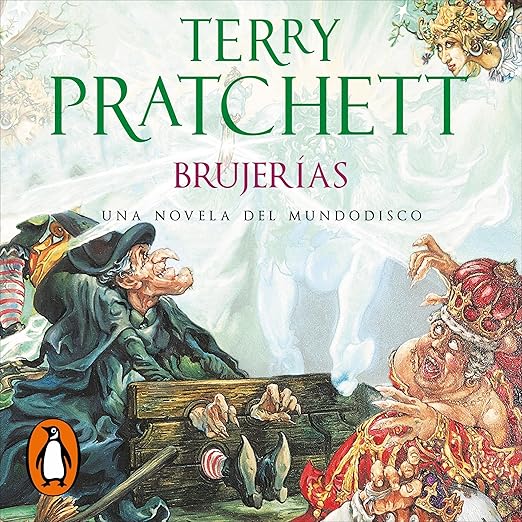
I came to the Discworld witches relatively late. My first dozen or so Pratchett novels were City Watch books, and I kept treating the Lancre trilogy as homework I’d get to eventually. When I finally sat down with Wyrd Sisters one rainy October afternoon, I understood immediately why readers argue so passionately about which sub-series sits at the top of the Discworld canon. I was listening to the Spanish edition here, narrated by Raúl Llorens, and I want to be transparent about what that means for this particular audiobook before we go any further.
The synopsis notes plainly: this audiobook is in Spanish. All reviews in the metadata are in Spanish. If you are searching for the English Discworld experience, this is not the edition for you. What exists here is a translation of the sixth Mundodisco novel, and as a standalone Spanish-language audio production, it is a reasonable entry point for Pratchett in that market.
Shakespeare Gets a Very Rude Letter
Wyrd Sisters is Pratchett at his most theatrically mischievous. The entire novel is a sustained riff on Macbeth, though calling it a parody undersells how much Pratchett actually understood Shakespeare’s mechanics. Three witches: Granny Weatherwax, Nanny Ogg, and the young Magrat. A mad duke who has murdered a king. A ghost who cannot move on. A kingdom that keeps being written over by the wrong story. What Pratchett understood, and what makes this novel more than clever pastiche, is that stories have gravity. They pull events toward preordained outcomes, and the witches spend the entire book trying to write a better ending before the Shakespearean machinery closes around them.
Reviewer Arthur Wendorf notes this as a good Pratchett novel without being quite the best, and I think that is roughly correct for readers coming from his strongest work. But for the witches subseries specifically, Wyrd Sisters is the essential foundation. You cannot fully appreciate the relationship dynamics of Granny and Nanny without this book establishing them.
What Llorens Does With the Comic Timing
Raúl Llorens has a warm, characterful voice that suits the material reasonably well. Pratchett’s prose depends enormously on rhythm: the setup buried three paragraphs back that detonates on page forty, the footnote that contradicts the main text with perfect deadpan. Translation necessarily disrupts some of that architecture. The Spanish edition preserves the broad comedic thrust, and readers who noted in the original reviews how the humor remains characteristic of Pratchett’s style are correct that the translation team understood what they were working with. Where Llorens is strongest is in differentiating the three witches vocally, giving Granny a dry authority that contrasts well with Nanny’s cheerful vulgarity. Where the production occasionally stumbles is in the more intricate wordplay passages, where the joke lands a beat late because the Spanish construction requires slightly different spacing.
The Underlying Seriousness Pratchett Always Hid
One reviewer wrote that the novel is very funny while subtly inviting reflection, citing the Chicago Tribune. That double register is exactly what separates Pratchett from simple comic fantasy. The witches’ debate about intervention, about whether magical power creates an obligation to use it, is genuinely philosophical. Granny Weatherwax’s insistence on not meddling, even when meddling is clearly the right thing, is one of the great through-lines of the entire Discworld series, and it gets its most elegant initial treatment here. The novel asks whether a story can be stopped from eating its characters alive. The answer Pratchett provides is not entirely reassuring.
Who Should Listen, Who Should Skip
Listen if: You are a Spanish-language listener who wants to enter the Discworld witches subseries from the beginning, or if you already love Mundodisco and want to continue with this installment. Listen if you enjoy comic fantasy that uses its humor as a delivery mechanism for sharper ideas about narrative power.
Skip if: You want the English Discworld audiobook experience, which has its own excellent recordings with different narrators. Also skip if you are new to Discworld entirely and wondering which Spanish-language edition to start with: the first two Mundodisco novels, El Color de la Magia and La Luz Fantástica, provide better foundational context for the world, though Wyrd Sisters is technically accessible as a standalone.
Frequently Asked Questions
Is this the same audiobook as the English Discworld recording of Wyrd Sisters?
No. This is a Spanish-language edition of the novel, translated for the Mundodisco market. The narration, pacing, and even some comedic constructions differ from English recordings. If you want the English version, you will need to search for the UK or US Discworld audiobook editions specifically.
Do I need to have read other Mundodisco books before this one?
Wyrd Sisters is the sixth Mundodisco novel but the first book focused on the Lancre witches. Pratchett designed the Discworld subseries to be accessible from multiple entry points. You will get more context from the earlier books, but this functions reasonably well as an introduction to Granny Weatherwax, Nanny Ogg, and Magrat.
How does Raúl Llorens handle distinguishing the three witch characters vocally?
Llorens does solid work differentiating the three witches. Granny Weatherwax gets a dryer, more authoritative register. Nanny Ogg is warmer and more casually comic. The differentiation holds well through the ensemble scenes, which is where narrators most often lose track of character consistency.
Is this edition appropriate for someone who has never read Pratchett but wants to try the Spanish translation?
Yes, with a caveat. The witches subseries is accessible to newcomers. However, if you want to understand the full texture of Ankh-Morpork and the wider Disc, starting from Los Magos or even the first two novels will give you richer grounding. Wyrd Sisters rewards readers who already feel at home in this world.