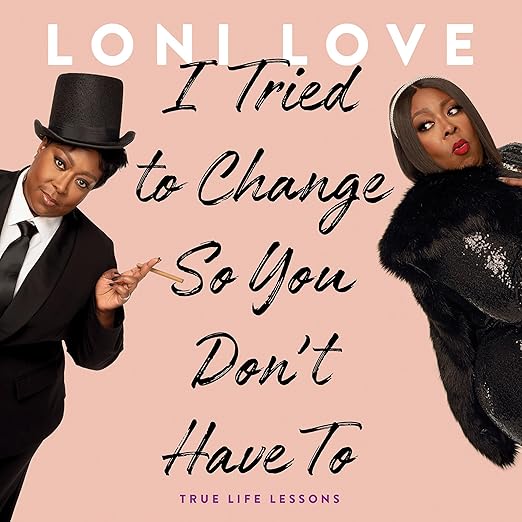
- Narration: A working stand-up reading her own comic memoir, which keeps the timing with the person who built it.
- Themes: Self-acceptance, class and body image inside the entertainment industry, a Detroit childhood
- Mood: Loud and warm, with hard edges running underneath
- Verdict: Buy it for the voice and the Detroit material, not for the 4.8, which one logged vote cannot arithmetically produce.
Loni Love earned an engineering degree before she ever earned a laugh in Hollywood, and that detail sits underneath everything else here. She grew up in Detroit housing projects, worried about affording the next meal rather than skipping it, then moved west into an industry where being thin, young and bubbly counts as a skill set. The memoir that came out of that collision won the African American Literary Award for Memoir, and the audiobook runs a little under six and a half hours with Love herself at the microphone.
The Review
Comic memoirs usually pick a lane: the joke book with a few sad chapters, or the sad book with a few jokes. Love refuses to pick. The chapters move from the projects to an engineering classroom to a Hollywood green room without announcing the transitions as lessons, and the humor arrives inside the hard material rather than around it. This is a book about what the effort to change actually costs, told by someone who kept the receipts on every attempt.
Her running joke about health food does the heaviest lifting. Introduced to kale salads and quinoa bowls by colleagues, Love reports that the greens looked to her like "weeds my grandma used to pay me a dollar to pull from her yard." The line is funny, and it is also precise class writing: the food is not the point, the initiation ritual is. She applies the same move to her hair, to dieting, and to relationships chosen because they looked correct from outside.
Reader response backs up the tonal balance. A five-star account reports finishing the whole thing inside twenty-four hours, written by somebody who does not normally read at all. A four-star response praises the book for keeping a serious recollection hilarious without flattening either register. Both describe the same specific effect: a writer who can hold a grim memory and a punchline in one paragraph without either canceling the other.
Why I Tried to Change So You Don't Have To Works as an Audiobook
One response in this pool deserves reading in full before you buy any edition. Its writer grew up in Detroit across the same two decades, attended the same high school, knows people from the graduating classes of 1988 and 1989, was raised in the same faith Love was, and finished the print edition so convinced by the voice on the page that they bought the audio version specifically because Love reads it. That is a purchase made with local knowledge.
Self-narration earns nothing on its own, but the arithmetic runs favorable here. The comedy is built out of timing, self-deprecation and Detroit cadence, and the woman who wrote it is a professional comedian whose day job is cohosting on television and satellite radio. Handing that material to a hired reader would mean rebuilding the timing from scratch and hoping the rebuild matched. What the recording does with any single joke is not something the public record settles, but the casting logic holds.
Purchase timing tells its own story. One response came from somebody who preordered in May, weeks ahead of the June publication date, purely on the strength of watching Love on television, and who reports afterward that the life lessons promised on the cover are fully present. That same writer places the arc of the book as running forward to the Daytime Emmy Love won alongside her cohosts. A celebrity memoir that satisfies a reader who bought sight unseen has cleared the bar that matters.
The Caveats
Set the score on this listing aside entirely. It displays 4.8 beside a rating count of 1, two numbers that cannot both be describing the same thing, because no decimal is reachable when one participant is choosing among five whole stars. Underneath that broken pair sit five written responses graded five, five, five, five and four. Average those and the result is 4.8 precisely, which suggests the headline figure was calculated from the written accounts while the counter beside it was not.
Humor is the thing most changed by a move into audio, and not always upward. A joke that lands on the page because of a line break has to be rebuilt with breath instead. A callback a reader can flip back and verify has to be carried in memory. Love's material leans on rhythm and delivered asides, which favors a recording, but it also leans on quoted dialogue in several voices, and that is where any single reader makes choices a printed page never forces.
One five-star response contains a caveat the record cuts off mid-sentence: the writer starts to describe something negative occurring between chapters eight and nine, and the text stops there. Whatever the objection was, it survived into a five-star grade, so it was not fatal, though a seam clearly got noticed at that point. Separately, the further you sit from Love's on-air work, the more the early Hollywood chapters read as background rather than payoff.
Who Should Listen to I Tried to Change So You Don't Have To
Anybody who has been instructed to become a slightly different person in order to stay employable is the core audience. Love writes about that instruction from inside an industry that issues it hourly, and she is specific about the costs rather than triumphant about the outcome. Listeners who grew up working class, who have been the only person in a room who could not afford to be in it, or who watched somebody else's diet turn into a moral argument will find the observations exact.
Nobody hunting an industry expose will be satisfied. Love is not settling scores, and the famous names function as scenery rather than subject. Listeners who want a comedy album should also look elsewhere, because the funniest passages are load-bearing memoir rather than routines, and anybody chasing continuous laughs will reach the poverty chapters and feel misled. The category label deserves a check against your own tolerance too, since this is celebrity memoir in structure even where the writing plainly exceeds the category.
My own recommendation lands on buying it, with one condition: decide on the casting and a sample rather than on a star rating that is not measuring anything. A comedian reading her own account of trying to become someone more marketable, and failing at it usefully, either appeals immediately or does not. For me it did, and the passages that stayed with me afterward were not the punchlines. They were the stretches where Love explains, without asking for sympathy, precisely what the attempt cost her.
Does Loni Love narrate the audiobook of I Tried to Change So You Don't Have To herself?
Yes. The credits list Loni Love as both author and narrator, so the comedian who wrote the material is the one delivering it across six hours and thirty-seven minutes of runtime. Given how much of the humor depends on timing and cadence, that casting is the clearest reason to choose this edition over the printed one.
How much of this audiobook is comedy and how much is straight memoir?
The balance tilts toward memoir. The award it took was in the memoir category, and the description frames humor as the delivery method for a story about poverty, conformity and self-acceptance. Expect sustained autobiography with jokes threaded through it rather than a recorded stand-up set.