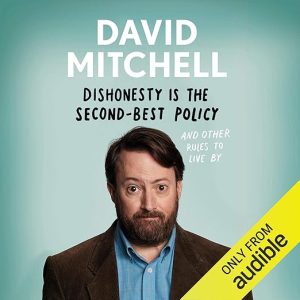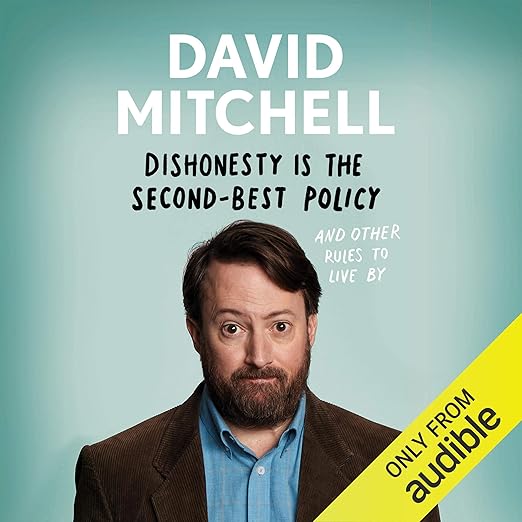
I discovered David Mitchell the way most non-British listeners probably do, through a YouTube rabbit hole of Would I Lie to You clips and QI panel appearances, and then spent six months wondering why I had not found the books sooner. This collection was the second one I listened to, on a rainy Saturday afternoon when I needed something that would make me feel both amused and vindicated in my generalized irritation at the state of the world. Mitchell delivered on both counts.
Dishonesty Is the Second-Best Policy is the follow-up to Mitchell's 2014 collection Thinking About It Only Makes It Worse, which the synopsis correctly identifies as having made things worse rather than better. The new volume covers roughly the years between the Brexit vote and the early Trump era, a period during which, as Mitchell observes with characteristic bleakness, the situation escalated from bad to considerably worse. He touches on everything from salad cream to terrorism, from proportional representation to farts, all with the same unrelenting logic that makes his television appearances so satisfying.
The Review
The format matters enormously here, and it is worth understanding going in. This is a collection of newspaper columns, Mitchell writes a weekly column for The Observer, rather than a unified book. There is no narrative arc, no building argument, no resolution. Each essay is its own small exercise in irritated precision, and they sit next to each other roughly thematically but not always logically. One reviewer found this deeply frustrating. Another found it the perfect casual listen. Both reactions are reasonable. If you need a book to go somewhere, this one will not satisfy. If you enjoy the specific pleasure of spending time with a very intelligent, very funny person who has thought more carefully than you have about why everything is slightly terrible, it is exactly the right listen.
Self-narration is the only format this should exist in. Mitchell's comic timing, his habit of building to a small devastation and then retreating from it, his particular vocal relationship with absurdity, these are not things a third-party narrator could replicate. The audiobook version is not just the most convenient format; it is the form the material was built for. One listener put it perfectly: this was probably the best way to absorb this book.
What Makes Dishonesty Is the Second-Best Policy Worth Hearing
A significant portion of Mitchell's references will require googling for non-British listeners. He writes primarily for Observer readers, and he assumes familiarity with figures and incidents that are not universal cultural touchstones. Brexit, UKIP, specific political personalities from the Cameron and May years, these land with different weight depending on how closely you have followed British politics. For listeners who have, the commentary is sharply observed. For those who have not, occasional googling is genuinely worthwhile and, as one reviewer noted, often interesting in itself.
The humor is not gentle. Mitchell is not interested in comfort or in finding the silver lining. His brand of comedic pessimism operates from the position that acknowledging how bad things are is more honest than pretending otherwise, and that honesty of that kind is itself a form of relief. The reviewer who described him as saying "everything I would say about modern life, except he's even more pessimistic" captures the dynamic perfectly. If you want to feel less alone in your frustration, Mitchell is an exceptionally articulate companion.
The Caveats
The essays on scampi and on salad cream are among the funniest pieces of sustained low-stakes argumentation I have heard in audio form. Mitchell applies the same analytical framework to condiment preferences that he brings to constitutional questions, and the effect is both ridiculous and somehow clarifying. The terrorism essay is more serious than the surrounding material and lands with unexpected weight. The proportional representation column is as good a ten-minute explanation of British electoral politics as exists in any format.
Who Should Listen to Dishonesty Is the Second-Best Policy
Mitchell fans who enjoy his television appearances will find this thoroughly satisfying. Listeners who have read the first collection and want more of the same will not be disappointed. Anyone approaching this as a first Mitchell experience might consider starting with Thinking About It Only Makes It Worse to calibrate expectations. Listeners who find British cultural references impenetrable or who need a book to build toward something will find the format frustrating rather than charming. This is comfort listening for a specific sensibility, and if that sensibility is yours, it is very comfortable indeed.
Before You Press Play
- Narration: Self-narrated by Mitchell, the only way this collection should be heard. His timing and tone are inseparable from the humor.
- Themes: British political absurdity, the erosion of common sense, pessimism as a coping strategy
- Mood: Wry and exasperated, like commiserating with the cleverest person at the pub
- Verdict: Essential for fans of Mitchell's television work, with one honest caveat: this is a collection of newspaper columns, not a book with a through-line.
A Few Questions About Dishonesty Is the Second-Best Policy
How British-specific is the humor, and will American listeners follow it?
Very British in its references, particularly around Brexit, UKIP, and specific political figures. The underlying sensibility, intelligent pessimism about the direction of modern life, translates universally. American listeners should expect to google perhaps a third of the cultural references, which most reviewers found worthwhile rather than annoying.
Does Mitchell read the whole book himself, and does his performance add to the material?
Yes, he narrates the entire collection himself. Multiple reviewers identified this as the definitive format for the material. His comic timing and vocal personality are inseparable from how the essays work, a professional narrator would lose what makes them click.
Is the book organized around any theme or argument, or is it purely episodic?
Purely episodic. It is a collection of newspaper columns organized loosely by topic, with no overarching argument or resolution. Each essay is self-contained. This is either the appeal or the limitation, depending on what you want from a listening experience.