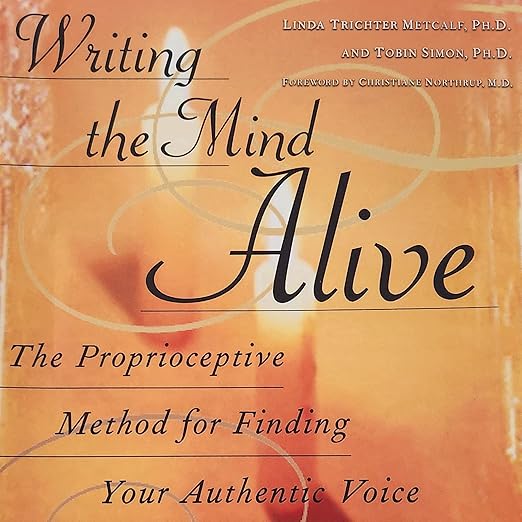
A candle, a pad, a pen, and a Baroque record playing in the background sound more like a meditation ritual than a writing method, but that is the exact toolkit Linda Trichter Metcalf built Proprioceptive Writing around, and which the Writing the Mind Alive audiobook spends six hours and twenty-two minutes explaining. Metcalf developed the practice in 1976, as a university English professor sitting down with pen and paper looking for a way to bring her own life into focus, later refining it into a structured method with colleague Tobin Simon that has since spread through decades of classrooms and workshops. Can an audiobook actually teach a physical, candlelit ritual meant to be practiced alone in silence?
Not Automatic Writing, Not Stream of Consciousness
The word 'proprioceptive' comes from the Latin proprius, meaning one's own, and Metcalf is careful throughout to distinguish her method from adjacent practices it might otherwise be confused with: this is not formal writing, not automatic writing, and not stream-of-consciousness journaling, despite surface similarities to all three. Reviewer Portia Iversen captures the method's real payoff precisely, describing how it teaches a writer to hear themselves think and to reconcile the gap between the words forming in their mind and the words that actually make it onto the page, a distinction most writing advice never addresses directly.
Reviewer ira rabois brings twenty-seven years of secondary school teaching experience to their account, describing Proprioceptive Writing as one of the most genuinely useful practices they used with both students and themselves across that entire career. That kind of long-view endorsement, from someone who had decades to test whether a technique actually holds up in a classroom rather than just in theory, carries real weight for a method built on a single professor's personal breakthrough in 1976 and refined over the following twenty-five years of teaching.
The choice of Baroque music specifically, rather than any calming background music generally, is a deliberate detail worth unpacking: Baroque compositions are prized in focus-and-productivity contexts for their steady, predictable rhythmic structure, a pattern some listeners associate with sustained concentration. Metcalf appears to have built her ritual around that same principle decades before it became a more mainstream productivity idea, using structured sound to create a container steady enough for genuinely unstructured, exploratory writing to happen safely inside it.
Nikolic Models the Unhurried Tone the Method Needs
Nina Nikolic's narration needs to model the unhurried, attentive quality the method itself demands, since a rushed or brisk reading would work directly against a book asking listeners to slow down and pay close attention to their own inner voice. The synopsis's own description of actual student 'writes' included throughout the book gives Nikolic real material to differentiate through pacing and tone, distinguishing Metcalf's explanatory voice from the more raw, unfiltered quality of the sample writing itself.
The audiobook format has a genuine advantage here that print does not: hearing Metcalf's own explanatory voice, or a narrator standing in for it, models the calm, unhurried register the practice itself asks a writer to bring to their own pen and paper. A method this dependent on tone and pacing benefits from being modeled aloud rather than only described on a page, since a listener absorbs the rhythm of reflective, unforced writing partly through how the instructions themselves are delivered.
The synopsis notes Proprioceptive Writing has been taught at institutions including the New School University, which signals the method moved well beyond Metcalf's original personal practice into a recognized part of academic and workshop curricula over its twenty-five years of development. That institutional adoption is a meaningful credibility marker distinct from reviewer testimony alone, since it suggests the method held up under sustained pedagogical use across many different teachers and student populations, not just Metcalf's own original classroom.
A 4.6 rating across 134 reviews is a strong, consistent showing for a niche writing-method title, and the two most detailed reviews available, a twenty-seven-year teacher and a working writer, both independently emphasize the same underlying benefit, hearing the gap between inner thought and written word close, which suggests the method's core promise is reliably delivering on itself across genuinely different kinds of practitioners rather than working only for one narrow type of listener.
A Candlelit Ritual No App Can Replace
The obvious tension, and the question worth asking before starting, is whether a fundamentally physical, solitary writing ritual can be taught effectively through listening alone. Metcalf's method depends on specific sensory conditions, a quiet room, a candle, a particular kind of music, actual pen moving across actual paper, none of which the audiobook itself can supply. Listeners will need to set up that environment independently and treat the audio as instruction and companionship for a practice they still have to physically do themselves, not as a passive substitute for it.
Reviewer Art Gal's brief, thinner review, describing the book as looking like a worthwhile gift without much further detail, is a useful reminder that this material rewards active engagement far more than passive listening; a listener who never actually picks up a pen during or after the audiobook will likely get considerably less from it than one who treats the six hours as a structured invitation to begin their own practice. This is closer to a course than a straight narrative listen, and works best treated that way.
Listeners arriving from the more recent wave of app-based journaling and guided-prompt writing tools should know Proprioceptive Writing predates and operates quite differently from that trend, no app, no daily prompt notification, just a sustained, ritualized block of unstructured time. That difference is likely a genuine selling point for listeners already fatigued by gamified self-improvement apps, but it also means this method asks for more upfront discipline and less built-in accountability structure than a habit-tracking app would provide.
Journaling That Finally Feels Structured Enough
Writing the Mind Alive suits listeners genuinely curious about expressive or therapeutic writing practices, especially anyone who has tried journaling before and found it either too formless or too effortful to sustain. Writers, teachers, and therapists looking for a structured alternative to free writing will find real substance in Metcalf's decades-refined method, and the actual student 'writes' included throughout give the abstract instructions concrete grounding in what the practice sounds like when it works.
Listeners looking for passive, no-effort self-improvement audio should know this method demands real participation, a pen, paper, and quiet time set aside specifically for the practice, not just attentive listening. Anyone unwilling to set up that physical ritual alongside the audiobook will likely find the instructions interesting in the abstract but will miss the actual transformation reviewers describe, since Proprioceptive Writing is a practice to be done, not just a concept to be understood.
Questions Listeners Ask
Can a physical writing method like Proprioceptive Writing actually work through an audiobook?
Only if the listener sets up the physical ritual themselves, a quiet room, pen and paper, the right music. The audiobook provides instruction and modeling, but the practice itself still has to be done by hand.
Does this audiobook explain how to do Proprioceptive Writing, or just describe its history?
Both. It covers Metcalf's 1976 origin story and the method's development with Tobin Simon, but also includes actual student 'writes' that model what the finished practice sounds like.