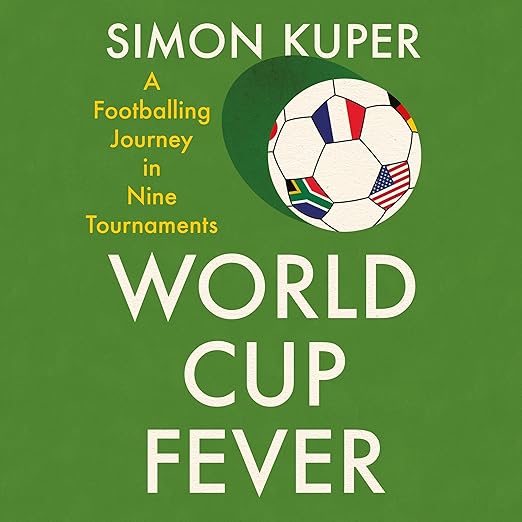
Sometime during the last days of 2022, I found myself at the edge of a conversation at a dinner table about what the Qatar World Cup had meant, or failed to mean, or meant despite everything. Simon Kuper's World Cup Fever arrived as the kind of audiobook I had been looking for in that conversation's aftermath: not a tactical breakdown, not a player biography, but a sustained attempt by one of football's finest writers to understand what the tournament actually does to the people who experience it, from the half-empty stands of Italia 90 to the troubling machinery of the most expensive tournament ever staged.
Kuper is one of very few journalists to have attended every World Cup since 1990, and that span of personal witness is what makes this audiobook something other than a history book dressed in memoir clothes. He was in France in 1998 when the host nation won, and he describes the quality of that celebration with the specificity of someone who stood in it. He was in South Africa in 2010 for the tournament that carried the weight of a national dream, and he renders the particular texture of what that meant to the country hosting it. Each tournament becomes a personal chapter in a life spent watching football as a reporter, a fan, and something harder to categorize than either.
From Thirteen Nations in Uruguay to Doha
The book begins with a question Kuper has been working on for decades: how did a semi-professional tournament held in Uruguay in 1930, attended by thirteen nations and poorly organized by any standard, become the world's largest sporting event and a vehicle for the kind of multinational sponsorship, geopolitical maneuvering, and moral compromise that defines contemporary sports governance? The trajectory from Montevideo to Doha is one of the more remarkable institutional stories of the twentieth century, and Kuper traces it with a journalist's eye for the telling detail and the revealing character.
The chapters on the ethics of hosting are particularly sharp. Kuper does not moralize, which is part of what makes his writing on the subject more useful than most. He observes the contradictions, the stadiums built on coerced labor, the TV revenues flowing to federations with deeply compromised leadership, the way national fervor papers over institutional corruption and asks us to simply feel the football, without pretending those contradictions resolve themselves in the presence of a great goal.
Colin Mace Delivers Without Underlining the Jokes
Colin Mace's narration fits Kuper's prose with the ease of a long-standing collaboration. Kuper's sentences have a dry precision that can easily go flat in the wrong hands; Mace gives them the observational irony they require without underlining the jokes. The football chapters, which carry genuine nostalgic warmth alongside the institutional critique, receive appropriately different treatment in his delivery. He is an intelligent narrator working with intelligent material, and the eleven-hour runtime moves with the pace of conversation rather than lecture.
The personal dimension of the book, Kuper writing about what it has cost in relationships, time, and perspective to spend thirty-plus years following a global tournament from city to city, adds something valuable to what could have been pure analytical journalism. He is honest about the absurdity of his own investment as much as football's, and that self-awareness keeps the book from becoming the kind of reverent sports memoir that embarrasses itself in the presence of people who do not share its subject's significance.
France 1998 and Football Amid Political Pressure
The book's structure, organized around the individual tournaments Kuper attended, means the experience is cumulative rather than argument-driven. Listeners looking for a single thesis about football's role in global culture will find Kuper offering observations and accumulating evidence rather than building toward a conclusion. That is a deliberate choice: the book mimics the World Cup's own episodic structure, the four-year intervals between major chapters, more than it attempts to impose a retrospective narrative of clear meaning.
The 2022 Qatar section is among the most conflicted in the book, and Kuper does not hide that conflict. He attended the tournament knowing its costs, wrote about those costs, and still found himself moved by the football. He does not resolve that contradiction into a clean verdict, which some listeners will find unsatisfying and others will find the only honest position available.
Listeners unfamiliar with European football culture, particularly the tournaments Kuper covers from 1990 through 2006, may find some of the nostalgic texture less accessible than readers who lived through those years as football fans. The book does not require deep football knowledge to follow, but some of the emotional register in the earlier tournament chapters depends on shared memory that not all listeners will carry.
Kuper's account of the 1998 tournament in France, which he was positioned to cover as a French-fluent journalist working in Western Europe, is one of the emotional centers of the audiobook. The French victory in the final against Brazil carried a specific cultural meaning in 1998 that the book conveys with considerable precision: a multiracial national team winning on home soil at a moment of intense political pressure around immigration and national identity. Kuper does not reduce that meaning to a simple political lesson, but he does not pretend the football was separable from its context. That refusal to simplify is characteristic of his approach across the book's full span of tournaments.
A Journalist's Memoir Filtered Through Football
Fans of narrative sports journalism who have followed the World Cup across multiple tournaments will find this audiobook one of the more honest and well-observed accounts of what the experience is like from the press benches and the stands. Listeners who enjoyed Kuper's earlier work, including Soccernomics and his Financial Times columns, will recognize the observational intelligence and the restrained prose that makes him one of the more valuable writers on the game.
Those expecting match-by-match analysis or player profiles will want a different book. This is a journalist's memoir filtered through football rather than a football book that happens to use journalism as its format, and that distinction matters when deciding whether it suits your listening habits.
Do I need to be a football fan to appreciate this audiobook?
A basic interest in football helps, but the book's real subject is what the World Cup means as a social and political event rather than as a sporting competition. Listeners interested in how mega-events shape cities, nations, and cultural memory will find plenty to engage with even without deep football knowledge.
Is World Cup Fever the audiobook primarily a personal memoir or an analytical history of the tournament?
It is substantially both. Kuper uses his personal experience at each tournament as the organizing frame, but the chapters consistently reach outward into the political and commercial history of the World Cup's development. The memoir and the journalism are not separable; each enriches the other.