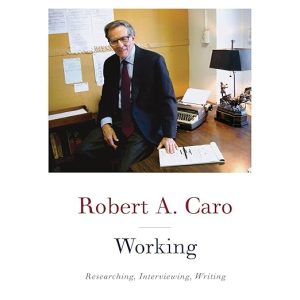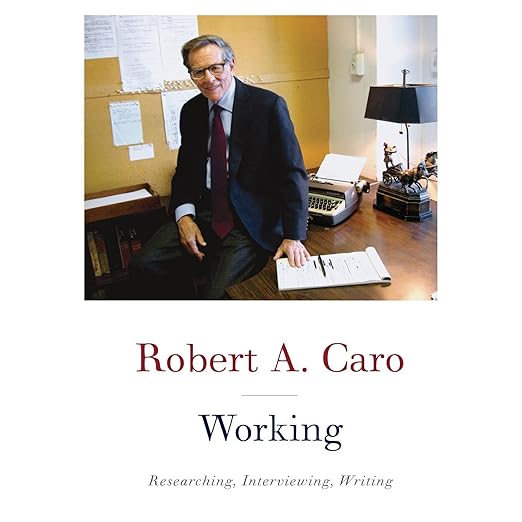
I have been reading Robert Caro for years in the way that many people read Caro, in long sustained stretches with the knowledge that there is still more to come, punctuated by the slightly anxious awareness that the final volume of The Years of Lyndon Johnson remains unfinished. Working arrived in 2019 as something in between, not a biography and not quite a memoir, but a collection of essays and reflections on what it means to spend a career doing the kind of research Caro does. I saved it for a week when I had time to pay proper attention. It deserves that attention.
The audiobook format for Working is not incidental to its value. Caro narrates it himself, and the experience of hearing him discuss his work in his own voice, at his own considered pace, is genuinely different from reading the same words on the page. Reviewer Mary Moe noted that his speech delivery seems slow at first but earns that pace because the prose is dense enough to need the room. I found the same to be true. This is not slow narration caused by uncertainty or performance anxiety. It is a writer who has spent sixty years making every word count insisting, through the physical act of delivery, that you count them alongside him.
A Closer Look at Working
Most of what makes Caro exceptional is not describable simply in terms of what he writes about. Robert Moses wielded enormous unelected power over New York City for decades. Lyndon Johnson's path from rural Texas poverty to the presidency changed American politics permanently and violently. Those subjects are interesting, undeniably. What is rarer, and what Working examines directly, is how Caro uncovers what there is to know about subjects that powerful people have every incentive to obscure.
The chapters on his research methodology are the heart of the book. He describes moving to the Texas Hill Country with his wife Ina to understand what Johnson's early life felt like from the inside, what it meant to grow up in a place without electricity where the land shaped everything, including the political ambitions of the people who wanted desperately to leave it. He describes the combination of discouragement and exhilaration involved in confronting the 44 million documents held by the LBJ Library in Austin. He describes the specific techniques he developed for interviewing people who had reasons not to talk, and how patience and presence slowly earned their willingness to speak. Reviewer Andres Kabel called Working the most inspiring entry into a working historian's mind he had ever read, and that response makes sense. Caro is not describing talent. He is describing method, discipline, and a willingness to sit with uncertainty for as long as the work requires without reaching for premature conclusions.
What Makes Working Worth Hearing
The phrase that has come to define Caro's approach, turn every page, runs throughout Working as both literal instruction and broader philosophy. He describes working through thousands of pages of congressional records to find a single memo that changed his understanding of how Johnson acquired the specific power that he did. He describes the Cross-Bronx Expressway and the residents displaced by Moses's construction projects, people whose stories would not have surfaced if Caro had relied on official sources alone or settled for the most accessible version of events.
This is research understood as moral obligation rather than merely professional thoroughness. Caro believes that the subjects he writes about, power and how it shapes both the people who wield it and the people affected by it, require a commitment to completeness that cannot be satisfied by the readily available documentary record. That conviction comes through in every essay in this collection, and it is more bracing to hear him articulate it in his own voice than it is to read it at the remove of a profile or a review. He is not performing conviction. He has simply lived it for sixty years.
Things to Know Before Starting Working
Reviewer Para, who gave the book four stars, noted that it is somewhat repetitive because it compiles interviews and essays produced across different periods rather than presenting a unified work conceived as a book from the start. That observation is accurate. If you have read every piece of long-form journalism Caro has produced about his methods over the past four decades, Working will contain familiar material presented from angles you have seen before. For most listeners, however, the compilation is a service rather than a limitation, because those pieces are scattered across decades of magazine archives and are not easily assembled without the book doing that work.
What the book is not is a full biography of Caro himself. Personal life surfaces only where it directly intersects with the work: the years in the Hill Country, the long editorial collaboration with Robert Gottlieb at Knopf, the writers' community at the New York Public Library that saved him from years of total professional isolation. If you want the full personal history, this is not it. Reviewer Christopher Bain's observation stands: anyone who has not yet read the Moses or Johnson books should at minimum listen to Working to understand what they are missing. It functions simultaneously as a standalone meditation on craft and as the most compelling argument Caro could make for everything that surrounds it.
Who Robert A. Caro Is Writing For
Listen to Working if you care about biography as a literary form and want to understand what separates serious work in the genre from its more surface-level counterparts. Listen if you are a writer of any kind and want to hear someone describe the discipline required to do significant work without romanticizing that discipline into something unrecognizable or impossibly saintly. Listen if you are already a Caro reader and want to understand the machinery and the cost behind the books you have read.
Consider something else if you want narrative momentum of the conventional kind, or if a deliberate, contemplative pace across seven hours tests your patience beyond its limit. At 4.6 stars across 270 ratings, Working has found exactly the audience it deserves, and that audience will find this audiobook version, in the author's own voice, the definitive way to encounter it.