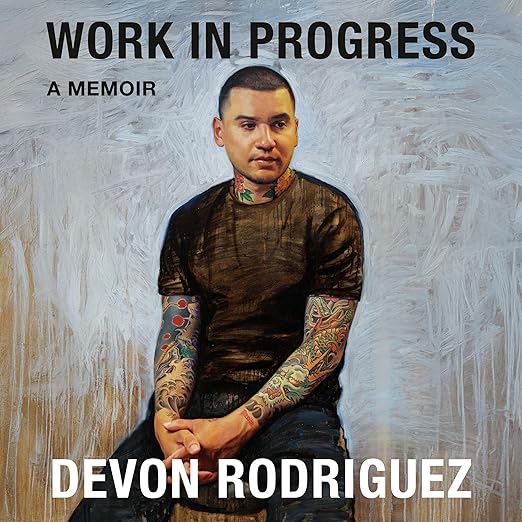
Devon Rodriguez sketches strangers on the subway and posts the results, and his memoir is what this audiobook actually contains. The byline on the listing says James Martin. So does the narrator credit. Nothing in the description supports either, and the genre tag filed against it reads Religious, which suits a Bronx portraitist with a social media following about as well as you would expect. Work out what you are buying before you buy it.
A Bronx Portraitist Skipped Gallery and MFA Both
Set the metadata aside and the book underneath is coherent and genuinely appealing. Rodriguez grew up in the Bronx, used drawing to survive devastating abuse as a child, and built an audience by filming himself sketching commuters and handing them the portrait. The description calls it a twenty-first-century fable about a young man with a pencil, a phone, and a relentless drive to succeed, which is promotional language that happens to describe the shape of the story accurately.
Rodriguez's chosen route lifts this above a standard success narrative. Rodriguez skipped the conventional path completely: no gallery representation, no MFA, none of the slow accumulation of institutional approval that normally precedes an art career. He went to short video instead and found millions of people waiting. That is a real argument about where artistic legitimacy now originates, and it is more interesting than the hardship-to-triumph arc this category usually supplies.
Never-Before-Seen Drawings Do Not Survive Into Audio
Worth stating plainly, since the promotional tone smooths over it: the childhood at the center of this involves devastating abuse, and drawing is presented as the thing that carried Rodriguez through it. That is not a footnote attached to the success story, it is the reason the success story has any stakes at all. Listeners who find that material hard should know it sits in the book rather than meet it unprepared, and anyone wanting the fable without the wound should understand the trade is not on offer.
Then comes the format collision. The description advertises never-before-seen drawings of the people and places that made him, a selling point that does not survive the move into audio. A memoir by a visual artist, organized around portraiture, loses its evidence the moment you can only hear it. Whether the publisher supplies a companion file is stated nowhere on the page, and for this book specifically that silence is not a minor detail.
The Argument for Hearing This Rests on Voice
The argument for hearing this rather than reading it rests on voice. Rodriguez built his following by talking to strangers on camera, and the person-on-the-street interview is his working medium; a memoir from somebody whose craft involves putting people at ease in under a minute has a reasonable chance of carrying well when spoken. The publisher promises frank, profound, and occasionally hilarious, and two of those three travel better in audio than in print.
Its subject also reaches well past art. Rodriguez has drawn more than a thousand people, and the through-line is what portraiture does to the person being looked at, the proposition that being observed carefully by a stranger for the length of a sketch changes something. That is a solid eight-hour idea, and it should land for listeners with no particular investment in drawing.
It is also, as things stand, not out yet. The listing dates publication to the end of September 2026, which explains the shape of the page: a rating tally of twenty-six sits above no written responses at all. Anyone deciding today is deciding on the description and the subject rather than on any account of the finished recording, and that deserves stating plainly instead of reading a high average as evidence of quality.
James Martin Occupies Fields That Aren't His
Credit problems deserve more than a shrug. James Martin occupies both the author and narrator fields, the genre tag says Religious, and the description concerns somebody else entirely. Any of those could be the error: a mismatched record, a title shared with another book, a placeholder that survived into publication. What a buyer cannot do is determine which, and the practical result is that the narrator credit carries no weight at all. Confirm who reads it before spending anything.
With no written responses on the page, nothing independently tests the description's claims. Publisher copy is doing all of the persuading, and this copy works hard: most followed artist on social media worldwide, motivational magic for the digital age. Those are assertions rather than findings. Treat them as the pitch they are, and wait for readers if you have any doubt.
A final caution is structural. This is a memoir by somebody still early in a career, and the title concedes the point: the work is in progress. Books built this way tend to be strongest on origin and thinnest on the present, because the present has not yet resolved into a story. Expect the Bronx childhood and the early viral years to carry the weight, and expect the closing stretch to read closer to a status update than a conclusion.
Buyers Wanting the Drawings Should Look Elsewhere
Listeners who follow the creator economy and want a first-person account from somebody who built something inside it are the audience here, along with anyone drawn to outsider stories from the art world. If you have watched the subway videos and wondered what the person holding the pencil was thinking while the train moved, that is precisely the gap this book proposes to close.
Buyers who came for the drawings should stop here, since they are the one element an audio edition cannot deliver and the description sells them hard. Anyone pulled in by the Religious tag should also reconsider, because nothing in the description supports that classification. And if you need other people's accounts before committing, this listing simply cannot supply them yet.
The honest summary is that the book sounds promising and the page describing it is a mess, and those are two separable problems. Wait for release, confirm who is actually reading it, and check whether a companion file carries the artwork. With those three answers in hand this becomes an easy recommendation for the right listener. Without them you are buying on faith in a listing that has already got the author's name wrong.