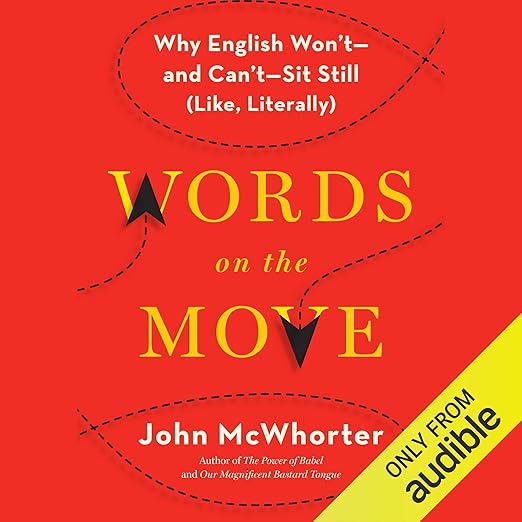
McWhorter's argument unfolds with the relaxed confidence of someone who has spent decades being right about something that other people find threatening. Words on the Move, by linguist John McWhorter and narrated by McWhorter himself, takes direct aim at the conviction that English is decaying. That literally used to mean "figuratively," that LOL functions as a social softener rather than an indicator of laughter, that business jargon like "what's the ask?" are signs of deterioration: McWhorter's counter-argument in this audiobook is not just that these changes are acceptable, but that they are exactly what language has always done, and that our distaste for them is a recurring emotional response to language shift that every generation mistakes for a uniquely modern crisis.
What John McWhorter Delivers
McWhorter self-narrating is essential to this book's success. He is, by professional reputation and by the evidence of this seven-hour recording, an exceptional talker. His academic work is demanding and technical, but his public writing and speaking - including his Lexicon Valley podcast and his Columbia lectures - operate in a register that is simultaneously rigorous and entertaining. The audio format does something with that voice that print cannot fully capture: you hear the pleasure he takes in his own examples. When he explains that silly once meant "blessed," or that ought was originally the past tense of owe, or that the -ly suffix in adverbs is a remnant of the word like, he delivers these facts with the timing of someone who has watched audiences react to them and knows exactly where the surprise lands. These are not facts McWhorter is sharing for the first time; they are facts he has shared many times, and the refinement shows.
Reviewer Kevin Currie-Knight describes him as having "a knack for explaining things about language in ways that are clear, crisp, witty and interesting," and that assessment understates the specific pleasure of hearing it rather than reading it. McWhorter in audio is demonstrably more fun than McWhorter on the page, not because the writing is weaker but because his personality amplifies the text in the recording. The book covers semantic shift, grammatical evolution, pragmatic markers, and the geographic puzzle of why New Orleans speakers historically sounded like Brooklyn residents, and each chapter develops its own case study while advancing the larger argument that language change is not deterioration but evidence of a living system under constant pressure from actual usage.
What John McWhorter Gets Right
Reviewer Kelly Mills describes being "convinced" by the argument and dropping a "superior attitude about words that bothered me before," which is exactly the response McWhorter is working toward. The book is partly persuasion: he wants listeners to experience language change as fascinating rather than alarming, and he succeeds by showing the historical depth of shifts that currently feel new. Words that seem to have been corrupted recently have in almost every case been changing for centuries, and McWhorter's historical examples strip the moral weight from contemporary complaints about language use. The analysis of LOL - how a literal acronym for laughter became a tone softener that signals the speaker is being gentle rather than that anything is actually funny - is one of the more illuminating sections of the book. McWhorter connects this to a centuries-old process by which words acquire pragmatic functions unrelated to their original meaning, and by the time he has finished the analysis, LOL has become evidence of language's vitality rather than its debasement.
Reviewer Kelly Mills also notes that the book "feels like an excuse to also go off in fun directions about the evolution of language, well-researched." That quality - the confident digression of someone who knows their subject deeply enough to trust that the side roads are as interesting as the main road - is part of the audio experience's particular pleasure. McWhorter's enthusiasm is audible and contagious, and it sustains the seven-hour runtime in a way that a more disciplined, chapter-by-chapter structure alone would not.
Where John McWhorter Loses Some Ground
Some passages are denser than others, and McWhorter's enthusiasm for his subject occasionally carries him into tangential examples that delight fans of linguistics but may feel like detours to listeners with narrower interests. The book also assumes some basic familiarity with grammatical terminology - nothing graduate-level, but terms like pragmatic marker, semantic bleaching, and morphology appear without extended explanation. They are always contextualized by concrete examples, so listeners without a linguistics background can follow, but those who have studied language will get more from the terminology sections. The New Orleans and Brooklyn sound connection chapter is one of the more self-contained and enjoyable sections for listeners who want to sample the approach before committing to the full arc.
The one thing the book does not do is accommodate people who are fundamentally committed to the idea that language has a correct form that should be preserved against change. McWhorter is not dismissive of that position, but he systematically dismantles it, and listeners who find the dismantling itself threatening rather than interesting may find seven hours too long for the experience. For everyone else, the duration is precisely right.
Who Should Pick Up Words on the Move
Anyone who has felt strong negative reactions to modern language changes - from literally used hyperbolically to vocal fry to texting abbreviations in professional contexts - should consider this audiobook a direct and generous challenge to those reactions. Language teachers, editors, and writers who work at the intersection of standard usage and living speech will find the analytical framework genuinely useful for articulating what language actually does versus what we wish it did. The seven-hour runtime is precisely right for the scope, and McWhorter's narration of his own work makes the audio version the preferred format for this particular book. Listening to an argument about spoken language, rather than reading it, is the appropriate way to encounter it.
Key Details
- Narrator: McWhorter self-narrating is the preferred format - his timing, vocal pleasure in his own examples, and professorial charm cannot be replicated by a hired narrator.
- Subjects: Semantic shift, pragmatic language function, the history of English usage anxiety
- Tone: Witty and expansive, with the pleasure of a live lecture from someone who loves their subject
- Bottom line: The audio format is the best way to experience McWhorter's argument - hearing his voice transforms interesting content into something genuinely irresistible.