Quick Take
- Narration: Clarissa Pinkola Estés reading her own work is essential, her cantadora storytelling voice gives this material a weight no other narrator could provide.
- Themes: Wild woman archetype, Jungian feminine psychology, myth as self-knowledge
- Mood: Incantatory and layered, demanding active listening
- Verdict: The original audio edition that preceded the famous print book, shorter than the full text but more intimate, and worth approaching as its own distinct work.
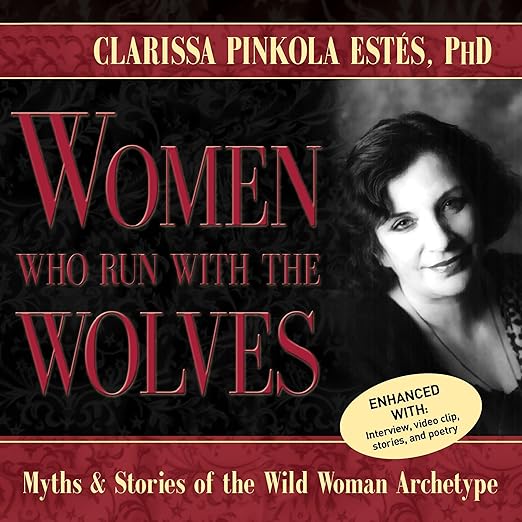
I want to be careful about how I frame this particular entry, because Women Who Run with the Wolves is one of those books that has accumulated enough cultural weight to make honest criticism feel reckless. It is a genuine landmark. And the audio version under review here is not the full book, it is the original audio edition that Estés recorded three years before the print edition was published, which became an underground bestseller in its own right. It is shorter, more focused, and in some ways more powerful than the expanded text, because it is Estés at the lectern, as the cantadora she trained to be, without the apparatus of a publishing house shaping the delivery.
Running at 2 hours and 18 minutes, this is not a comprehensive rendering of the full Women Who Run with the Wolves experience. Listeners who want the complete book should seek the unabridged audiobook of the print edition. What this audio edition offers is something different: Estés as performer, as oral storyteller, as keeper of old stories delivering the myths and commentary that form the heart of her wild woman framework in the tradition from which they emerge. That distinction matters.
Our Take on Women Who Run with the Wolves
The theoretical center of the book is the wild woman archetype: an inner nature that is instinctive, creative, and cyclical, which Estés argues modern Western culture systematically suppresses in women through a combination of socialization, aesthetics, and institutional structure. She draws her case from fairy tales, myths, and dreams across cultures, reading these narratives through a Jungian lens that takes their symbols seriously as maps of psychological reality rather than entertainment.
That combination, Jungian depth psychology applied to women’s mythological inheritance through the voice of a trained storyteller who is also a psychoanalyst, is genuinely rare. Most books in this space lean toward one mode or the other. They are either academic and distanced, or personal and vague. Estés holds both registers simultaneously, which is what makes the work generative rather than merely interesting.
Why Listen to Women Who Run with the Wolves
The fundamental reason to listen rather than read is Estés herself. Her narration is not narration in the conventional audiobook sense, it is performance in the sense that oral storytelling is performance. She is a cantadora, a keeper of the old stories in the tradition of the Latina storytelling lineage she grew up within. When she tells a myth, it is not a recitation. The pauses are meaningful. The emphasis carries the interpretation. One reviewer described the experience as receiving “good medicine expressed,” which captures something precise about how the performance lands.
At 2 hours and 18 minutes, this audio edition is deceptive in its brevity. It contains material that will take much longer to digest than the listen itself requires. Reviewers describe returning to it, sitting with it, finding new entry points on repeated encounters. That quality, the text revealing different things at different moments in a listener’s life, is characteristic of myth handled well.
What to Watch For in Women Who Run with the Wolves
The audio edition’s brevity is both its strength and its limitation. For listeners new to Estés’s work, this is a powerful introduction, but it is not a substitute for the full text. The print edition of Women Who Run with the Wolves is much longer and covers significantly more ground, additional myths, more extended psychological analysis, more case material from Estés’s practice. Approaching this audio edition as the complete work would be like reading a musician’s demo tape as their full discography.
The Jungian framework is also worth naming plainly. Estés writes from within that tradition without extensively explaining its premises. Listeners unfamiliar with archetypes, the collective unconscious, or the basic vocabulary of depth psychology may find certain sections more opaque than others without background reading. That is not a flaw in the work, but it shapes the accessibility of particular sections.
Who Should Listen to Women Who Run with the Wolves
Anyone drawn to feminist psychology, myth, and the intersection of storytelling and self-knowledge should listen to this audio edition regardless of whether they have read the print book. For those who have read the print edition and want to encounter the ideas in Estés’s own voice, this is essential, it is a different experience, not a redundant one. Listeners expecting a conventional self-help audiobook or a linear argument will find the mythological, storytelling mode requires a different kind of attention. That different kind of attention is exactly what this material is asking for, and meeting it is genuinely rewarding.
Frequently Asked Questions
Is this the full Women Who Run with the Wolves book, or a shortened version?
This is the original audio edition that Estés recorded before the print book was published. It is significantly shorter than the full text and should be understood as a distinct companion work rather than a complete rendering of the book.
Do you need to be familiar with Jungian psychology to understand this audiobook?
Basic familiarity helps but is not required. Estés grounds her analysis in myth and story before introducing psychological vocabulary, which means the material is accessible through narrative even when the theory is unfamiliar. Some sections will reward additional reading in Jungian concepts.
Is this audiobook primarily for women, or does it speak to a broader audience?
Estés writes from and for women’s experience, but reviewers across genders describe finding the work valuable. The wild woman archetype is framed as a specifically feminine energy, but the mythological and psychological material engages anyone interested in those traditions.
How does listening to Estés narrate her own work compare to reading the text?
Significantly different, because Estés is a trained oral storyteller. The pauses, emphasis, and vocal quality carry interpretive weight that a print read cannot replicate. Most listeners who encounter both formats report that the audio offers something the print edition cannot, a quality of direct transmission that suits oral material.