Before You Press Play
- Narrator: Vivek Ramaswamy is credited as his own reader, which puts the argument in the voice of the person who built it.
- Subjects: stakeholder capitalism, corporate political messaging, American identity
- Tone: Combative and briskly argued
- Bottom line: Strong on the mechanics of corporate incentives, thinner in its closing vision, and best suited to listeners already skeptical of how business talks about virtue.
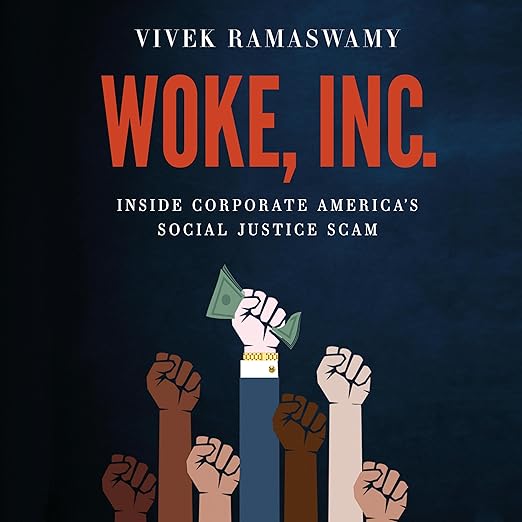
A February 2026 response calls the material here a bit outdated, and that one line places this audiobook more precisely than the publisher copy manages. Woke, Inc. was released in August 2021, argued from inside the boardrooms of that exact moment, and has since sat on the shelf long enough for one of its own supportive reviewers to note the drift in passing. Vivek Ramaswamy reads it himself across ten hours and twenty-seven minutes, which turns a business polemic into something nearer a spoken brief. How well that lands depends almost entirely on how much of the conclusion you brought with you.
Is Woke, Inc. Worth Your Time?
Ramaswamy builds on one claim: that stakeholder capitalism, the promise of a more diverse and environmentally friendly corporate world, functions as a transfer of money, voice and identity away from ordinary people and toward the executives selling it. The description calls this the defining scam of our century and traces the route through corporate boardrooms and five-star conferences into Ivy League classrooms and what it terms secretive nonprofits. The framing is autobiographical as much as analytical. Ramaswamy trained as a scientist at Harvard and a lawyer at Yale, became a hedge fund partner in his twenties, led a biotech company as CEO, and grew up the child of immigrants in a small Ohio town, and the book keeps circling back to that history as its credential.
Where the argument earns its keep is in the mechanics. One respondent, whose display name carries two book titles alongside it, condenses the case into a sentence the marketing copy never quite writes: shareholder capital gets redirected by management teams into questionable social causes without skin in the game, corporations behave like nonprofits, and nonprofits work on the government to do their bidding. That is a structural complaint and a checkable one. The weaker stretch is the closing movement, which the description frames as an exploration of what it means to be an American in 2021, a passage promised to begin in cynicism and end in hope. That is a mood, not a thesis, and mood is exactly what a self-read recording amplifies.
The Best Parts of Woke, Inc.
Author and narrator are one credit here, and for this title the doubling carries real information. The book's central move is a claim of access: I sat in those boardrooms, I heard what was said, here is what it meant. When the voice making that claim belongs to the person who made it in print, the listener is not handed a performance of the argument so much as its owner. Nothing on the listing indicates whether Ramaswamy had read for a microphone before August 2021, and not one of the five written responses mentions the recording. What the credit tells you is about structure. About tone it says nothing at all: for ten hours and twenty-seven minutes, no interpreter stands between the case and the person hearing it.
Center Street published it and the description leads with a New York Times bestseller line, so the commercial posture is set before a word of the argument arrives. That matters for how the middle chapters sound. The book is at once a critique of a business practice and a piece of positioning, and the listing makes no attempt to hide the second thing. Its own tag set files it under Economics, Politics and Activism, and Professionals and Academics, three categories pulling in different directions that between them describe the audience fairly well. The genre fields are stranger: biographies and memoirs alongside money and finance, with no politics category anywhere, on a book whose subject is explicitly political.
Before You Commit to Woke, Inc.
Listeners who want the other side argued at full strength will not find it. The book argues one side and makes no attempt at the other, and the written column underneath reads accordingly: five responses, four of them at five stars, the fifth at four. The dissent that exists is mild. The respondent posting as BD in Jacksonville calls it good overall and a relatively easy read, notes that some of it is a bit outdated now, and still plans to keep it for future reference. That is the strongest objection anywhere on the page, which tells you more about who leaves reviews than about how the book was received.
Ten hours and twenty-seven minutes is a long sitting for an argument stated plainly in its first hour and supported thereafter. The structure rewards patience and frustrates anyone hoping for a compressed version. If your interest is the mechanism, the boardroom material and the nonprofit chapters carry most of the weight. If your interest is the concluding vision of American identity, you wait a long time for a comparatively short payload, and the description's own promise of a movement from cynicism to hope is the part that depends most on already sharing the premise.
Four of the five written responses stop in the middle of a sentence, one of them breaking mid-word, so what you read in that column is a fragment of an opinion whose ending is missing. Pescador breaks off while describing a juvenile treatment facility in Colorado and a parallel to the book's Youth Core proposal; the sentence that would have explained the parallel simply is not on the page. Read the column as a set of headlines and not as evidence.
Should You Listen to Woke, Inc.?
Pescador, who reports reading it twice to be sure nothing was missed, and Sab, who found it eye-opening and relatable, describe the same listener: somebody already uneasy about how corporate America talks about itself and looking for vocabulary to say why. For that person this is a well-organized ten hours with, as Sab notes, a great many sources attached. B. Parsley supplies the most useful map of the shape, calling it the story of a journey through two of the top universities in the country, into some of the biggest corporations, and eventually into a biotech company of his own.
Anyone looking for a balanced survey of stakeholder capitalism should walk past it. This is advocacy, competently built, and the audio format removes the visual cues that let a reader skim the sections that are not persuading them. Listeners who want the opposing case argued at comparable length will need a second title, and this one nominates none. The rating badge offers no shortcut either: 4.6 is not a figure four whole-star votes can produce under any rounding rule, and the counter reads four while five written responses sit directly below it.
Listeners who came to test the argument against its strongest opposition should know that the opposition here is summarized, not staged, and that the closing movement turns from analysis toward a statement of national feeling. Skeptics of the corporate diversity apparatus will find their case made at length, sourced as it goes, and spoken by the man who made it.
Does Vivek Ramaswamy reading the audiobook himself change how the argument works?
It changes the register more than the content. The book's central move is a claim of access, that he sat in the rooms he describes, and hearing it in the author's own credited voice keeps that claim in the foreground for the full ten hours and twenty-seven minutes. What it cannot do is soften a case built to be one-sided.
Why does the rating badge on this audiobook disagree with the reviews below it?
The listing shows 4.6 from four votes, and 4.6 cannot be produced by four whole-star votes under any rounding rule. The counter also says four while five written responses are visible. Treat the badge as decoration and read the responses instead, which run four at five stars and one at four.
How much of the 2021 material has aged out by now?
One respondent writing in February 2026 says some of it is a bit outdated, while still calling it a good account of recent historical events worth keeping for reference. The corporate examples are anchored to the moment of writing. The structural claim about management incentives and social causes is not date-stamped in the same way.
Is this audiobook a fair introduction to stakeholder capitalism as a subject?
Only as one side of it. The description states its position openly, calling stakeholder capitalism the defining scam of our century, so nobody is ambushed. If you want the case for the practice argued at similar length by someone who believes it, you will need a second title, and this listing points toward none.