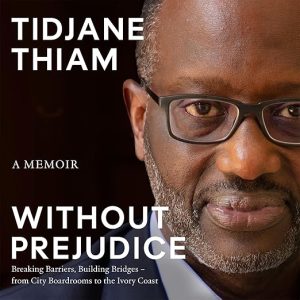
Ivory Coast, France, London and Zurich: the career behind this audiobook crosses more ground than most memoirs attempt, and Tidjane Thiam covers all of it in a little over eight hours. A childhood spent across a turbulent west and north Africa comes first, then the elite French educational system, which he entered as an outsider and left as one of the first Black consultants at McKinsey and Company. Then the Ivorian government, then exile after a coup, then the chief executive's office at Prudential in London and later at Credit Suisse in Zurich. The description is unusually direct about the price attached to that last stretch: as the only African, Black and Muslim head of large Western corporations, he drew public and media scrutiny out of all proportion, along with racism and xenophobia. Ben Onwukwe takes the reading.
Crediting Backers Instead of the Self-Made Myth
Four things are being written at once here, and the description names them: autobiography, business, politics and personal philosophy. That combination explains both the appeal and the limitation. A book covering a father's politically motivated imprisonment, a coup that forced a career into exile, and the mechanics of running a global insurer has to keep changing altitude, and Thiam is plainly more interested in what each stage taught him than in narrating any of them at length. He also makes a point the genre usually skips, crediting the people in public and private life who trained and backed him, which sits oddly against the self-made framing these books normally prefer.
Written reactions on this page form an unusual pattern worth understanding before you weight them. Five endorsements sit under the 4.7, filed from five different marketplaces, and three of them landed within three days of each other in late September 2025, about a month after the August release. One consists of two words. Another is written entirely in French, which the record neither flags nor translates for anyone browsing the English page. What that column gives you is a map of where this book is being read, which is genuinely interesting, rather than a set of assessments you can weigh against each other.
Vantage Point Is the Actual Product Here
Vantage point is the product, and the response filed in Canada makes the strongest case for it. That entry credits Thiam with insights on leadership, family, race and the future of Ivory Coast, and identifies the source of those insights precisely: an African-born graduate of France's top schools who then ran leading UK and Swiss companies, combining down to earth anecdotes with what the writer calls razor-sharp analyses. Very few people can speak from inside all of those rooms. Anyone who has read a shelf of chief executive memoirs written from a single country's assumptions will find the shift in perspective worth the running time by itself.
Purpose is the other thread, and the entry filed in France gets at it from a different angle entirely. That response recommends the book to African young people and takes from it a single proposition: that the pursuit of excellence should be a habit rather than a privilege. The writer also mentions having attended the same secondary school in Abidjan in 1979 and 1980, which is a reminder of how directly this memoir addresses a specific readership. For younger listeners in Africa and across the diaspora, the book functions less as a business title than as evidence about what is possible and what it costs.
Filed Where Business Listeners Won't Think to Look
Enthusiasm outruns description across most of this column, which limits how much you can learn from it. The entry filed in the United States calls it a book about a modern pioneer among African managers who shattered ceilings and recommends it in the strongest terms without saying much about its contents. The entry filed in the United Kingdom urges every African to read it and lists four adjectives. Both are heartfelt and neither tells a prospective buyer what the eight hours actually contain, so treat the column as a signal of who values the book rather than as a guide to its shape.
Expectations about the banking years need managing too. The description promises the business principles that carried Thiam to the top of global finance and calls the result equal parts inspirational and aspirational, which is language pointing toward lessons rather than disclosures. Anyone hoping for a forensic account of what happened inside either institution should read that framing carefully first. It is also worth noting the shelving: biographies and memoirs, tagged Cultural and Regional, which files a book about the leadership of two of Europe's larger financial firms somewhere business listeners are unlikely to look.
Generous About the Road, Guarded About the Rooms
African professionals and students are the audience this book is most obviously built for, and it addresses them without any hedging. Listeners interested in race at the top of global finance get a first-hand account rather than a study, which is rare enough to matter. Anyone working on leadership development will find explicit principles rather than implied ones. And listeners who follow Ivorian or west African politics get the political chapters as lived experience, including a father's imprisonment and a coup that ended one career and started another.
Two groups should think carefully. Anyone wanting the granular institutional history of a bank in crisis should look for a reported book by a journalist instead. Listeners who dislike the lessons-drawn structure of the executive memoir will feel it here, since reflection consistently takes precedence over scene. What this record delivers is generous about the road traveled and considerably more guarded about the rooms at the end of it. Decide on that ratio before buying, because it does not shift over eight hours.
Does the audiobook cover the Credit Suisse years in detail?
The description makes no promise of a forensic account. Zurich and London supply the setting for a set of principles rather than the subject of an inquiry, and the memoir's interest lies plainly in how Thiam reached those offices rather than in the mechanics of what happened inside them.
Who narrates the audiobook, and does Thiam read any of it himself?
Ben Onwukwe is the only performer credited, with no indication anywhere of an author-read introduction or afterword. That matters on a memoir carrying this many place names, institutions and people, where a reader's handling of unfamiliar names does real work for the listener.
How much practical business advice does it actually contain?
Enough to matter, and it arrives stated rather than implied: principles are sold alongside the life, which is a different proposition from a memoir you have to mine for lessons yourself. Whether that satisfies depends entirely on whether you arrived wanting method or wanting the story.