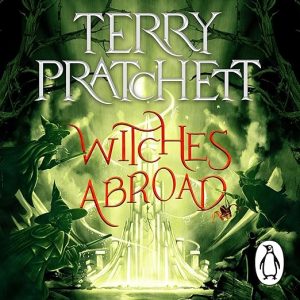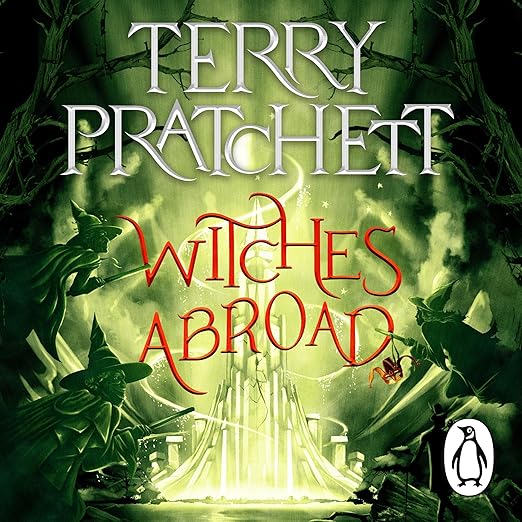
Genua is a long way to travel just to stop a wedding, but that is exactly what sends Granny Weatherwax, Nanny Ogg, and Magrat Garlick on the road in this audiobook. Terry Pratchett's twelfth Discworld novel, third in the Witches sequence, sends its trio up against a power-hungry Fairy Godmother determined to force a servant girl into her own glass-slippered happily-ever-after, whether the girl actually wants one or not. Pratchett's real target across the whole nine-hour, fifty-three-minute runtime is the fairy tale itself as a mechanism, the way a good story can trap people inside it just as effectively as a villain can, and the witches' job becomes fighting narrative gravity as much as any single antagonist.
Is Witches Abroad Worth Your Time?
This particular audiobook is a genuine production event within the Discworld catalog, not just another standard narration. Indira Varma, known for Game of Thrones, Luther, and This Way Up, narrates the main text, while BAFTA and Golden Globe winner Bill Nighy reads Pratchett's famous footnotes separately, and Peter Serafinowicz voices Death, all under a new theme composed specifically for this Penguin production by James Hannigan. Splitting the footnotes into a distinct voice is a genuinely smart structural solution to a problem that has dogged Discworld audio for years: Pratchett's asides are frequently funnier than the main text around them, and giving them their own dedicated performer keeps that specific comic rhythm from getting lost inside a single narrator's flow.
Genua itself is worth a closer look as a setting choice: Pratchett builds it as Discworld's own loose, comic riff on a steamy port city dripping with imported fairy-tale iconography, a deliberately theatrical backdrop for a plot about stories imposing themselves on reality. Sending three very practical, unglamorous Lancre witches into a city built almost entirely out of narrative cliche is itself the joke underneath the plot: Granny, Nanny, and Magrat's plain-spoken skepticism is the exact opposite of the storybook logic Genua runs on, and watching that friction play out across the runtime is where a lot of the book's sharpest comedy comes from.
The Best Parts of Witches Abroad
Two blurbs printed right alongside the book's own description make the pitch about as directly as possible: the Daily Mail calls Pratchett a writer who mixes 'the fantastical and mundane to better comic effect' than anyone else, and George R.R. Martin, not a small name to have in your corner, calls him 'One of our greatest fantasists, and beyond a doubt the funniest'. Both claims hold up across this specific book. The Fairy Godmother plot gives Pratchett room to satirize fairy tales broadly, Cinderella most directly, while still landing the philosophical point buried inside the comedy: 'You can't go around building a better world for people. Only people can build a better world for people. Otherwise, it's just a cage.'
One reviewer, arriving at this entry only after most of the rest of the series, frames the appeal precisely: 'What a joy it was to realize that there was a Discworld book I hadn't read!' They note that reading it this late means encountering a Discworld where the City Watch is still mostly a running joke and Tiffany Aching, one of Pratchett's later breakout characters, has not been introduced yet, an earlier, rawer version of the same universe that longtime readers will recognize evolving in real time. A second reviewer calls this their favorite of the Witches books so far, praising how directly 'ALL fairy tales are fair game for skewering.'
A third, shorter review sums up the appeal in more casual terms, comparing the fairy-tale subversion here to Shrek and specifically singling out the witches as the funniest characters in a cast already full of them. That comparison is a useful shorthand for a listener unfamiliar with Pratchett specifically: the same basic instinct that made Shrek's fractured-fairy-tale approach land with a mainstream audience is at work here too, applied with sharper, more literary wit and considerably more philosophical ambition underneath the jokes than a single animated film ever attempted.
Before You Commit to Witches Abroad
The publisher's own note states plainly that Discworld novels can be listened to in any order, and that is genuinely true structurally, but it is worth a caveat specific to this book: as the third entry in the Witches sequence, Witches Abroad benefits from the established dynamic between Granny Weatherwax, Nanny Ogg, and Magrat that the first two Witches books, Equal Rites and Wyrd Sisters, spend real time building. New listeners can absolutely start here without confusion, since Pratchett was always writing with new readers in mind, but the specific comic chemistry between the three witches lands even better with that earlier context already in place.
The full-cast structure, three credited performers plus a new theme, is a real production investment, and it comes with its own small adjustment period: listeners used to standard single-narrator audiobooks may need a beat to register that Bill Nighy's footnote voice and Peter Serafinowicz's Death are intentional, distinct performers rather than an inconsistency in the recording. Once that structural logic clicks, it becomes one of this production's genuine strengths rather than a distraction, letting Varma's central narration stay focused on Granny, Nanny, and Magrat while the footnotes get their own dedicated comic beat.
The audiobook description notes the first Discworld novel, The Colour of Magic, was published back in 1983, which puts the eight years between that debut and this one into useful perspective: by book twelve, Pratchett had already settled into the sharper, more purposeful satirical voice this recording captures, distinct from the looser parody of the earliest entries. Listeners curious about the series' evolution, rather than only this one book, will find Witches Abroad a genuinely useful marker of where Pratchett's writing had grown to by the early 1990s.
Should You Listen to Witches Abroad?
Discworld fans filling a gap in their reading, and any listener who wants proof that satire and genuine emotional stakes can coexist inside the same lighthearted package, have the most to gain here, especially anyone who already enjoys Shrek-style fairy-tale subversion and wants a sharper, more literary version of that same impulse. Readers of the earlier Witches books specifically will get the fullest version of the joke, since the established chemistry between the trio only deepens across the series.
New listeners with zero Discworld experience should still feel comfortable starting here, per the publisher's own guidance, though they should know they are meeting Granny, Nanny, and Magrat mid-development rather than at their absolute introduction. Listeners who strongly prefer a single consistent narrator throughout, without a footnote voice or a separate performer for a recurring character like Death, may find the full-cast structure takes a little adjustment before it starts to feel like an asset rather than a novelty.
Common Questions
Do I need to read the Discworld series in order before starting the Witches Abroad audiobook?
No. The publisher states Discworld novels can be listened to in any order, though as the third Witches book, it benefits from the established chemistry between Granny, Nanny, and Magrat built in the first two entries.
Who voices Death in the Witches Abroad audiobook?
Peter Serafinowicz, known for Star Wars: Episode I and Shaun of the Dead, voices Death as a distinct performer within the full-cast Penguin production.
How does this audiobook handle Terry Pratchett's footnotes?
Bill Nighy reads the footnotes as a separate, dedicated performer apart from Indira Varma's main narration, preserving their distinct comic rhythm rather than folding them into the primary reading.