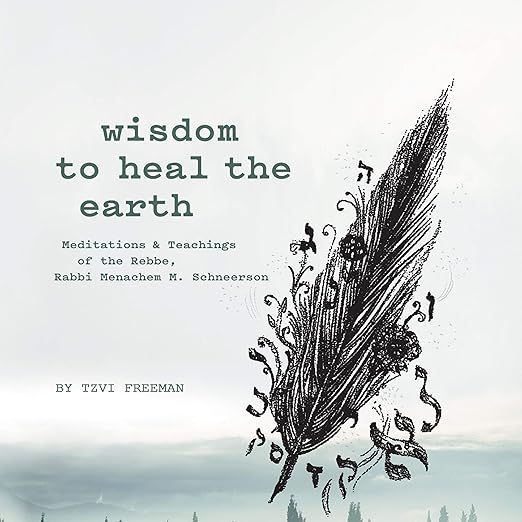
Quick Take
- Narration: Shlomo Zacks brings the meditative register of the text into the audio format with a voice that serves the material’s contemplative purpose without becoming liturgical.
- Themes: Tikun Olam and individual mission, the sacred dimension of ordinary action, the Rebbe’s vision of collective human destiny
- Mood: Quietly profound, devotional without being exclusionary
- Verdict: A collection of brief meditations that works as both a Jewish spiritual resource and a broader philosophical companion, particularly effective when engaged with slowly rather than consumed in sequence.
I came to Wisdom to Heal the Earth through a recommendation from a colleague who described it as the kind of book you open to a random page when you need to think clearly, rather than the kind of book you read straight through. I tested that description by listening to several consecutive chapters first, then doing exactly what she suggested, and she was right. Tzvi Freeman’s format for delivering the wisdom of Rabbi Menachem M. Schneerson, the Lubavitcher Rebbe, is built for a specific kind of attention: brief, intense, and then reflective. The meditations are short and dense, and they reward sitting with them rather than moving through them.
Freeman’s approach here follows the model he established in Bringing Heaven Down to Earth, using concise meditations as vehicles for the Rebbe’s teaching rather than lengthy discursive argument. The particular development in Wisdom to Heal the Earth is the addition of brief complementary essays alongside each meditation, and the focus has shifted toward the Rebbe’s vision of what the world is moving toward: Tikun Olam, the concept of repairing and perfecting the world as individual and collective mission. The frame is explicitly Jewish but the application Freeman draws out is deliberately universal.
Our Take on Wisdom to Heal the Earth
One of the most interesting reviews this book has received compares it to Stephen Mitchell’s translation of the Tao Te Ching, and that comparison illuminates something real about what Freeman is doing. The Tao Te Ching’s power comes from compression: each passage is brief enough to hold in mind and dense enough to carry genuine weight. Freeman achieves something similar by distilling the Rebbe’s vast body of teaching into meditations that are individually small but collectively substantial. A reviewer described the format as allowing you to pick a number between 1 and 385 and read the corresponding meditation as a prompt for conversation or reflection. That is exactly how the book functions at its best.
Shlomo Zacks narrates with the measured quality that the material requires. These are not texts that benefit from dramatic performance; they are texts that benefit from stillness, and Zacks provides it. His voice has the quality of someone reading in genuine belief rather than professional delivery, which is the appropriate register for devotional material of this kind. At six and a half hours, the audiobook is not a casual listen in the way that a thriller or a memoir might be. It is better approached as something you return to across several sessions, using the contemplative pacing as an invitation rather than finding it slow.
Why Listen to Wisdom to Heal the Earth
The universal application of the Tikun Olam framework is the book’s strongest outward-facing argument. Freeman does not restrict the Rebbe’s teaching to an exclusively Jewish audience; the vision of every person entering the world with a specific mission to repair their assigned portion of it is presented as a human proposition rather than a sectarian one. A reviewer who described themselves as a Judeo-Christian student of the Tao found the book accessible and moving, which suggests Freeman has succeeded in the translation of a specifically Jewish intellectual tradition into a form that speaks across those boundaries.
The format’s strength is also its constraint. Because each meditation is short, the book cannot develop any single idea at length. What it provides instead is a repeated encounter with a coherent worldview from multiple angles. Over 385 entries, the Rebbe’s vision accumulates rather than building linearly, which means the book rewards rereading and rereturning more than most devotional works. The audio format is particularly suited to this: you can listen to a section, pause, and return without losing narrative momentum, because there is no narrative to lose.
What to Watch For in Wisdom to Heal the Earth
Listeners who approach the book expecting systematic theological argument will not find it. The meditative format is deliberately impressionistic, building understanding through accumulation and resonance rather than through logical progression. If you want a comprehensive account of the Rebbe’s theology, you would need to go to the primary sources or to more systematic secondary literature. What Freeman provides is an entry point and an invitation, not an endpoint.
The audio format also requires particular patience because of how the meditations are structured. Each is short enough that the listener must do significant work to sit with the implications before moving on. Listening while commuting or doing tasks that require cognitive engagement will likely miss much of what the book offers. This is genuinely a sit-quietly-and-listen experience.
Who Should Listen to Wisdom to Heal the Earth
Listeners with an interest in Jewish spiritual wisdom, in the teaching of the Lubavitcher Rebbe, or in the Tikun Olam framework as a philosophical orientation toward daily life will find this among the more accessible audio introductions to the tradition. It also works for listeners from outside Jewish practice who want a spiritual companion that operates through reflection rather than argument. Skip it if you prefer your spiritual nonfiction systematic and discursive, or if you need to listen actively while doing other things. The book requires the kind of attention that rewards stillness, and it is best experienced that way.
Frequently Asked Questions
Do you need to be Jewish or have prior knowledge of Chabad teaching to benefit from this book?
No. Freeman is explicit about the universal application of the Tikun Olam framework, and reviewers from outside Jewish practice, including one who describes themselves as a Judeo-Christian student of the Tao, have found the book meaningful. The wisdom is rooted in Jewish thought but the application Freeman draws out is deliberately addressed to a broader human audience.
Is the audio format appropriate for a book structured as brief meditations, or is print better?
Both formats work, but for different listening habits. The audio is particularly strong if you engage with it one or a few meditations at a time, pausing and reflecting between entries. Listening straight through without pausing is likely to produce less engagement with the material than the format is designed to generate. The print format allows random access more easily, which some readers prefer.
How does Wisdom to Heal the Earth relate to Freeman’s earlier book, Bringing Heaven Down to Earth?
Both books use the same format of brief meditations drawn from the Rebbe’s teaching. Wisdom to Heal the Earth adds complementary essays alongside each meditation and focuses specifically on the Rebbe’s vision of collective human destiny and Tikun Olam. Freeman describes it as taking the reader further than the earlier book, toward the Rebbe’s broader vision of where humanity is headed.
At 385 meditations over six and a half hours, is the book better suited to full consecutive listening or returning to in sessions?
Reviewers consistently describe it as a book to return to rather than consume in sequence, and that is the format the author seems to intend. The meditations are individually dense enough that sustained listening without reflection is likely to reduce their impact. Multiple sessions, or the practice of selecting a meditation and sitting with it, is the use pattern the structure supports.