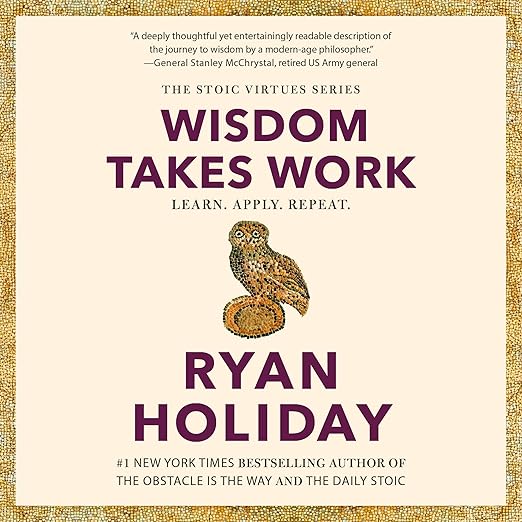
Quick Take
- Narration: Ryan Holiday reading his own work is the only way this book should exist in audio form. His unhurried, deliberate delivery enacts the book’s core argument that slow thinking is the point.
- Themes: Cultivating practical wisdom, the cost of intellectual shortcuts, self-education as lifelong practice
- Mood: Measured and serious, occasionally urgent, carrying the weight of a career culmination
- Verdict: The strongest entry in Holiday’s Stoic Virtues series and a genuine contribution to the practical philosophy shelf, though readers sensitive to contemporary political examples should note the Elon Musk passages land unevenly.
I started Wisdom Takes Work on a Tuesday morning commute and ended up sitting in my parked car for an extra twenty minutes because I did not want to break the rhythm of what Holiday was building. That almost never happens with nonfiction audiobooks, which tend to reward dipping in and out. This one pulled differently. There is something in the accumulation of it, the way Holiday circles wisdom from multiple directions before landing on a claim, that made stopping feel like a small betrayal of the argument itself.
This is the final installment of Holiday’s Stoic Virtues series, following his earlier volumes on courage, discipline, and justice. The series has been a long project, each book building on the others, and the decision to end with wisdom is structurally intelligent. Wisdom, Holiday argues, is the virtue that enables all the others. Without it, courage becomes recklessness, discipline becomes rigidity, and justice becomes cruelty. That framing gives this book a weight the earlier volumes did not fully carry.
The Case Against Intellectual Shortcuts
The book’s central argument is precise and uncomfortable: we live in an era that actively rewards the appearance of wisdom over its substance. Reaction, certainty, and tribalism move faster than reflection, and the systems we inhabit are calibrated to amplify the former and suppress the latter. Holiday is not making a nostalgic argument here. He is not claiming that things were better before. He is making a structural point about what wisdom actually requires, which is friction, time, and the willingness to be wrong repeatedly before arriving at something durable.
The historical figures he draws on are well-chosen: Montaigne on self-doubt and essay as a form of thinking, Seneca on the gap between knowing and applying, Joan Didion on the discipline of noticing, Abraham Lincoln on holding contradictions without collapsing into false resolution. These are not decorative references. Holiday works through them in enough detail to demonstrate what wisdom looked like in practice, not just in principle. This is the skill he has refined across the series, and it is at its sharpest here. The reader encounters not a catalog of sage wisdom but a study in how wisdom is actually constructed through specific habits and specific struggles over long stretches of time.
Where the Argument Gets Contemporary and Complicated
One reviewer flagged that a significant portion of the book uses Elon Musk as a case study in intelligence without wisdom, and that is accurate. Holiday does not simply dismiss Musk but engages with his arc as a genuine warning: high intelligence, enormous capability, extraordinary resources, and an apparent failure of the prudential judgment that wisdom provides. The passages are carefully argued rather than merely polemical, but they do occupy more of the book than the marketing framing prepares you for.
It is worth saying that Holiday raises fair points even when the target is contested. The argument that power without wisdom is catastrophic is not a partisan claim. Thucydides made it, Aristotle made it, and the Stoics made it repeatedly. Holiday is applying an old framework to a contemporary figure. Whether that feels fair or pointed will depend on where you stand, but the underlying philosophical structure holds regardless of the example chosen. The reviewer who called it an exercise in Elon-jabbing was not entirely wrong, but the book earns its argument well beyond that single case study.
Ryan Holiday Narrating Ryan Holiday
Holiday reads his own work, and the effect is exactly what you want from a book about slow, deliberate thought. He does not hurry. His pauses are genuine rather than performative. When he makes a distinction between two related concepts, you can hear him dwelling on the difference rather than racing past it. The nine-hour-forty-four-minute runtime at this pace is generous rather than long, and the Penguin Audio production is clean.
Multiple reviewers describe this as the culmination of Holiday’s life work, and the sense of arrival is audible. He writes about the complete Stoic Virtues series as a unified project only now fully visible in retrospect, which gives the listening experience a particular emotional register that is difficult to manufacture and impossible to fake. This is a writer who has spent years thinking about a single problem and is now accounting for what that thinking produced.
There is a passage toward the end of the book where Holiday reflects explicitly on what completing this series has meant to him, not as an author accounting for his bibliography but as someone who spent years thinking carefully about how to live. That moment of personal accounting is one of the most unguarded things he has written, and it elevates the book from capable practical philosophy to something that earns the word culmination in its truest sense. Reviewers who describe this as Holiday’s best work are pointing at that quality, the sense that the argument has been road-tested over a long distance rather than constructed in advance and filled in. That kind of earned authority is rare in any genre, and it is what makes Wisdom Takes Work worth returning to after the first listen rather than treating it as a book to be finished and set aside.
Who This Book Is Built For
Listeners who have followed the Stoic Virtues series from the beginning will find the most in this volume, as it rewards the accumulated context. But it also stands alone better than the series structure might suggest, because the argument is self-contained and Holiday builds his foundations carefully. Those who want practical philosophy grounded in real cases and real reading, rather than abstract theorizing or motivational uplift, will find this among the most substantive entries in the genre. Listeners who prefer their philosophy without political friction should be aware that the contemporary passages are more pointed here than in Holiday’s earlier work.
Frequently Asked Questions
Do I need to have read the earlier Stoic Virtues books before listening to Wisdom Takes Work?
No, the book works as a standalone. Holiday builds his core argument from the ground up, and the philosophical framework he draws on is explained clearly enough for new readers. That said, listeners who have followed the series will experience the culmination quality of this volume more fully and feel the series arc paying off.
How much of the book is actually about Elon Musk, and does it feel like a political polemic?
Several substantial passages use Musk as a case study in intelligence without wisdom, more than the framing prepares you for. Holiday’s argument is rooted in classical Stoic philosophy rather than contemporary partisanship, but the target is specific enough that listeners with strong feelings about Musk will notice the editorial angle. One reviewer found it overly pointed; others consider it a fair application of the philosophical framework.
Does Ryan Holiday narrating his own book add to or detract from the listening experience?
It is a genuine asset. Holiday’s unhurried, deliberate delivery enacts the book’s central argument about the value of slow thinking. He does not perform enthusiasm or urgency, which suits a book that actively argues against reactive thinking as a substitute for genuine wisdom.
How does this compare to other books in the practical Stoicism genre?
Wisdom Takes Work is the most structurally ambitious entry in Holiday’s own catalog. The historical breadth, from Montaigne to Seneca to Didion to Lincoln, gives it more range than many Stoicism titles, and the sustained argument about contemporary relevance makes it feel genuinely urgent rather than simply classical and decorative.