- Narrator: Virtual Voice handles Garcia's biography with acceptable clarity but lacks the tonal range to convey Churchill's rhetorical drama - functional rather than immersive.
- Subjects: Wartime leadership, political resilience, the gap between public legend and private struggle
- Tone: Admiring but measured, spanning decades of history with sustained pace
- Bottom line: A solid introduction to Churchill's life that works best as background listening for those new to the subject.
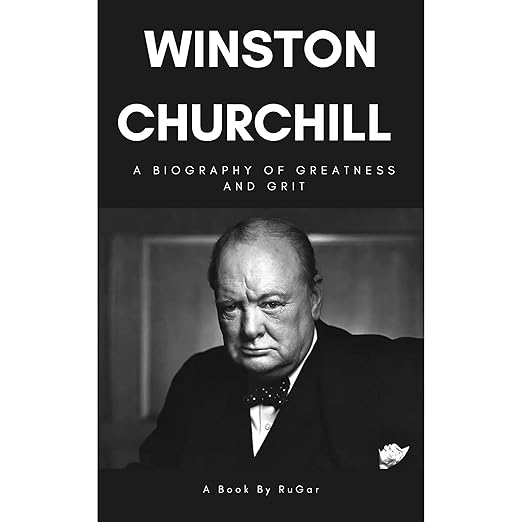
Churchill's finest speeches have a quality that recordings never fully capture: the weight of the moment behind the words, the knowledge that the men listening in those dark months of 1940 had no certainty how the story ended. Ruben Garcia's audiobook biography Winston Churchill: A Biography of Greatness and Grit, narrated by Virtual Voice and running nearly seventeen hours, attempts to reconstruct that weight through narrative - to trace how the man inside the legend was formed, tested, and shaped into the figure history preserved. It's an ambitious undertaking from an author whose title signals its admiring register from the first page.
Reckless, Ambitious, and Hungry for Recognition
Garcia's biography belongs to a well-populated shelf. Churchill is one of the most written-about figures in modern history, and any new entry into that field must establish what ground it intends to occupy. This biography positions itself as an accessible, single-volume account that traces Churchill's arc from his restless youth as a soldier and war correspondent through his long political career and into his role as wartime Prime Minister. The subtitle, A Biography of Greatness and Grit, announces the framing clearly: this is a work of admiration, interested in Churchill as a study of will and character rather than a more forensic examination of his contradictions and failures.
That framing shapes what the biography does well and where it runs thinner. Garcia's account of the early decades is genuinely engaging. The young Churchill - reckless, ambitious, hungry for recognition, willing to put himself in physical danger for the story - makes for propulsive reading, and Garcia renders those years with momentum. The Boer War period, the Gallipoli disaster, the wilderness years of the 1930s: these are handled with clarity and enough historical grounding to give listeners who are not Churchill specialists a solid orientation. The material on Churchill's private life - his marriage to Clementine, his friendship with Violet Bonham Carter, his oscillating states of depression and creative energy - adds dimension that strictly political biographies often flatten.
A Virtual Voice, Technically Competent and Flat
At nearly seventeen hours, this audiobook offers enough scope to give the major periods of Churchill's life genuine room. Listeners who want a single volume that moves from birth to death without requiring prior knowledge of British political history will find Garcia's approach accessible and well-organized. The prose is clear and narrative-driven rather than academic - this is not a work that gets bogged down in historiographical debates or footnote culture. For listeners who encountered Churchill through the film Darkest Hour or through brief references in popular history and want to understand the larger arc of his life, this biography provides that orientation.
The Virtual Voice narration is worth addressing directly. The technology has improved considerably, and for a straightforward biography structured around historical narrative, it performs adequately. The voice is clear and maintains a consistent register. Where it falls short is in the passages that require emotional or rhetorical lift: Garcia includes Churchill's speeches, and those passages need a human narrator's sense of weight and timing to land with real force. A Virtual Voice reading of "We shall fight on the beaches" is technically competent and experientially flat. Listeners for whom the rhetorical dimension of Churchill's legacy is central may find that gap frustrating.
Painting at Chartwell, No Longer at the Center
The sections covering Churchill's relationship with the British Empire are worth listening to with particular attention. Garcia does not shy away from acknowledging that Churchill held views on India, on colonialism, and on non-European peoples that sit in direct tension with his wartime rhetoric about freedom and democracy. The biography addresses those tensions without dwelling in them, which is a choice that readers can evaluate according to their own expectations of what a Churchill biography should do. For some listeners, this will read as appropriate proportionality; for others, a more searching examination of those contradictions would sharpen the portrait.
Garcia's account of the post-war years and Churchill's second premiership is briefer than the wartime coverage, as is common with Churchill biographies, but it includes the details of his declining health and his quiet final years that add a melancholic note to the biography's otherwise triumphant arc. The image of Churchill painting in the garden at Chartwell, no longer at the center of events, is handled with genuine feeling.
The seventeen-hour runtime allows Garcia to give sustained attention to the period most Churchill biographies rush through: the 1930s, the wilderness years after Churchill's warnings about Germany went unheeded in Parliament and in the press. Those years reveal something important about the character Garcia is portraying. Churchill was not vindicated quickly or gracefully. He spent nearly a decade being dismissed, argued against, and patronized by men who would later claim to have recognized his gifts all along. Garcia's account of that period has the texture of genuine historical frustration - a man who sees what is coming and cannot make anyone in power listen - and the Virtual Voice narration, for all its limitations in dramatic passages, handles the steady accumulation of that frustration with reasonable clarity.
A Comfortable Companion to Roberts and Manchester
Listeners approaching Churchill's life for the first time who want a comprehensive narrative overview without the density of a scholarly biography will find this a useful entry point. History readers who already own Andrew Roberts' Churchill: Walking with Destiny or William Manchester's three-volume The Last Lion will find this covers familiar ground, though Garcia's accessible style makes it a comfortable companion rather than a replacement. Listeners who require deep political analysis or a critical examination of Churchill's imperial record should look for more analytically focused biographies. Those for whom Virtual Voice narration is a dealbreaker should note that limitation before committing to seventeen hours.
A Few Questions About Winston Churchill
Is this audiobook suitable for listeners with no prior knowledge of British political history?
Yes. Garcia writes for a general audience and provides enough historical context that listeners unfamiliar with the specifics of British parliamentary politics, the Boer War, or 1930s appeasement will be able to follow the narrative without confusion.
How does this Churchill audiobook compare to more established biographies in audio format?
Andrew Roberts' Churchill: Walking with Destiny and William Manchester's The Last Lion are generally considered the benchmarks in English-language Churchill biography and are available in audio with professional narrators. Garcia's biography is more accessible in length and tone - roughly half the runtime of the Roberts - and serves a different audience than those comprehensive scholarly works.
Does this audiobook cover Churchill's personal struggles, including his well-documented depression?
Yes. Garcia includes material on what Churchill called his "black dog" - his recurring depressive episodes - as well as his marriage, his painting, his complicated relationship with alcohol, and his domestic life. The biography aims to show the private man alongside the public legend.