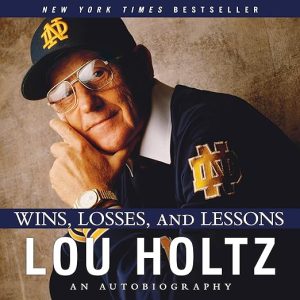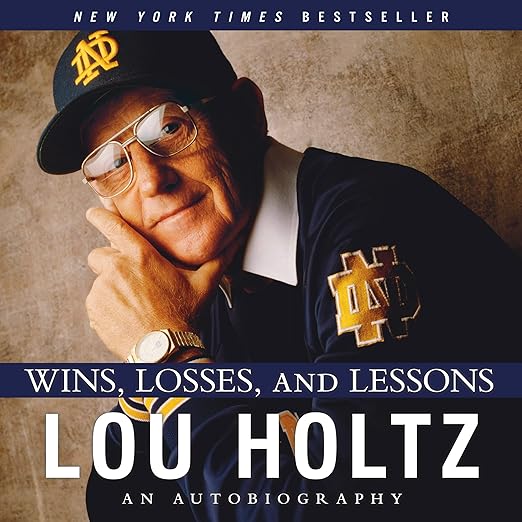
Lou Holtz opens his own audiobook with a line that tells you exactly what kind of memoir this is going to be: 'When I die and people realize that I will not be resurrected in three days, they will forget me. That is the way it should be.' That's not false modesty from a coach whose sideline resume includes leading six different schools to bowl games, it's the dry, self-deflating register that carries the entire book.
A Rail-Thin Kid With a Pronounced Impediment
The synopsis leans hard into Holtz's actual coaching record, three national Coach of the Year awards, the only coach ever to take six different programs to season-ending bowl games, the ninth-winningest coach in college football history, and the book earns that recitation by immediately undercutting it with the story of a rail-thin 135-pound kid with marginal academic credentials and a pronounced speech impediment. Reviewer Richard M. Cavagnol captures the resulting tone well, describing Holtz as 'not only a great tactical coach' but 'a very human and empathetic coach who rose to great heights from a humble background,' adding that his 'anecdotes and football stories are priceless.'
What keeps five and a half hours of coaching-career recap from turning into a highlight reel is the specific chronology: William and Mary, North Carolina State, Arkansas, Minnesota, Notre Dame, and finally South Carolina, each program getting its own real turnaround story rather than a single generic winning arc repeated six times. Reviewer Gordon G. Marcum keeps his assessment simple and direct, calling it 'a great read' full of 'great stories of his life and experiences' from, in his words, 'a great Christian man,' which matches the faith thread the synopsis itself signals without spelling out in detail.
The Third Term Carries the Book's Real Weight
The title's three-part structure, wins, losses, and lessons, signals exactly where the book's real weight falls: not on the box scores implied by wins and losses alone, but on the third term, the meaning Holtz draws out of both categories equally. A coach who only wrote about the wins would produce a highlight reel; naming losses in the title up front, and then adding lessons as the actual point of recounting either one, sets different expectations than a typical championship-season retrospective.
Cavagnol's underdog framing deserves a closer look, since the synopsis backs it up with real specifics rather than leaving it as vague uplift: a rail-thin frame, marginal grades, and a stutter are unusually candid details for a coach to lead with in his own telling, rather than glossing over the rough start on the way to the accolades that follow.
The six programs named in the synopsis span genuinely different eras and different competitive tiers of college football, from smaller regional schools to the sport's most storied name. Successfully rebuilding that many different programs, each with its own culture, expectations, and starting talent level, is a specific, verifiable claim behind the six-schools-to-bowl-games distinction, not just an impressive-sounding number on its own.
A Stutter Becomes Part of the Listening Itself
Holtz narrating his own memoir is close to essential here, and not just for the standard self-narration authenticity argument. His speech impediment, named directly in the synopsis as part of his early life story, becomes part of the listening experience itself rather than something a professional narrator would smooth away in translation. Hearing Holtz's actual voice deliver lines about overcoming a stutter as a rail-thin kid adds a layer of lived truth a polished studio read simply cannot replicate.
Decades of live press conferences and motivational speaking, the synopsis notes he became one of the most sought-after motivational speakers in history, show up directly in the pacing and comic timing of his delivery. That's a rare asset for a self-narrated audiobook: most first-time author-narrators need real coaching to sound natural at length, but Holtz has been performing versions of these stories from a podium for decades, and it shows in how naturally his trademark dry wit actually lands.
Holtz's decades as a motivational speaker mean this book sits comfortably alongside the broader genre of coach-turned-speaker audio, a lane that includes plenty of forgettable, generic content but rewards the rare figure who can actually deliver stage-tested material without sounding like he's reading from a teleprompter. Reviewers consistently credit specific stories and dry wit over generic uplift, suggesting Holtz lands closer to the genre's better examples than its formulaic ones.
Breadth Traded for Depth Across Six Decades
At five hours and forty-two minutes, this runs shorter than a lot of comparable coaching memoirs, which means depth on any single season or game gets traded for breadth across an entire six-decade career, from his graduate-assistant days at Iowa through his final seasons at South Carolina. Listeners hoping for a detailed, game-by-game account of any one era, the Notre Dame national championship run especially, may find the pace moves past specific seasons faster than expected.
Evelyn Jagpat's review calls the book 'a game changer that will recharge your life and propel you further,' language that leans more motivational-speaker than straight memoir, and that's worth flagging as accurate to the book's actual character. This isn't purely a chronological career account; it carries real self-help and leadership-lesson intent throughout, consistent with the title's explicit promise of lessons, not just wins and losses.
The book moves chronologically through six coaching jobs rather than organizing thematically around specific lessons, which means listeners looking for a quick-reference structure they could revisit later for a specific piece of advice will instead need to remember which program a given insight came from. That's a minor navigation tradeoff for a memoir this focused on narrative rather than a structured leadership manual.
The book also can't offer the outside, journalistic perspective an unauthorized biography might; every account here runs through Holtz's own memory and framing of events across six different programs and many decades, which means listeners get his interpretation of contested moments in his career rather than a neutral third-party reconstruction of them.
A Style That Appeals to Every Reader
College football fans, especially anyone who followed Holtz's Notre Dame or Arkansas years directly, are an obvious audience, but the broader appeal reaches further than sports fandom. Reviewer Evelyn Jagpat's claim that the book is 'written in a style which will appeal to every reader' tracks with how the synopsis frames it, less a coach's game-by-game record than a life-lessons memoir that happens to be set inside a football career.
A listener wanting statistical deep-dives, detailed game film breakdowns, or a purely tactical coaching manual should look toward Holtz's other, more instructional football writing instead; this audiobook stays personal and narrative throughout, closer to reflective memoir than playbook. The faith and motivational-speaking threads run consistently through the whole runtime as well, worth knowing going in for listeners hoping for a secular, strictly football-focused account.
Frequently Asked Questions
Does Lou Holtz narrate this audiobook himself?
Yes, and his own speech impediment, part of his life story, becomes part of the listening experience itself rather than something a professional narrator would smooth over.
Does this audiobook cover all six college football programs Lou Holtz coached?
Yes, it moves through William and Mary, North Carolina State, Arkansas, Minnesota, Notre Dame, and South Carolina, giving each its own turnaround story.
Is this audiobook more of a football memoir or a motivational book?
Both; reviewer Evelyn Jagpat describes it in explicitly motivational terms, and the book carries real self-help and leadership intent throughout, consistent with its title's promise of lessons alongside wins and losses.