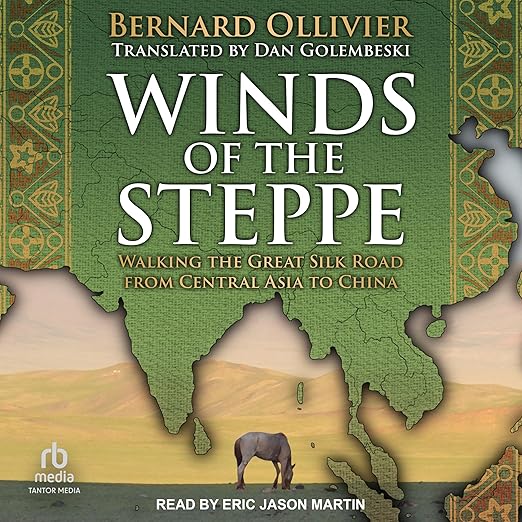
Quick Take
- Narration: Eric Jason Martin handles the meditative, walker pace prose with the right kind of unhurried authority that long-distance travel writing demands.
- Themes: Solitude and encounter, cultural humility, physical endurance as philosophical practice
- Mood: Reflective, occasionally austere, with flashes of warmth in human encounters
- Verdict: The concluding volume of Ollivier Silk Road trilogy rewards those who have read the earlier books most, but remains a genuinely moving account of what it means to walk toward something that keeps receding.
I was halfway through my second cup of coffee on a quiet Tuesday morning when Winds of the Steppe pulled me into the Taklamakan Desert at Ollivier pace, which is to say slowly, deliberately, with no guarantee of shade or company. Bernard Ollivier, the French journalist who walked the entirety of the Silk Road from Istanbul to Xi an in his sixties, published the account of his journey across three volumes. This is the third and final one, covering the Central Asian and Chinese legs of a walk that had already taken him through Turkey, Iran, and Central Asia in the earlier books.
Ollivier is not a young adventurer chasing extremity for its own sake. He was a retired journalist dealing with the grief of his wife death when he began the walk, and that biographical context, which the earlier volumes establish, gives the physical journey its psychological weight. By the time we join him in this volume, threading through the Pamir Mountains and descending into the backstreets of Kashgar, the walk has become something larger than tourism or endurance: it is a sustained act of renegotiating what a life looks like after the shapes that organized it have dissolved.
The Landscape of Central Asia in Audio
The geography Ollivier moves through in this volume is genuinely unfamiliar to most Western listeners. The Tian Shan Mountains, the Taklamakan and Gobi Deserts, the Xinjiang Uyghur Autonomous Region, these are places that appear in news coverage but rarely as places where someone simply walks and watches and talks to the people who live there. Ollivier ground-level encounter with everyday people along the route is the book most consistent strength. He describes the Islamic hospitality of the Central Asian sections with real warmth, the custom of treating travelers as honored guests regardless of origin or language, and contrasts this with the more solitary experience of walking through China, where the cultural and linguistic barriers are higher and the Silk Road infrastructure has largely been absorbed into modern development.
One reviewer noted this explicitly: the China sections are more introspective and lonelier, the human encounters fewer and less intimate. This is not a criticism of the book so much as an honest account of what Ollivier found. Several reviewers describe this volume as the weakest of the three for that reason, while still recommending the trilogy as a whole. The reviewer who said it goes on my Read Again shelf captured what the cumulative experience delivers: not a sequence of dramatic events but a sustained shift in perspective that compounds over thousands of miles and hours of listening.
Walking as a Form of Argument
What Ollivier is quietly arguing throughout the Silk Road trilogy, and what becomes most explicit in this final volume, is that slowness is epistemologically superior to speed when it comes to understanding a place and its people. The traveler who moves through on a train or bus or plane arrives with preconceptions and leaves with impressions; the walker who spends weeks crossing the same terrain in real time is forced into a kind of intimacy with the landscape and its inhabitants that no faster mode of travel can replicate. Ollivier makes this argument not polemically but through accumulation, through the simple record of who he met on a given day and what they ate and what they could not say to each other because of language.
The reviewer who described looking up every location on Google Maps to follow the journey is a useful guide to how to listen to this book: actively, with curiosity, willing to do a little research to give the place names their physical reality. Eric Jason Martin narration supports that kind of engaged listening. His delivery is unhurried, and he handles the French names and Central Asian place names with appropriate care.
Entry Points and Trilogy Context
Winds of the Steppe works best as the concluding volume of the trilogy rather than as a standalone. Reviewers consistently recommend starting with Out of Istanbul and Walking to Samarkand to understand the journey emotional arc and Ollivier character before arriving at this final stage. Read cold, the book is still a rich and unusual piece of travel writing. Read as the conclusion to a journey the listener has been on since Istanbul, it carries the accumulated weight of everything that came before.
Frequently Asked Questions
Do I need to have read the earlier Silk Road books to appreciate Winds of the Steppe?
Reviewers consistently recommend reading Out of Istanbul and Walking to Samarkand first. The emotional and biographical context the earlier books establish deepens this final volume considerably, though it can be read independently as a travel account of Central Asia and China.
How does Winds of the Steppe compare to the other two volumes in the trilogy?
Several reviewers describe this as the weakest of the three, primarily because the China sections are more solitary and introspective than the warmer, people-rich Central Asian legs of the journey. The overall rating remains high, and most series readers found it a satisfying conclusion.
Is this primarily a walking or adventure book, or does it have significant cultural and historical depth?
Both, but the cultural and philosophical dimensions are primary. Ollivier account of Islamic hospitality, Buddhist remnants along the old Silk Road, and the contrast between ancient trade routes and modern China gives the book substantial historical and anthropological texture alongside the personal journey.
Is Winds of the Steppe available as a free audiobook?
Yes, this audiobook is listed at /bin/zsh.00 on Audible for eligible members, making it a free audiobook for qualifying listeners. It runs approximately 12.5 hours and is narrated by Eric Jason Martin.