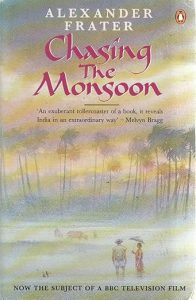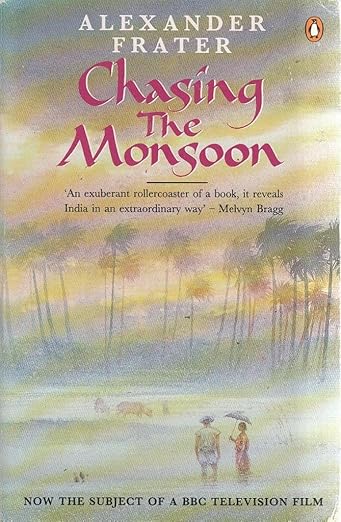
Rain arrives on a schedule in India, and Alexander Frater set out to travel at its speed. Bernard Mayes is the credited reader across eleven hours and thirty-nine minutes of audio, and this audiobook is attached to a listing that otherwise describes a paperback: two hundred and eighty-eight pages, a thirteen-digit ISBN, and a release date of January 1, 1991.
Frater's premise is a calendar rather than a route. The summer monsoon begins enveloping the country from around the twentieth of May, one arm coming from the east and the other from the west, and the two meet over central India around the tenth of July, a date the description says can be calculated to within seven or eight days. He set out to stay sometimes ahead of it and sometimes behind it, watching what the weather does to everyone waiting for it.
Waiting is the real subject of the first stretch. The description hands the meteorologist a crown, calling the weather forecaster king during the anxious weeks before the break, and then reports what happens when the rain finally lands: a joyful period, a run of scandals, a general loosening. That is a stranger and more interesting proposition than a travelogue, and it is the part the written accounts respond to most warmly.
All five written responses carry five stars, which is unusual and worth reading carefully rather than taking as a verdict. Four of them praise the same thing, and they praise it in almost the same terms: the sheer poetry and descriptions, observations of the culture of the monsoon called superb, great descriptions of people and places, and a keen eye for the variations between regions. That is a countable consensus about prose. The reader who called it delightful goes furthest, reporting a wish to hold a formal dress party of the kind the book describes in Bombay, with every guest rushing out into the first rain. That is the sort of thing you only take away from writing that made a scene stick.
What Stands Out
Place names arrive in a dense stream here, and the reading credit belongs to Bernard Mayes. The description alone reaches Bangkok, a cowboy town on the Thai-Malaysian border, Rangoon and Akyab in Burma, plus Bombay in one of the written accounts. A book of this kind lives or dies on whether those names land cleanly, which makes the opening minutes the stretch worth sampling before anything else.
Prose is the reason to take this by ear at all. When four separate readers all reach for description as the thing they liked, they are describing a book whose pleasures are sentence-level rather than structural, and sentence-level pleasure survives the move into speech better than almost anything else. Nothing here depends on a chart, a table or a photograph. It depends on somebody noticing what a Bombay street does when the rain finally comes. The copy promises a joyful period once the break arrives, a spell of promiscuity and a proliferation of scandals, and material like that needs timing rather than illustration to land.
Twenty ratings hold a 4.7 average, and the written record stretches from 2014 to 2025. Eleven years of readers arriving at the same book and saying similar things is a more useful signal than the number itself, because twenty is a small tally that a handful of votes could move. The consistency across that span is what makes the enthusiasm credible. One response, written entirely in capitals, adds nothing analytical and still tells you something about the effect the book has on people.
Things to Know Before Starting Chasing the Monsoon
This page is, on the evidence, a print record with a reader credit bolted onto it. The page count belongs to a paperback. A thirteen-digit ISBN sits in one slot and its ten-digit form sits in the product code, which is what happens when a paperback entry gets reused. Invisible left-to-right marks are embedded inside the publisher and language values. Only a name and a runtime point anywhere near a recording.
Consequences follow straightforwardly. Every account here is a reader's verdict on a paperback, the responses date from 2014 onward, and the 1991 date they sit beneath belongs to a print edition rather than to any audio one. Establish the recording's own date and production before paying, because this listing will not tell you either. Nothing published here identifies who commissioned the audio, when it was made, or whether it covers the complete text.
Somewhere in transcription the description also lost a clause. It reports that the weather forecaster is king, "consulted by pie-crested cockatoos", which reads as copy that was scrambled or truncated on its way onto the page. Small, but it is a reminder that the publisher's summary here has not been checked in a very long time.
A further mismatch is worth flagging. A book sold as an India title spends a good part of its stated itinerary elsewhere, since Bangkok, a border crossing into Malaysia and two stops in Burma all belong to the route as the copy describes it. Weather does not respect a national boundary, so the detour is honest, but a buyer expecting something confined to India should know the route wanders.
Best Suited For
Anyone who has spent time in India, or wants to, will recognize what these readers responded to. One calls the book quintessential India and says it is for people who really love the country or think they might, which is a fair description of its audience. Travelers planning a trip during the rains will find the atmosphere here rather than the logistics, and the difference between those two things is the whole reason to pick this over a guidebook.
Weather itself is the other draw. This is a national drama built around a single meteorological event, with forecasters as public figures and a whole country watching a date, and one written response reaches for the modern context directly, calling it a wonderful book especially now that we are dealing with global warming. A listener who thinks about climate will find the framing lands differently in 2026 than it did on publication.
Skip it if you need current guidance. A journey undertaken for a book published in 1991 is a historical document now, and prices, timetables and place names have all moved on. Readers who want maps, photographs or a route they can follow should buy something built for the purpose. Rain, and the writing about it, is what you are paying for here.
The Short Version
- Performance: Bernard Mayes has the reading credit for a text thick with place names across three countries.
- What it covers: the Indian summer monsoon, waiting and release, travel writing as reportage, weather as public drama.
- Feel: humid, unhurried and quietly funny.
- Our call: superb prose about rain, attached to what is really a 1991 paperback record.
Frequently Asked Questions
Is this audiobook only about India?
No. The monsoon is the subject and India is the center of gravity, but the stated journey also reaches Bangkok, a frontier town between Thailand and Malaysia, and Rangoon and Akyab in Burma. The system itself crosses those borders, so the detours belong, though the map is wider than the title suggests.
Why does this audiobook listing show a page count and an ISBN?
Because the entry appears to have been built from a paperback record and never rebuilt. It carries a print page count, a thirteen-digit ISBN duplicated in ten-digit form as the product code, invisible formatting marks inside two values, and a 1991 date that predates any recording by decades.
How dated does a 1991 travel book feel now?
Dated in practicalities and little else. The reporting on forecasting, on the waiting and on what rain does to a city holds up as social observation. One reader argues it reads more urgently now given the climate. Nobody should use it to plan a route or a budget.