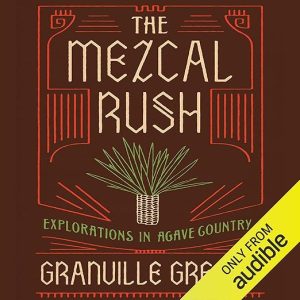
Mezcal bars started appearing in a specific kind of city neighborhood around 2014, and Granville Greene's audiobook The Mezcal Rush is the account of what was happening on the other side of that trend. Narrated by Kevin Free, this eight-hour audiobook asks what the gold rush looks like from the maestros mezcaleros who actually make the spirit, distilling their drinks using local agaves and production techniques passed down across generations in subsistence farming communities, watching their product become a luxury export at a pace their communities had no framework to manage. the maestros mezcaleros who actually made the spirit, distilling their drinks using local agaves and production techniques passed down across generations in subsistence farming communities, were watching their product become a luxury export at a pace their communities had no framework to manage.
Free's narration suits the material well: he reads Greene's prose without forcing false warmth or overstating the pastoral elements, and his pacing gives the community portraits the gravity they deserve. At eight hours and thirteen minutes, Greene has room to operate as a genuine reporter rather than a travel writer in a hurry.
Where This One Lands
Greene is at his strongest when he stays close to the people rather than the product. His time with the maestros mezcaleros produces the book's most compelling passages: the sense of a liquid language celebrating village identity and craftsmanship, as he describes it, that is simultaneously being transformed into a positional good for urban bar programs. The tension is not simple. Greene does not write the communities as victims or the American market as a villain. He is more interested in the complications that arise in the middle ground, and the audiobook is richer for that restraint.
One reviewer praised the book specifically for not reading like promotional copy, which is a real distinction in a genre where spirits writing often tips into breathless enthusiasm for the product itself. Greene never gives you a list of mezcal cocktails. He gives you the story behind why a particular agave variety takes decades to mature before it can be harvested, and what it means for a farmer when a New York bar program pays a premium for it one season and moves on to the next trend the following year. That contrast between the temporal rhythms of traditional agriculture and the cycles of cocktail culture is one of the audiobook's most resonant threads.
Why Listen to The Mezcal Rush
Kevin Free's narration is the reason to choose this over the print version. Greene's writing moves between reportage, cultural history, and personal observation, and Free tracks those shifts cleanly. Spanish place names and the names of agave varieties land without condescension or affectation. For a book that spends considerable time in Oaxacan villages, the sonic texture of the narration matters, and Free delivers a performance that feels engaged rather than mechanical.
The eight-hour runtime also gives Greene room to address the Del Maguey mezcal brand in some depth, particularly in the first half, where one reviewer felt the treatment leaned heavily on that brand's story. Greene does course-correct and broadens his lens as the book progresses, but listeners should know that the early chapters are substantially shaped by what he learned through that specific corner of the mezcal world. For a book positioned as an exploration of a whole tradition, the imbalance is real, even if the writing quality remains high throughout.
The audiobook also works well as a companion to any broader reading about the economics of craft production going global. The mezcal story shares structural features with what happened to artisanal whisky from Scotland and Japan as Asian and American premium spirits markets expanded, and with what happened to natural wine when it moved from niche restaurants to supermarket shelves. Greene does not make those comparisons explicitly, but the audiobook gives listeners enough of the underlying dynamics to draw them independently. That kind of transferable framing is part of what makes The Mezcal Rush worth more than the time it takes to listen.
Greene also uses mezcal's arc as a way into larger questions about authenticity and commodification that extend well beyond spirits. The book's title, with its explicit reference to a gold rush, signals that Greene understands what this kind of market attention does to places and people: it accelerates, it extracts, and it moves on. The maestros mezcaleros he profiles are not antiheroes resisting capitalism, and they are not passive victims of it either. They are navigating an unfamiliar situation with the tools they have, and Greene's reporting gives that navigation the respect it deserves. That framing is what separates The Mezcal Rush from most food writing in this vein.
What Gives Us Pause
The political and cultural framing that Greene brings to the material will not land equally with every listener. A minority of reviewers objected to what they read as ideological coloring in his framing of the export economy and the communities involved. That objection is worth noting without necessarily endorsing. Greene is clearly a writer with a point of view, and the audiobook reflects that. For listeners who prefer their food journalism strictly product-focused and apolitical, the framing may grate. For listeners interested in the human and economic story behind an artisanal industry's encounter with global demand, it is one of the audiobook's genuine strengths.
The book also does not function as a buyer's guide or a tasting primer. Listeners hoping to leave with a curated list of bottles to seek out will be disappointed. The Mezcal Rush is interested in the production side and the community side, not in rating or ranking specific expressions. That is the right scope for what Greene set out to write, but it should calibrate expectations accordingly.
The Right Listener for The Mezcal Rush
Food and travel journalism readers who want something with genuine moral weight behind the reportage will get the most from this audiobook. It pairs well with books like Michael Pollan's work on the food system or Dan Saladino's Eating to Extinction, which share the same interest in what happens to traditional agricultural products under the pressure of global market demand. Mezcal enthusiasts who already know the product well will find the cultural and economic context illuminating. Listeners who want a straightforward spirits education or a regional travel guide will be better served by something else entirely.