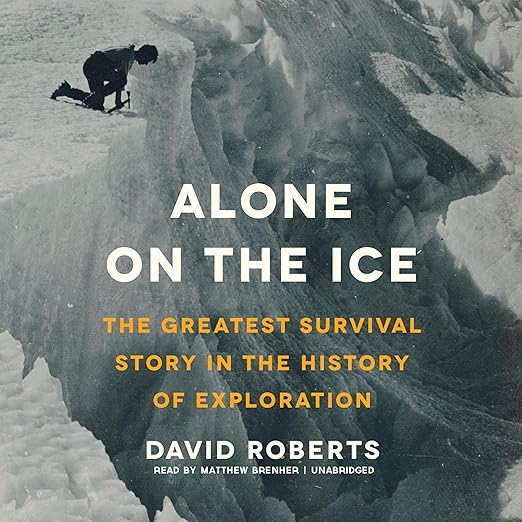
There is a photograph of Douglas Mawson taken when he staggered back into base camp on February 8, 1913. His face is so altered by starvation and scurvy and elemental exposure that the first teammate to reach him reportedly asked, which one are you? He had been presumed dead. He had crawled 100 miles across Antarctic ice, alone, with no dogs, no food, no sledge companions, and the soles of his feet entirely detached from the flesh beneath. He taped them back on and kept moving.
I came to Alone on the Ice after a season of reading polar exploration books, which is a particular kind of reading habit that takes hold of certain people and does not let go. I had read Lansing's Endurance and Huntford's Scott and Amundsen. I thought I understood what Antarctic survival literature could do. Roberts' account of the Australasian Antarctic Expedition of 1911-1914 expanded that understanding considerably.
How Alone on the Ice Holds Up
David Roberts is not just a skilled narrative historian; he is also a mountaineer and adventure writer with a personal stake in extreme survival literature. That shows. He understands what the body does under catastrophic stress, he understands what the mind does, and he understands how to render both in prose that keeps you listening when you know perfectly well the subject survived. The tension in polar survival literature is not will he live, Mawson lived, that is given, it is how, and Roberts answers that question with granular precision.
The book is also an honest account of Mawson's complexity as a leader. He was demanding, expecting from his men the same level of commitment and endurance he gave himself. Some of his men adored him; others found him impossible. Roberts does not sand down the edges. The expedition's extraordinary scientific achievements, it mapped and named significant portions of the Antarctic coast, are given proper weight alongside the drama of the eastern sledging party's collapse.
Why Alone on the Ice Works as an Audiobook
Matthew Brenher's narration is well-calibrated for this kind of history. He reads with authority but without flourish, which is exactly right. The story has enough inherent drama that a narrator who pushes for emotional effect would undercut it. Brenher trusts the material, and the material trusts him back. At nearly 12 hours, the audiobook covers the full context of the expedition, its planning, its scientific mission, the other sledging parties, the wait at base camp, rather than jumping directly to Mawson's solo ordeal, and that context makes the survival sequence hit harder.
Weak Spots in Alone on the Ice
Readers who come expecting wall-to-wall survival drama may need to adjust their expectations in the early hours. Roberts builds the expedition carefully before the eastern party sets out, covering Mawson's background, the Australian geographic context, and the scientific objectives. This is not padding: it is the difference between reading a sequence of extreme events and understanding why those events matter.
The fates of Mawson's two companions, Ninnis and Mertz, are harrowing in ways that the synopsis only hints at. Mertz's death in particular involves a physiological horror that Roberts handles with appropriate gravity. Listeners sensitive to descriptions of extreme physical suffering should be prepared for the middle section.
The Right Listener for Alone on the Ice
This is essential listening for anyone who has found themselves absorbed by polar exploration history. It stands alongside Endurance as required reading in the genre, and in some respects, particularly in its account of individual rather than collective survival, it makes a distinct and important contribution. Roberts has done something significant here in giving Mawson a popular account commensurate with his achievement.
It is also a strong recommendation for listeners who prefer their adventure nonfiction grounded in historical detail rather than sensation. This is careful, rigorous, and emotionally devastating in the way that only true stories can be. You finish it knowing more about what human beings are capable of, and that knowledge is not comfortable, but it is valuable.
Quick Take
- Read by: Matthew Brenher's restrained delivery suits the material precisely, Mawson's ordeal is extraordinary enough without dramatic embellishment.
- At its heart: Human endurance at its absolute limit, the complexity of leadership, Antarctica as ultimate frontier
- Vibe: Gripping and sobering, with the particular quality of true stories that feel like they should be impossible
- Short version: David Roberts makes a compelling case that Douglas Mawson belongs in the same sentence as Shackleton, and after 11 hours you will agree.
A Few Questions About Alone on the Ice
How does Alone on the Ice compare to Endurance by Alfred Lansing?
Both books cover Antarctic survival from the Heroic Age of exploration, but they deal with different expeditions and different kinds of survival. Endurance is a collective story of 28 men keeping each other alive. Alone on the Ice is ultimately about one man surviving alone. Both are exceptional; this one is less well-known and arguably more extreme in its central ordeal.
Is Alone on the Ice primarily about the solo survival, or does it cover the broader expedition?
Roberts covers the entire Australasian Antarctic Expedition of 1911-1914, including its scientific achievements, multiple sledging parties, and the full cast of expedition members. The solo survival is the climactic sequence, but it occupies perhaps the final third of the book. The context makes it land harder.
Does Matthew Brenher's restrained narration style work for an extreme survival story?
Reviewers consistently find that restraint is exactly right for this material. Mawson's ordeal is so inherently extreme that a dramatic narrator would feel like an intrusion. Brenher lets the facts carry the weight, which they do, entirely.