Quick Take
- Big ideas: rural-to-urban migration, exam pressure and class mobility, entrepreneurship during the startup boom, decoupling and divided identity
- Atmosphere: measured and unhurried, closer to reflection than to reportage
- Worth it?: a genuinely useful view of China's rise from inside one ordinary life, delivered by a synthetic voice that the material could have done without.
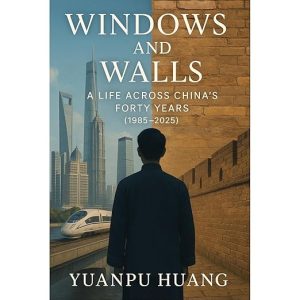
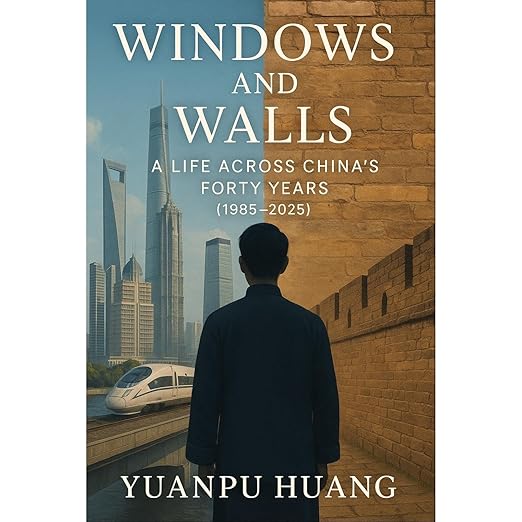
Forty years of Chinese transformation fit inside one life here, and the audiobook walks that life in order across nine hours and thirty-five minutes. Yuanpu Huang was born in 1985, which places a childhood in a mountain village at one end and a research company built during the startup boom at the other, with Beijing universities and the crushing weight of the examination system in between. The book's stated ambition is modest and unusual: not to explain China through slogans or statistics, but through the texture of an ordinary life shaped by extraordinary times.
Windows and Walls, the Same Event Twice
Two nouns of the title carry the organizing structure, and they run in parallel throughout. Windows are the moments of opening: education, mobility, global exchange, individual choice. Walls are what restricts: systems, expectations, borders, class ceilings, and history itself. It is a simple frame and it does real work, because it lets Huang describe the same event twice without contradicting himself. A university place is a window and a wall at once, depending on which side of the examination you were standing on.
Someone posting their first-ever review anywhere found the journey from a small mountain village compelling, describing an ethnic minority 'of no societal or economic advantage' who has 'honestly shared his journey along the sometimes rocky, sometimes fortuitous path to a global presence.' The detail in that account that matters most is the word honestly. This reader specifically credits the book with chronicling 'successes, failures, questioning of his own decisions and choices,' which is the part most memoirs of self-made success quietly omit.
Huang is also explicit about what the book declines to be. Not a political manifesto, and not a celebration of a Chinese miracle. That refusal is what makes it usable: a listener gets opportunity and constraint, ambition and doubt, movement and friction, without being told what conclusion to draw about the country producing them. Restraint of this kind is rarer than it sounds in the genre, where insider accounts of China tend to arrive shaped either as vindication or as indictment, and where the shaping usually happens before the first chapter.
First Person, From a Chinese Source at Last
Point of view is the entire proposition. One reader captures it exactly, noting this was the first time they had read a comprehensive history 'in first person, from a Chinese,' having until then read 'things told by foreigners.' That is a genuine gap in what reaches English-language listeners, where accounts of China's rise are overwhelmingly written by correspondents, analysts and academics looking in. Huang is describing a life he actually lived, and the difference shows in which details he considers worth including.
Chronology helps too. Because the book proceeds in order, from village childhood through examinations, university, early ventures and finally globalization and decoupling, a listener never has to hold competing timelines in mind. That is a real advantage in audio, where a nonlinear memoir becomes hard work fast. Nine and a half hours in strict sequence is about as forgiving a structure as this material could have been given, and the four decades it covers arrive at a steady pace rather than compressed into a highlight reel.
Virtual Voice Struggles Most With Chinese Names
Narration here is synthetic. This listing credits Virtual Voice, meaning the text has been rendered by a text-to-speech system rather than performed by a person, and that decision sits awkwardly beside what this particular book is selling. A memoir trades on the specificity of one voice, and the one thing a generated reading cannot supply is the sound of the person whose life it is. Add a text carrying Chinese place names, personal names and institutional terms, exactly the vocabulary where synthesized pronunciation is least reliable, and you have a production choice a prospective buyer should sample before committing.
Publication timing on this record does not line up either. January 17, 2026 is given as the release date, yet the three earliest responses were all filed before it, one of them back in December. The oldest is a two-line thank-you crediting the book with 'bridging knowledge.' Either reviewers received copies well ahead of publication, or the date field is simply wrong; the page gives you nothing to decide between those. Elsewhere a reader measures this against the author's own first book and finds 'greater depth and more thoughtful analysis,' while the record's series information is entirely blank, so a newcomer is never told an earlier volume exists, let alone whether reading it first would help.
Intimacy Is the Quality Most Exposed Here
Newcomers whose picture of China comes entirely from news coverage will get the most out of this, and one reader says exactly that, describing having long followed the country's rise while never really understanding much about everyday life, and turning to this book specifically to learn about 'the China we never hear about in the United States.' That reader draws a further conclusion, that the two countries' systems seem more alike than different, before that sentence stops mid-thought. It suits listeners interested in class mobility and ambition anywhere too, since the exam pressure and the ceilings translate well past their original setting.
Anybody wanting analysis of Chinese policy, economics or governance should look elsewhere, because this book deliberately stays at the level of one life and never zooms out to the institutional picture. The same goes for listeners who need a clear verdict on the country: the whole design is to let you see rather than to tell you what to think. If a synthesized reading is a dealbreaker for you in memoir specifically, that is a reasonable line to draw here, since intimacy is the quality most exposed by it. Twenty-six ratings is also a thin base for a title published this year, so the headline average is best read as provisional rather than established.
Good to Know
Is the Windows and Walls audiobook read by a human narrator?
No. The listing credits Virtual Voice, an automated text-to-speech narration system rather than a performer. The prose comes through intact, but expect even pacing without interpretive emphasis, and check a sample for how the Chinese names and places are handled before you buy.
Does this audiobook take a political position on China?
It works hard not to. The description rules out both manifesto and miracle narrative, and the book stays with lived experience rather than argument. Readers looking for either a defense or an indictment will find the refusal to supply one either refreshing or frustrating, depending on what they came for.