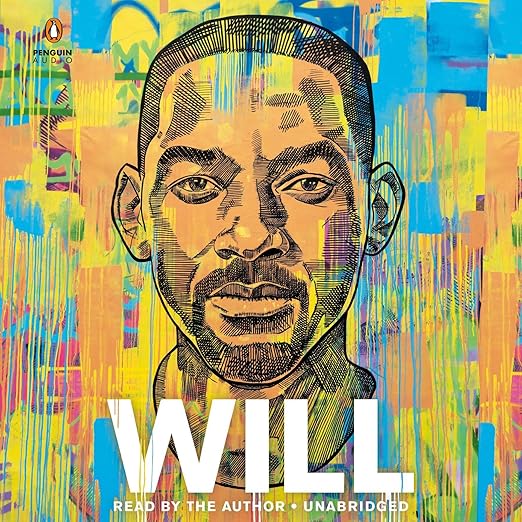
Will Smith narrating his own memoir is not just an authorial choice; it is the product itself. This audiobook works in audio in a way that a third-party narration of the same text would not, and the evidence for that claim is in the production: Smith is performing, pacing, pausing, and shading this material with the awareness of someone who has spent four decades in front of audiences. The memoir's opening argument, that the version of Will Smith the world knows is a character he built, requires his own voice to land with full weight.
Mark Manson's Radical Responsibility Frame
The book moves from West Philadelphia childhood through the rise to rap stardom, into Hollywood's biggest stages, and then into the harder terrain of what Smith calls his education: the ways in which his need to control, perform, and win created a family dynamic that the people closest to him experienced as exhausting rather than inspiring. The collaboration with Mark Manson, whose work on radical responsibility is visible in the book's structural framing, gives the memoir an analytical layer underneath the storytelling. Smith is not simply narrating events; he is accounting for himself in a way that involves genuine admission of failure.
One reviewer described it as an eye-opening and deeply personal account of Will Smith's life, offering an inside look at his rise to fame, his struggles with identity, and the lessons he has learned. Another specifically recommended the audiobook version above the print as the best audiobook he had listened to, noting the production quality and Smith's delivery as the differentiating factors. Oprah Winfrey's blurb, calling it the best memoir she has ever read, establishes the book's literary ambition alongside its entertainment value, and the audiobook delivers on both.
Funny in Childhood, Slow Through the Violence
Smith's narration carries the performance range this material needs. He is funny in the early childhood sections, particularly in his West Philadelphia accounts, without letting the comedy become defensive. He slows significantly in the passages about his parents' relationship and the violence he witnessed as a child, and those modulations are not scripted pauses; they are the genuine weight of the material pulling on the delivery.
The downloadable PDF of music credits accompanies the audiobook, which is a minor but useful companion for listeners who want to trace the musical career being described. At sixteen hours and sixteen minutes, the memoir is long, but the pacing never feels padded. The family material in the later sections, where Smith reckons with what his drive cost the people around him, is the most honest part of the book and the most demanding to listen to. One reviewer noted that the later part of the book is the worst overall, which reads not as a quality judgment but as a comfort one: the later sections ask more of the listener than the entertainment-industry narrative of the first half, and that is the point.
Star Performers in His Own Circus
The shift in register from the first half to the second is deliberate and significant. The first half of the memoir covers the rise, the music career, the television years, the Hollywood ascent, and it carries the energy of someone recounting a genuinely extraordinary series of events with full command of the storytelling. The second half asks harder questions: what did this cost the people around you? Smith's family felt like star performers in his circus, a seven-days-a-week job they had not signed up for. That admission, and the sustained examination of what produced it, is where the book's real value lies.
Listeners who want a celebration of Smith's career without the harder self-examination will find the book only partially satisfying. The Manson-influenced analytical framework means the memoir does not simply describe things that happened; it interprets them in terms of the psychological patterns that drove each phase of Smith's life. Some readers find this layer adds depth; others find it interrupts the storytelling. In audio, Smith's delivery makes the analytical passages feel like natural extensions of the narrative rather than imported commentary, which is an argument for the format over print specifically.
The NAACP Image Award for Outstanding Literary Achievement, alongside Oprah Winfrey's description of it as the best memoir she has ever read, positions Will in the top tier of celebrity memoir by any measure. As an audiobook specifically, it is one of the clearest cases in the genre for why the author's own narration can transform material that would read differently on the page. Smith's voice carries the performance history, the comedic timing, the pauses, and the weight that made his public persona over four decades. Listening to him account for that persona in his own voice is the experience this memoir was built to provide, and sixteen-plus hours is exactly enough time for it to do what it sets out to do.
Why the Self-Narration Outweighs the Print Edition
Listeners who want a celebrity memoir that does not stay in safe territory will find Will Smith's audiobook more honest than most in the genre. The self-narration is the decisive production choice, and listeners who value an author's own voice in memoir specifically should prioritize the audio version over print. Fans of Smith's music and film career will find detailed coverage of the creative and business decisions that shaped each phase.
Listeners interested in the psychological and philosophical dimensions of ambition and its costs will find the Manson-influenced analytical framework a useful addition to the entertainment biography scaffolding. Those seeking an uncomplicated celebration of Smith's achievements will find the book more complicated than they may want. At sixteen hours and sixteen minutes, this is a substantial commitment, and it rewards full attention across the entire arc rather than selective listening to the entertainment-career sections alone.