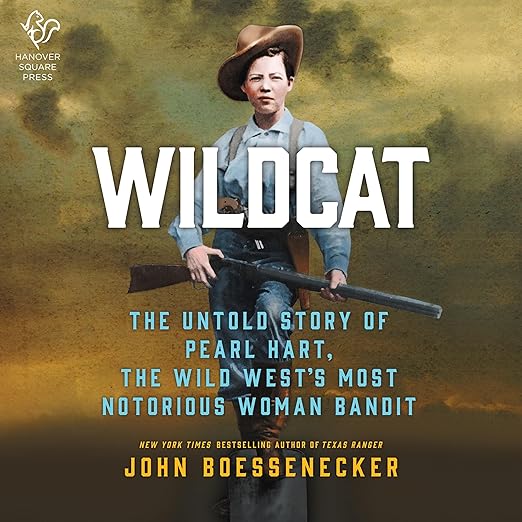
Quick Take
- Narration: Courtney Patterson gives Pearl Hart’s story the period texture it deserves without overdramatizing a subject that is already dramatic enough on its own terms.
- Themes: Female outlawry and survival in the American West, family dysfunction as origin story, myth versus documented history
- Mood: Rigorously researched and narratively engaging, the rare biography that reads like a novel without departing from evidence
- Verdict: Boessenecker delivers the first genuinely sourced account of Pearl Hart’s real identity, and the truth is more interesting than the legend.
I have a weakness for historical biography that does the unglamorous work of excavating who someone actually was beneath the legend that accrued around them. Wildcat caught my attention because the Pearl Hart story seemed obvious, famous female outlaw, stagecoach robbery, media sensation, and I suspected the reality would be more complicated. It was, in ways that made the familiar legend look like a rough sketch over a much more detailed drawing.
On May 30, 1899, Pearl Hart held up a stagecoach in Arizona, disguised as a man, and robbed the passengers at gunpoint. The event made her a media sensation and the most notorious female outlaw on the Western frontier. Her true background, her real name, her family, her life before and after the robbery, had remained genuinely obscure to historians until John Boessenecker conducted the archival research that forms the foundation of this book. Using territorial records, genealogical data, and newspaper archives, he established that Pearl Hart was born Lillie Davy, and that her family’s history is itself a story worth telling at length.
Our Take on Wildcat
The Davy family is the book’s most unexpected subject. Pearl’s siblings lead lives almost as extraordinary as hers, and their shared origin, an abusive, alcoholic father, a childhood organized around survival and petty crime, provides context that the legend of Pearl Hart, the bold female bandit, had always lacked. One reviewer described the family as neighbors from hell and also as a portrait of what survival looks like without adequate external support, which captures both the sensational and the structural dimensions of the account.
Boessenecker is known for rigorous sourcing, reviewers consistently noted the footnoted, certified-fact approach, and that care shows in how the book handles the gap between documented record and popular mythology. He does not write sensationally. He writes carefully, and the care makes the sensational material more rather than less affecting. A reader who investigated Pearl Hart through ancestry.com confirmed independently that Boessenecker’s core findings held up, which is an unusual verification of biographical research from a lay reader and reflects well on the author’s archival work.
Why Listen to Wildcat
Courtney Patterson’s narration manages the period setting without costuming it, the delivery is clear and engaged, giving the archival material room to develop without theatrical ornamentation. At eight hours, the book is compact for a full biography of this scope; Boessenecker moves efficiently without feeling rushed. The sections on Pearl’s media celebrity, how she cultivated her persona after capture, how the press constructed the Bandit Queen narrative around her, are particularly strong and have obvious contemporary resonance.
The American West rarely generates female protagonists who are neither romanticized outlaws nor tragic victims, and Pearl Hart’s story as Boessenecker reconstructs it refuses both categories. She is a specific person with a specific history, and that specificity is what the book is ultimately celebrating.
What to Watch For in Wildcat
Readers who come expecting a swashbuckling Western adventure will need to adjust their expectations. This is biography in the careful, scholarly sense, rigorously sourced, attentive to gaps in the record, honest about what the evidence does and does not establish. The period after Pearl’s release from prison receives less coverage than her earlier life, partly because the record is thinner there, and some listeners have noted wanting more resolution about her later years. The family material is extensive and some readers may find it diverts attention from Pearl herself, though Boessenecker clearly believes, and makes a convincing case, that you cannot understand her without understanding the Davys.
Who Should Listen to Wildcat
History readers with an appetite for well-sourced Western biography, particularly those interested in the intersection of gender, survival, and American mythology. Listeners curious about what the American frontier actually looked like for working-class women will find this more illuminating than most popular treatments. Skip it if you want pure adventure narrative or a romanticized portrait, Boessenecker’s Pearl Hart is complicated and specific, and that is the whole point.
Frequently Asked Questions
How did Boessenecker establish Pearl Hart’s real identity, and how reliable is his research?
He used territorial records, genealogical databases, and newspaper archives. At least one independent reader verified his core finding, that Pearl Hart’s real name was Lillie Davy, through ancestry.com and newspapers.com, which speaks well to the archival reliability.
Does the book cover Pearl Hart’s life after her release from prison?
Yes, but the post-prison years receive less coverage than her earlier life because the documentary record is thinner. Boessenecker is honest about what the evidence establishes and where gaps remain.
How much does the book focus on Pearl’s siblings versus Pearl herself?
Significantly. The Davy family history is a substantial portion of the book. Boessenecker argues, convincingly, that Pearl’s choices and identity are incomprehensible without understanding her family of origin.
Is Wildcat suitable for general history readers or is it aimed primarily at Western history specialists?
General history readers will find it fully accessible. Boessenecker writes engagingly without sacrificing precision, and no specialist knowledge of the American West is required.