Key Details
- Performance: Bernadette Dunne matches Strayed's prose register with precision, direct, occasionally wry, and capable of holding grief and dark comedy in the same passage without collapsing either.
- What it covers: grief and self-dissolution, physical endurance as survival mechanism, the generosity of strangers
- Feel: Raw and specific, with sudden patches of dark humor
- Our call: A memoir that earns its reputation through emotional honesty about the limits of adventure as cure; Dunne's narration is among the stronger performances in the literary memoir audiobook genre.
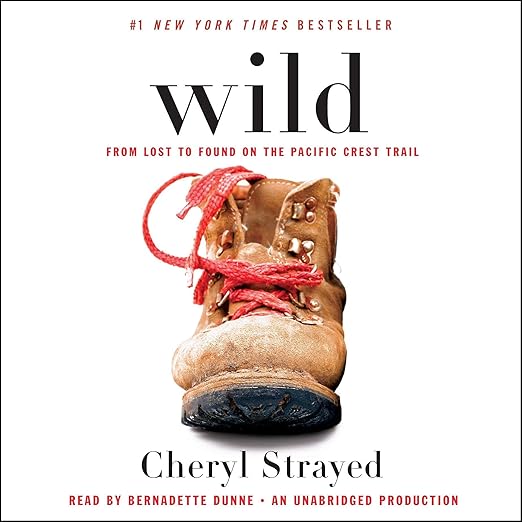
Cheryl Strayed's PCT pack weighed more than she could safely carry, and she hauled it anyway. That piece of information, the oversized pack named Monster, the blisters, the boots thrown off a cliff in rage, arrives early in Wild, and it does something unusual for a memoir: it establishes the protagonist's relationship with her own judgment before she starts making important decisions. I listened to Bernadette Dunne's narration of this audiobook during a period when I was thinking about what grief actually does to a person's sense of scale, and Wild is one of the most precise accounts of that distortion I have encountered in the genre.
Strayed was twenty-two when her mother died of cancer, and the aftermath was not mourning, it was dissolution. The marriage to Paul, the heroin, the series of men, the years of not quite returning to anything. Four years passed between her mother's death and her decision to walk eleven hundred miles of the Pacific Crest Trail alone with no prior long-distance hiking experience. The book does not frame that decision as inspirational. It frames it as the only remaining option in a person who had exhausted other methods of staying alive in a functional sense.
That honesty is what separates Wild from the genre of adventure memoir that uses physical challenge as a metaphor for personal growth. Strayed does not arrive in the Mojave with a therapeutic plan. She arrives overwhelmed, unprepared, and carrying too much weight in every sense the book intends. The PCT does not heal her through scenery and endurance. It heals her, to the extent that healing is the right word, through attrition, through the radical narrowing of concern that extreme physical circumstance produces, and through a succession of strangers who meet her with more generosity than she expects and probably deserves.
Dunne's Pacing Carries Both the Register and the Timeline
Bernadette Dunne's narration is one of the better casting decisions in literary memoir audio. She matches Strayed's prose register, direct, slightly raw, with a humor that surfaces at unexpected moments, without imitating the author's private voice. The Strayed that emerges through Dunne is not a performed version of the public Cheryl Strayed; she is a twenty-two-year-old making very questionable decisions and occasionally noticing the absurdity of her situation. Reviewer Sami described the prose as placing her 'on the trail with boots hurting and snakes nearby', that sensory immediacy comes through in Dunne's pacing, which slows for landscape and quickens for the moments of fear or comedy that punctuate the hiking sequences.
The book's time structure, moving between trail present and the years before it, is handled with more skill in audio than it might read on page. Dunne navigates the flashback sequences with enough tonal distinction that listeners track the temporal shifts without needing visual cues. The mother's illness, the heroin period, and the dissolution of the marriage are each rendered in a register slightly different from the trail narrative, and that differentiation comes from Dunne's performance as much as from Strayed's prose shifts.
She Is Trying Not to Disappear Entirely
The book has attracted readers who want an Oprah Book Club 2.0 experience of personal transcendence, and it is genuinely capable of providing that. But Strayed's more lasting achievement is in not simplifying the emotional math. Reviewer Bryan Carey noted that grief leads people 'to try things they never considered before,' which captures the book's surface movement accurately but undersells what Strayed is after: she is not trying hiking as a grief management strategy. She is trying to not disappear entirely, and hiking is what she lands on. That distinction matters for how you receive the ending, which is more ambiguous than the genre usually permits.
The PCT section through Northern California and Oregon is where the physical narrative becomes most demanding for listeners, as Strayed encounters record snowfall and route-finding challenges that exceed what she prepared for. Those sections test the audiobook's pacing in a useful way: they are slower, more repetitive, and more frightening than the book's other sections, and they are supposed to be. Dunne does not smooth them into adventure highlight reel material, which is the correct call.
The relationship between Strayed's grief and her physical experience on the trail is the book's most carefully observed territory. Strayed is precise about the way sustained physical exhaustion changes the emotional bandwidth available for the grief she has been carrying. It is not that the trail cures her or distracts her. It is that the trail simplifies her emotional calculus down to what is in front of her feet, day after day, until she has enough distance from the worst years to begin looking back at them without being consumed. That is a different psychological proposition from the therapeutic retreat model that the book is sometimes assimilated to, and Bernadette Dunne's narration preserves that distinction clearly.
Listeners who are interested in the Pacific Crest Trail as a physical entity will find Strayed's account useful but unusual. She is not a reliable source for trail conditions or preparation protocols, which is partly the point. Her incompetence is documented rather than concealed, and the comedy of her spectacularly inadequate pack preparation sits alongside the genuine danger she encountered in the snowfields of Northern California. Both the comedy and the danger are real, and the audiobook earns its Oprah selection by refusing to clean up the mess into something more conventionally inspirational.
A Specific Trail, a Specific Grief, a Specific Person
Listeners who respond to memoir that earns its emotional territory through specific detail rather than general reflection will find Wild genuinely rewarding. It is not a book about the lesson the trail teaches; it is a book about a specific trail, a specific grief, and a specific person navigating both. That specificity is what has made it last beyond its Oprah Book Club moment.
Readers who want a straightforward inspirational arc, challenge confronted, weakness overcome, lesson learned, may find Wild's honesty about the limits of that narrative more uncomfortable than satisfying. The book does not end with Strayed transformed into someone who has her life together. It ends with someone who has survived long enough to begin finding out who she is, which is a more credible and more interesting conclusion.
Good to Know
Does Bernadette Dunne's narration of Wild capture Cheryl Strayed's voice accurately?
Dunne does not attempt to impersonate Strayed; she translates the prose into a performance that matches its register. Listeners who have heard Strayed speak in interviews will notice it is not the same voice, but the emotional accuracy is high. The narration serves the writing rather than competing with it.
Is this audiobook suitable for someone who has never hiked the Pacific Crest Trail or read trail memoirs?
Yes. Wild is not primarily a hiking book; it is a grief memoir that happens to take place on a trail. No prior outdoor experience or PCT knowledge is needed to follow or feel the story. The physical challenges are described in terms accessible to any listener.
How does the Wild audiobook handle the timeline shifts between trail narrative and backstory?
Dunne uses tonal differentiation to mark the flashback sequences, giving them a slightly different emotional weight than the trail present. Listeners track the temporal structure through her performance without needing chapter markers or visual anchors.