Quick Take
- Narration: Chloe Cannon brings genuine warmth and comedic timing to Roberts’s double coming-of-age story, handling both the Botswana sequences and the Philadelphia school scenes with equal conviction.
- Themes: belonging, cultural identity, childhood in the wild
- Mood: Funny, tender, and occasionally heartbreaking
- Verdict: A beautifully observed memoir about growing up between two utterly incompatible worlds, the African wilderness and the elite American middle school.
I was halfway through a long train ride when I started Wild Life, and I missed my stop. Keena Roberts has written one of those memoirs that makes you forget you are sitting in a commuter car, partly because Botswana is so vividly rendered that it crowds out the present, and partly because the private school section in Philadelphia is so accurately observed that it made me wince in recognition even though my own adolescence bore no resemblance to hers.
Roberts’s childhood was genuinely unusual in a way that rewards the prose it takes to describe it. Her parents were primatologists who spent half the year studying baboon colonies on an island camp in Botswana, bringing their daughters with them. The other half of the year was spent in Philadelphia, where Keena attended an elite private school with students whose version of wilderness was the social hierarchy of the lunch table. The structural contrast between these two worlds, one physically dangerous and emotionally free, the other physically safe and socially treacherous, is the engine of the entire book.
Our Take on Wild Life
What makes this more than a novelty memoir is Roberts’s quality of observation. She is not simply exoticizing her unusual childhood or playing up the fish-out-of-water comedy for easy laughs (though there is genuine comedy here, she is funny in a dry, self-aware way). She is actually thinking about what the contrast between these two worlds illuminates: what belonging means, how competence is defined differently in different environments, and why a kid who can change a truck tire and track a lion by its spoor might be completely undone by middle school field hockey culture.
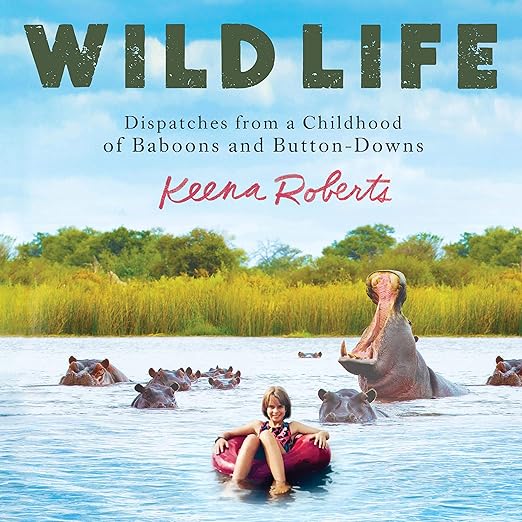
The Botswana sections are extraordinary. Roberts describes the island camp with the kind of physical precision that can only come from embodied memory, the smell of the dust, the sound of hippos at night, the specific weight of a spear. She writes about the baboon colony her parents studied with obvious affection and scientific respect, and those sections have a quality that reminds me of Gerald Durrell in their ability to make animals feel like full characters in the narrative. The comparison to Don’t Let’s Go to the Dogs Tonight in the synopsis is apt, both books are about children navigating African landscapes with unusual parents, though Roberts’s voice is lighter and more comedic than Fuller’s.
Why Listen to Wild Life
Chloe Cannon’s narration is an excellent match for the material. She handles the tonal shifts between the Botswana sections, often lyrical, occasionally frightening, full of specific natural detail, and the Philadelphia sections, dryer, more ironic, occasionally devastating, without overcorrecting in either direction. The comedic timing in the school sections feels natural rather than performed, and the more emotionally tender passages are given appropriate space. At nine hours and forty-two minutes, this is a comfortable length for the material, long enough to develop the world fully, short enough that the pace never drags.
Several reviewers mention the memoir’s clarity of voice as one of its defining strengths, and that is accurate. Roberts does not overwrite, the sentences are clean and specific, and the episodic structure of the book (each chapter tends to center on a particular moment or encounter) suits the audio format well. You are never lost, and the chapters have enough self-contained shape that the book works well in shorter listening sessions too.
What to Watch For in Wild Life
A note for parents considering this for family listening: there are sequences involving animal danger, encounters with lions, elephants, and hippos, that are vivid enough to be genuinely tense. Roberts is also candid about the emotional difficulty of the school years, including bullying, isolation, and the particular cruelty of middle school social exclusion. Neither category is traumatic in the way some memoirs are, but parents of younger children may want to preview those sections.
The memoir ends somewhat open, as memoirs about adolescence often do. Roberts is not yet at a place where she has fully resolved the tension between her two worlds, the book captures a formation rather than a conclusion. Some readers may want more resolution than the ending provides, though I found the openness honest and appropriate to the material.
Who Should Listen to Wild Life
Readers who loved Alexandra Fuller’s Botswana memoirs, Delia Owens’s nature writing, or coming-of-age accounts that take environment seriously as a shaping force will find this deeply satisfying. It is also a strong recommendation for anyone who has ever felt genuinely out of place, Roberts’s account of negotiating incompatible identities resonates well beyond her specific circumstances. The audiobook is a particularly good format for this one because Cannon’s narration preserves the spoken quality of Roberts’s voice throughout.
You might approach with lower expectations if you are looking for sustained dramatic tension, this is a memoir of ordinary days that happen to be set in extraordinary places, and some chapters are quieter than others. But the writing throughout is strong enough to sustain the calmer passages.
Frequently Asked Questions
Is Wild Life appropriate for younger readers, given that it is a childhood memoir?
The memoir deals with topics including animal encounters involving real danger, middle school bullying and social cruelty, and the loneliness of adolescence. These themes are handled with sensitivity rather than gratuitousness, but parents of younger children should be aware that some sequences are emotionally intense. It is written for an adult audience reflecting on childhood rather than as a children’s or YA book.
How much of Wild Life is set in Botswana versus Philadelphia, and which sections are stronger?
The book alternates roughly equally between the two settings, mirroring the structure of Roberts’s actual life. Most reviewers find the Botswana sections more vivid and lyrical, while the Philadelphia sections provide the comedic and emotional contrast that gives the book its energy. The memoir’s power comes from holding both worlds simultaneously rather than privileging one.
Is prior knowledge of Botswana or primatology needed to appreciate the wildlife and camp sections?
None at all. Roberts explains the context of her parents’ baboon research naturally as part of the narrative, and the wildlife descriptions are accessible and sensory rather than scientific. The book treats the natural world as experiential rather than academic, which means readers with no background in either Africa or primatology will find those sections fully navigable.
How does Chloe Cannon’s narration handle the shifts between humor and more emotional content?
Cannon manages the tonal range well. The dry, self-aware comedy of the Philadelphia sections and the more lyrical, sometimes frightening quality of the Botswana sequences require different registers, and she moves between them without jarring transitions. Multiple reviewers describe the narration as a strong element of the listening experience.