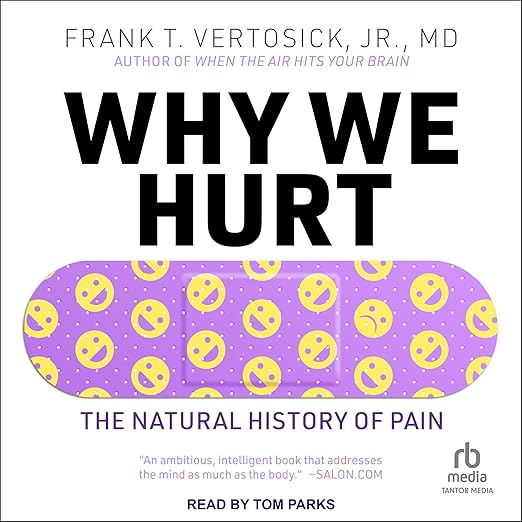
Quick Take
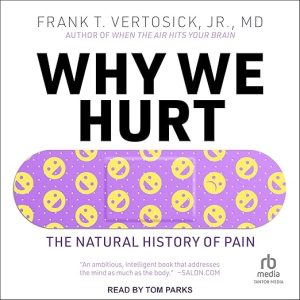
- Narration: Tom Parks handles Vertosick’s anecdote-driven prose with warmth and clarity, a good match for a book that blends clinical explanation with personal story.
- Themes: The evolutionary function of pain, chronic pain syndromes, the limits of medical knowledge
- Mood: Intellectually curious and humanizing, with a thread of personal vulnerability throughout
- Verdict: A physician’s meditation on pain that holds up well, honest about medicine’s failures, accessible without being simplistic, and more philosophically interesting than most books in this space.
I first heard about Why We Hurt from a physiotherapist who recommended it to a patient asking why her chronic migraines weren’t responding to treatment. That is an unusual pathway to a book, and it says something about the kind of work Frank Vertosick has done here. This is not a self-help book about managing pain, and it is not a medical textbook about pain mechanisms. It is something harder to categorize: a neurosurgeon’s sustained, humane attempt to explain why pain exists at all, using his own severe migraines as an entry point and the cases of his patients as the through-line.
The book begins with Vertosick’s own experience of migraine, not as a rhetorical device to manufacture relatability, but as a genuine puzzlement. Here is a surgeon who operates on brains for a living, and he cannot explain why his own head turns against him with such regularity and ferocity. That productive discomfort between expert knowledge and lived experience animates the entire book.
Pain as Evolutionary Logic
Vertosick’s central argument is that pain is not a malfunction but a feature, an evolutionary system that has served biological organisms well over millions of years and that we misread when we treat it purely as a problem to be eliminated. Each chapter approaches a different pain syndrome: back pain, angina, cancer pain, arthritis, carpal tunnel, migraines, and others. In each case, Vertosick excavates the evolutionary function that underlies the syndrome, even when that function is essentially obsolete in modern bodies. The argument is not that you should be grateful for your chronic pain. It is that understanding why you hurt changes how you relate to the hurting.
One reviewer quoted the Seattle Times calling this an investigation of what it means to be human, which sounds like jacket copy but is genuinely apt. Vertosick keeps returning to the question of why a nervous system that evolved for survival produces suffering that does nothing to protect us once the underlying damage is established. The gap between the signal’s purpose and the signal’s experience is where most of the interesting thinking happens.
The Anecdotal Architecture That Actually Works
The book is structured around case studies, which is a format that medical writing often gets wrong, either the cases become clinical and bloodless, or they become manipulatively emotional. Vertosick threads this needle by being genuinely specific. His patients are not types; they are people with particular histories and particular ways of being in pain. One reviewer mentions reading sections aloud to an eight-year-old child who suffers from migraines, which is a striking testament to how accessible the prose is without being dumbed down. Tom Parks’s narration captures this accessibility; his delivery is warm without being cozy, attentive to the clinical detail without sounding like a lecture.
Where the Book Shows Its Age
Why We Hurt was published in the early 2000s, and some of the treatment discussions reflect what was known then rather than now. Pain science has moved significantly since Vertosick wrote this, the centralized sensitization model, the role of neuroplastic pain, the reconceptualization of chronic pain as a condition of the nervous system rather than strictly of tissue damage have all been substantially developed in the intervening years. Listeners who have encountered the more recent research on pain neuroscience education will find some sections familiar and may wish for engagement with those frameworks. That said, the evolutionary and philosophical core of the book holds up well, and the case studies are not time-stamped in the same way the treatment sections are.
Who Will Get the Most from This
Anyone living with chronic pain who wants a framework for understanding it that is neither purely biomedical nor purely psychosomatic will find Vertosick’s approach genuinely useful. Healthcare professionals looking for a literate, non-technical account to recommend to patients are well served here. Readers interested in the philosophy of medicine, why we know what we know, and what we still cannot explain, will appreciate the intellectual honesty throughout. If you have already read extensively in pain neuroscience, some sections will feel dated, but the core argument about pain’s evolutionary function remains worth your time.
Frequently Asked Questions
Is this book primarily for people with chronic pain, or does it work as straight medical science reading for those not personally affected?
Both audiences are well served. The case-study structure gives people with chronic pain something to recognize themselves in, but the evolutionary and philosophical arguments are genuinely interesting independent of personal experience with pain.
How does Why We Hurt compare to more recent pain science books like The Way Out by Alan Gordon?
Vertosick’s book predates the neuroplastic pain model that underlies books like The Way Out, so the explanatory framework is different. Why We Hurt focuses on evolutionary biology and specific pain syndromes rather than central sensitization theory. The two approaches complement each other rather than competing.
Does Tom Parks’s narration handle the medical terminology smoothly, or does it create friction for clinical terms?
Parks handles clinical language comfortably without sounding like he is reading a textbook. The balance between warmth and precision is well-calibrated for Vertosick’s prose style.
Are the treatment recommendations in the book still current, given it was written over two decades ago?
Some treatment information reflects the state of knowledge from the early 2000s and has been superseded. The evolutionary arguments and case-based observations hold up well, but listeners should not treat the clinical recommendations as current medical guidance.