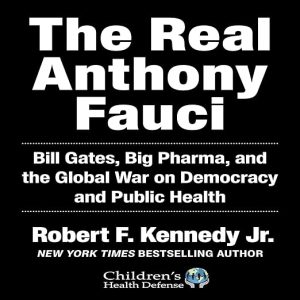
Twenty-seven hours and twenty minutes is an unusual amount of audiobook to build out of a single argument, and Robert F. Kennedy Jr. uses all of it. The description promises a story that obliterates media spin on Anthony Fauci; what arrives is a prosecution brief, running from the early AIDS crisis through what the copy calls a $60 billion global vaccine enterprise to the censorship of pandemic dissent, with Bruce Wagner credited across the whole span. The scale is the first fact a buyer needs, ahead of anything else on the page.
Kennedy's method is accumulation. The description sets out the machinery before it names a single allegation: as director of the National Institute of Allergy and Infectious Diseases, Fauci dispenses $6.1 billion in annual taxpayer-provided funding, which the book argues lets him dictate the subject, content and outcome of health research across the globe, and to ruin, advance or reward the careers it touches. From there it turns to specifics, chief among them that Fauci launched his career by partnering with pharmaceutical companies against off-patent AIDS therapies, orchestrated fraudulent studies, and pressured regulators into approving a treatment he had good reason to know was worthless. Those are the book's claims, in the book's own words, and they are why the runtime is what it is.
Whatever your position going in, one structural question stands: is a case this long strengthened by its own volume, or diluted by it? The copy's answer is that more than a year of painstaking and meticulous research sits behind it. The practical answer for a listener is that a runtime of this size, spent on citation-dense allegation, is a very different experience from reading the same material, because you cannot skim, cannot check a note as it passes, and cannot flip back to see whether a name has already appeared. That is the central format tension here, and conviction about the subject does not resolve it.
Bruce Wagner's Full Day of Sustained Accusation
Endurance is the assignment Bruce Wagner has taken on, and it is worth describing precisely. This is a text of institutions, agency acronyms, dollar figures, drug names and dates, delivered in a register of sustained accusation for more than a full day of audio. Material like that has two failure modes: flatten it and the thing becomes unlistenable, press it and the book stops sounding like reporting and starts sounding like a broadcast. Cue up a stretch where the funding figures come thick and see whether the numbers stay separable from the adjectives around them, because that is the seam where a book of this kind is won or lost.
One five-star, filed in January 2023, describes the book as reaffirming suspicions the writer already held about big pharma and its influence, then adds that the issues go way deeper than had been imagined. That entry is the clearest available statement of what this book does for the audience it was written for: it does not convert anybody, it extends what they already suspect. It also volunteers a concession worth noticing, allowing that the government might genuinely have believed the pandemic could be worse than it proved and acted accordingly, before that entry breaks off mid-thought. Listeners arriving already skeptical will find the whole span organized to confirm and enlarge that skepticism.
Five or Six Stars Nobody Explains Away
Stars are the first oddity on this record. Twenty-seven ratings displaying 4.8 can only total 129 or 130 out of a possible 135, so five or six stars have been withheld by people who left no explanation behind them. Every one of the five visible grades is a five, which puts the entire deduction among the ratings nobody can read. Whether all five written entries even feed that counter is unknowable from this page, since two of them were filed in other countries, so read the arithmetic as a description of the tally rather than of the writers underneath it.
Two things can be true of a book like this, and one entry says so with unusual honesty. A separate five-star, this one from January 2022, calls the experience disturbing on its own terms, reports that it incites anger and distrust of the most basic and venerated institutions and of the public officials who staff them, and then admits the difficulty: the writer cannot decide how much of it to accept. A top grade attached to unresolved doubt is the entry a buyer trying to calibrate should read first. Believing the machinery exists is not the same thing as accepting every allegation made about it.
Filing is the other thing worth flagging. This record sits under health and wellness and under science and engineering, which is where somebody looking for a book about immunology would land, and that is not what this is: it is advocacy journalism with a named target, and the description says so in its first two sentences. The reader column carries its own oddity. Two of the five entries were written in languages other than English, one from Italy recommending the book be taken in small doses and naming two other titles alongside it, one from Japan running to a single phrase of approval, both folded into an English-language average.
Built for Readers Who Already Want the Prosecution
Buy it if you have already concluded that the institutional account of American public health deserves an adversarial reading, and you want the longest and most heavily sourced version of that reading available in audio. It was written for readers who suspect the machinery and want that machinery documented: funding flows, regulatory relationships, the traffic between agencies and the companies they oversee. It rewards patience and note-taking, it assumes a tolerance for accusation as a default register, and it was never built to be dipped into.
Neutral history is not on offer, and the copy never pretends otherwise. Anyone wanting a balanced account of the pandemic, of AIDS-era drug approval, or of Anthony Fauci's career should look elsewhere, because this is a case for the prosecution and it argues like one. The same caution applies to listeners who need to verify as they go, since the record attaches no source list or companion file to the audio and the running time makes checking anything genuinely laborious. Stepping outside the argument while it runs is not something this edition makes possible.
Quick Take
- Performance: Bruce Wagner is the only voice across a text of acronyms, dollar figures and drug names, so stamina rather than character work is what you are buying.
- What it covers: pharmaceutical funding and regulatory capture, AIDS-era drug approvals, censorship of pandemic dissent
- Feel: Relentless, prosecutorial, exhausting by design
- Our call: Take it as the fullest version of one side of an argument, never as a history of the pandemic.
How long is The Real Anthony Fauci audiobook, and can it be taken in sections?
Twenty-seven hours and twenty minutes, and sections are the only sane approach. Its case runs roughly in order of events, beginning with AIDS-era drug approvals, passing through the handshake with Bill Gates the description places in early 2000, and closing on pandemic media control, so the material divides naturally even without a chapter guide.
Does the audiobook include the book's source notes or a companion PDF?
Nothing on this record mentions either. Skyhorse Publishing is the publisher of record and the listing offers audio alone, so a listener wanting to check a claim as it passes has no attached apparatus to check it against. For a book built on documentation, that is a real limitation.
Who reads the recording, and does Robert F. Kennedy Jr. narrate it himself?
Bruce Wagner is the credited reader, and Kennedy does not voice his own book here. For a text written from the position of an investigator, that puts a professional distance between the accusations and the voice making them, which some listeners will prefer and others will find strange.