Quick Take
- Narration: Michael Greger narrates his own work with the rapid, data-dense delivery of a man who has given this presentation at hundreds of lectures, the pace rewards active listening and punishes distraction.
- Themes: Disease prevention through whole-food nutrition, the gap between clinical practice and nutritional science, plant-centered eating as evidence-based medicine
- Mood: Urgent and encyclopedic, like a very long and very well-researched conversation with a doctor who genuinely wants to prevent your illness
- Verdict: The most comprehensive evidence-based case for plant-centered eating currently available in audio, most valuable for listeners willing to engage actively with nearly 19 hours of densely researched material.
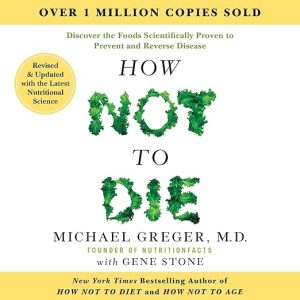
There are books you pick up with the vague intention of skimming for useful bits, and then there are books that refuse that approach. How Not to Die is firmly the second kind. I started it on a long train journey and found myself scribbling notes on my phone for the first time in months, not because Greger is a stylistically elegant writer, he is not particularly, but because the density of specific, referenced claims keeps demanding a response. The updated and revised edition adds material that makes the original argument, already substantial, considerably harder to dismiss.
Michael Greger, a physician and the founder of NutritionFacts.org, has spent his career doing something relatively rare in the medical world: reading the primary nutrition research and synthesizing it for a general audience. The result here is a book organized around the fifteen leading causes of disease-related death in America, each receiving its own chapter, with Greger walking through what the research shows about nutritional and lifestyle intervention for each. Heart disease, various cancers, Alzheimer’s, diabetes, Parkinson’s, all get the same treatment.
Organized by Cause of Death, Not by Dietary Rule
The structural choice to organize by disease rather than by dietary principle is significant and underappreciated. It means the book is not asking you to accept a general claim about plant-based eating and then trust the implementation. It is asking you to look at each major cause of early death individually and consider what the evidence shows about prevention. Reviewer Grady Harp, who noted that Greger serves as Director of Public Health and Animal Agriculture at the Humane Society, flagged this evidential approach as the book’s central strength. The argument accumulates through specificity rather than persuasion.
Greger’s self-narration is a point of genuine interest. He reads with the compressed energy of someone who has spent years giving these presentations, and his pace is fast, often faster than you expect. At just under nineteen hours, this is not a background-listening audiobook. The reviewer who noted watching his PBS lectures confirms that the audiobook version carries the same lecture-hall quality: data-dense, conviction-forward, but accessible enough that non-scientists can follow the argument.
What the Revised Edition Changes
The updated edition adds a new chapter on the gut microbiome and its relationship to systemic inflammation, updated supplementation recommendations, and a chapter addressing how media coverage, or the lack of it, shapes public nutritional understanding. That last addition is more polemical than the rest of the book, but it is honest about its nature. Greger is not pretending to be neutral about the food industry’s influence on nutritional research funding. The new material on high blood sugar, obesity, and chronic inflammation as addressable risk factors strengthens the book’s practical utility.
One of the reviews in the metadata is in Portuguese, noting the book’s emphasis on whole foods over animal products and refined ingredients. That international reach is some indication of the consistency of Greger’s core message across cultural contexts.
The Productive Tension in the Argument
The book’s weakness is also part of its strength. Greger is advocating for a position, a whole-food plant-based diet as the best evidence-based intervention for most of these conditions, and the advocacy shapes which studies get foregrounded. This is not dishonest, but it means the audiobook is most useful when paired with a critical reader who checks the citations rather than treating it as a final word. Greger acknowledges counter-evidence, but he interprets it consistently in the direction of his thesis.
For context, this sits at the stronger, more prescriptive end of the evidence-based nutrition spectrum compared to Masley’s 30-Day Heart Tune-Up, which advocates for a plant-rich but not plant-exclusive approach. Both are doing serious work; they simply make different interpretive choices about the same literature.
Who Should Listen and Who Should Skip
Anyone with a family history of cardiovascular disease, cancer, or diabetes who wants the most thorough nutritional case currently available in audio format should start here. The 18-plus-hour runtime is the correct length for the scope of the argument: do not look for an abridged version. Skip it if you want practical program guidance rather than evidence synthesis, or if dense research summaries delivered at lecture pace do not hold your attention for long stretches.
Frequently Asked Questions
Does the revised edition of How Not to Die substantially update the original, or are the additions minor?
The additions are meaningful. The gut microbiome chapter reflects significant research developments since the original publication, and the updated risk-factor guidance on blood sugar and obesity connects more explicitly to recent nutritional science. The revised edition is worth choosing over the original.
How does Greger’s self-narration affect the listening experience over nearly 19 hours?
Greger reads quickly and without much vocal variation, which suits his lecturing style but demands sustained active attention. This is not a book that works well as ambient audio. Listeners familiar with his NutritionFacts.org videos will find the audiobook delivery consistent with that format.
Is the book primarily about plant-based eating, or does it cover other lifestyle factors?
Both. The dietary section is the most substantial, but each of the fifteen disease chapters also covers exercise, sleep, stress, and other lifestyle variables relevant to that specific condition. The diet-centeredness reflects Greger’s primary expertise and research focus.
How does How Not to Die relate to The China Study in terms of argument and evidence?
Greger’s position is broadly consistent with Campbell’s findings regarding the risks of high animal protein consumption, and he cites similar literature. His treatment is more granular and disease-specific rather than sweeping, which gives the argument a different texture than Campbell’s longitudinal study framing. The two books read well together.