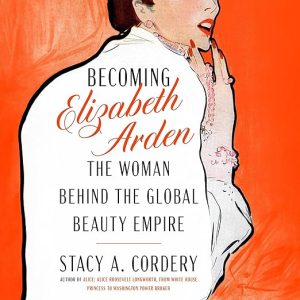
Stacy A. Cordery opens Becoming Elizabeth Arden with a woman who did not yet exist. Florence Nightingale Graham, born in rural Ontario to a Scottish immigrant family, would eventually rename herself after the street her first salon occupied and a Tennyson poem. She built a cosmetics empire that outlasted her, transformed the beauty industry, and made her a millionaire several times over before most of her female contemporaries had won the right to vote. The biography's central task, charting that transformation with the rigor it deserves, is handled with care. Tavia Gilbert's narration gives this long audiobook the pacing it needs to sustain nearly fifteen hours.
Tavia Gilbert Carries a Rags-to-Riches Arc
Cordery is an acclaimed biographer, and the research density here is considerable. The sourcing reaches into correspondence, business records, and period journalism to reconstruct not just what Arden did but how she was perceived: by competitors, by clients, by the press, and by the women who worked for her in conditions that the biography does not romanticize. Arden was a demanding employer with particular views about loyalty and presentation, and Cordery is honest about the gap between Arden's public championing of women's capability and her private behavior as a manager and employer across her long career.
The rags-to-riches arc is genuinely extraordinary. Arden arrived in New York with no formal training and limited capital, developed her skincare approach through self-education and observation, and built her first salon on Fifth Avenue through a combination of audacious credit management and acute perception of what wealthy women wanted and were not yet being offered. The early business chapters are among the strongest in the biography, because the problem-solving is so specific and the obstacles are so concrete. Arden in these sections reads like a case study in applied intelligence rather than a mythologized founder.
Tavia Gilbert is a skilled narrator who brings Elizabeth Arden to life across the full arc of her career. At nearly fifteen hours, the biography requires a narrator who can maintain listener engagement through the administrative and financial sections that necessarily accompany any serious business history. Gilbert handles these without making them feel like duty reading, which is no small achievement given the volume of detail Cordery provides throughout the text.
Thoroughbreds and the Business of Beauty
The historical context is one of the biography's most valuable contributions. Arden's career spans two World Wars, the Great Depression, the suffragette movement, the rise of Hollywood as a cultural force, and the transformation of cosmetics from a product associated with disrepute to one embraced across social classes. Cordery threads all of these contexts through Arden's specific business decisions, which means the biography illuminates the period as much as the woman. The decision to open a spa that treated health and beauty as integrated rather than separate was not just a business move; it was a philosophical claim about women's bodies and their care that was genuinely radical in the early twentieth century.
The horse racing subplot, which occupies a significant portion of the later sections, is one of the more surprising dimensions of Arden's life. She bred and raced thoroughbreds with the same obsessive attention to detail she brought to her cosmetics formulations, and her horses won significant races. Cordery is good at showing how the competitive drive and the brand management instincts were the same personality operating in different arenas. One reviewer who praised the biography highlighted the horse racing sections specifically as evidence of Arden's inventiveness and remarkable range across domains.
Florence Graham's Persona Outlasts the Private Woman
The mixed reviews are worth taking seriously. The biography is meticulous and comprehensive, but that comprehensiveness comes at a cost: the private interior life of Elizabeth Arden remains somewhat opaque even at fifteen hours. Cordery can document what Arden did and how others perceived her, but the woman herself: her inner emotional life, her self-understanding, her private relationship to the persona she constructed, remains elusive. This is partly because Arden was a deliberate and disciplined self-concealer; it is also a genuine limitation of the biographical sources available to the author.
The later career sections, which cover Arden's management of the business through the postwar period and into the 1960s, are necessarily less dramatic than the founding chapters. The obstacles are different: competitive pressures from Helena Rubinstein, the changing retail landscape, the challenge of maintaining brand relevance across decades. Cordery covers them with the same rigor, but the pacing in these sections is slower. Listeners who found themselves most engaged by the early entrepreneurial material may find the late-career chapters require more patience than the earlier ones.
The Arden story is, at its core, a story about the construction of identity as a competitive advantage. Florence Graham didn't just build a business; she built a persona and then merged with it so completely that the original self became inaccessible even to biographers with full archival access. That is an extraordinary human achievement on its own terms, whatever you think of the products she sold or the methods she used to sell them. Cordery captures the achievement without entirely capturing the woman, which is the honest outcome of working with the sources available.
American Business History Fans Will Appreciate This
Listeners interested in American business history, women's history, and the specific evolution of the beauty industry will find this audiobook rich and well-researched. Tavia Gilbert's narration makes the length manageable. Those seeking an intimate psychological portrait of Arden as a private individual will find the biography stronger on external documentation than on inner life, which is a legitimate reason to adjust expectations before starting. The nearly fifteen-hour runtime is a significant commitment, best suited to listeners who appreciate comprehensive biographical research and are interested in the period as much as the person. Casual readers looking for a quicker narrative would be better served by a shorter profile of Arden's life.
Key Details
- Performance: Tavia Gilbert delivers a skilled, engaging reading across nearly fifteen hours - she makes the administrative and financial sections as listenable as the dramatic ones.
- What it covers: entrepreneurship before the women's vote, the reinvention of personal identity, beauty as both commerce and cultural politics
- Feel: Dense and methodical - richly researched, better suited to committed biography listeners than casual ones
- Our call: A thorough, well-narrated biography that excels at business history but leaves Arden's inner life somewhat at arm's length.
Frequently Asked Questions
Is the Becoming Elizabeth Arden audiobook narrated well given its nearly 15-hour length?
Yes. Tavia Gilbert is a skilled narrator who maintains consistent pacing and character differentiation across the full runtime. The biographical material includes significant administrative and financial detail, and Gilbert keeps those sections engaging rather than perfunctory.
Does this audiobook cover the personal side of Elizabeth Arden's life, or is it primarily a business history?
Primarily a business history. Cordery is thorough on Arden's professional decisions, her business methods, and her public persona, but the private interior life is less accessible. Arden was a deliberate self-concealer, and the biographical sources focus largely on the external record.
Does the Becoming Elizabeth Arden audiobook address her rivalry with Helena Rubinstein?
Yes, the competitive relationship with Helena Rubinstein is covered, particularly in the later career sections. The rivalry shaped both businesses and is a recurring element in the biography's account of how the American cosmetics industry developed across the mid-twentieth century.