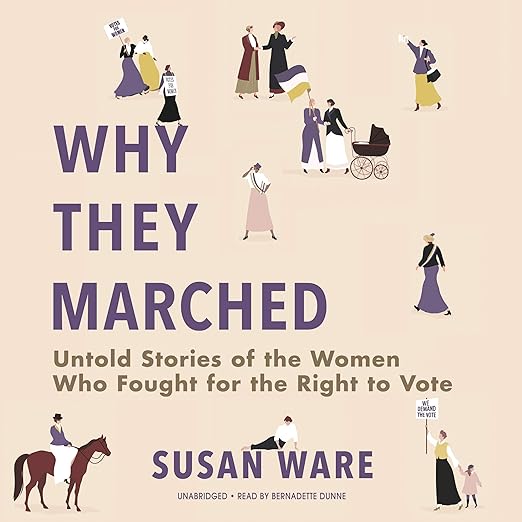
Quick Take
- Narration: Bernadette Dunne brings warmth and clarity to 19 distinct biographical portraits, her ability to navigate different emotional registers across diverse subjects is one of the audiobook’s genuine strengths.
- Themes: Women’s suffrage history, racial and class diversity within political movements, grassroots activism
- Mood: Inspiring and richly researched, with an emotional pull that builds across the portraits
- Verdict: Susan Ware’s decision to tell the suffrage story through overlooked regional activists rather than the canonical white leadership makes this a genuinely revelatory history, and Bernadette Dunne’s narration is well-matched to the material.
I read a lot of political history, and I have read most of the standard suffrage narratives. The story of Elizabeth Cady Stanton and Susan B. Anthony is important, and it is well-documented, and I have read it enough times that I know its shape before I pick up the book. What Susan Ware is doing in Why They Marched is fundamentally different, and I found myself genuinely surprised by it, surprised in the way that only happens when a familiar subject is approached from an angle that makes it strange again.
Ware’s premise is deceptively simple: the history of the suffrage movement has been told as the story of a few iconic leaders, almost all of them white and native-born, and that telling has obscured a far more complex and diverse movement that played out in communities across the country, far from the national spotlight. To correct that, she has assembled 19 biographical portraits of women who have been largely overlooked, and the cumulative effect is significant.
Our Take on Why They Marched
The range of subjects Ware has chosen is remarkable. Mary Church Terrell, a multilingual African American woman navigating a movement that was often hostile to her presence. Rose Schneiderman, a labor activist building coalitions on New York’s Lower East Side who understood that voting rights and working conditions were the same fight. Claiborne Catlin, who toured the Massachusetts countryside on horseback to drum up support. Emmeline B. Wells, a Mormon woman in a polygamous marriage who was determined to make her voice heard in a movement that viewed her community with suspicion.
What Ware is demonstrating is not just that the movement was diverse, it is that the movement’s eventual success was built on that diversity, on the thousands of local organizing efforts that never made the national newspapers but that slowly built the political conditions necessary for the Nineteenth Amendment. The well-known leaders were important, but they could not have succeeded without the infrastructure that these overlooked women built.
Why Listen to Why They Marched
Bernadette Dunne’s narration is excellent. She has the skill to make biographical non-fiction feel like listening to distinct lives rather than a recitation of facts, which matters enormously for a book structured as a series of individual portraits. Each woman’s chapter has its own emotional rhythm, Schneiderman’s immigrant ferocity, the aristocratic stubbornness of Mary Johnston bucking the Southern ruling class, the quiet persistence of the Massachusetts canvasser, and Dunne navigates these shifts with genuine sensitivity.
The book was originally published to coincide with the centennial of the Nineteenth Amendment’s passage, and one reviewer used it as a college course text with excellent results: the short, focused chapters worked well for classroom discussion, and the diversity of portraits offered students multiple entry points into the history. That pedagogical quality survives into the audiobook format; the chapter structure makes it easy to listen in sections rather than straight through.
What to Watch For in Why They Marched
The biographical format means the book does not attempt to provide a comprehensive chronological account of the suffrage movement. If you want that, the full political timeline, the legislative battles, the split between suffragists and the broader women’s rights movement, you will need to supplement this with something like Ellen Carol DuBois’s work on the subject. What Ware is offering is texture and character, not structural overview.
One reviewer provided the bluntest possible assessment: Interesting subject / Poorly written. I do not entirely share that view, I found Ware’s prose capable and her research impeccable, but there are passages, particularly in the introductory and bridging sections between portraits, where the writing becomes more dutiful than alive. Dunne’s narration compensates for some of this in the audiobook version.
Who Should Listen to Why They Marched
Anyone interested in American political history, the women’s suffrage movement, or the mechanics of grassroots political organizing will find this rewarding. It is also an excellent choice for listeners who want to move beyond the canonical Stanton-Anthony narrative without losing the rigorous historical grounding that serious scholarship provides. Students, educators, and general readers with an interest in untold American history are the natural audience. Readers looking for comprehensive political analysis of the suffrage movement rather than biographical portraits should pair this with broader histories of the period.
Frequently Asked Questions
Does Why They Marched cover the full political history of the suffrage movement, or just biographical portraits?
The book focuses on biographical portraits of 19 overlooked activists rather than providing a comprehensive political timeline. It is a supplement to, not a replacement for, broader suffrage histories. If you want the full legislative and political arc, pair it with something like Ellen Carol DuBois’s work.
How does Bernadette Dunne’s narration handle the diversity of characters and emotional registers across 19 portraits?
Dunne is well-suited to this material. She brings distinct emotional registers to each biographical portrait without overplaying the differences, and she handles the shifts between subjects with sensitivity. It is one of the better narrator-material matches in historical non-fiction audiobooks.
Is Why They Marched appropriate for a course reading list or classroom use?
Yes. One reviewer used it as a college freshman writing course text with strong results. The short, focused chapters work well for discussion, and the diversity of women depicted offers multiple entry points for comparative analysis. It was designed in part for the centennial of the Nineteenth Amendment and has pedagogical intentions built into its structure.
Are the women profiled in Why They Marched genuinely obscure, or are some well-known?
The selection is deliberately weighted toward overlooked figures, though a few, like Mary Church Terrell, are known to historians of the period. Ware’s emphasis is on women whose contributions are not included in the standard popular narrative of the movement, so even readers familiar with suffrage history will likely encounter portraits of women they have not read about before.