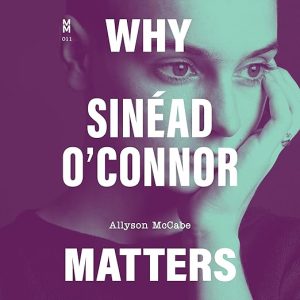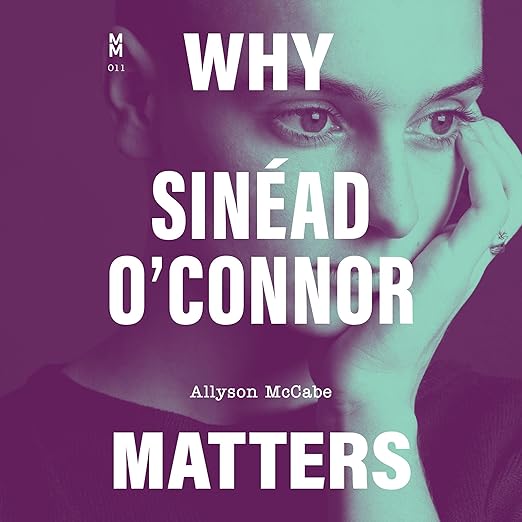
Music criticism that takes a long view tends to reveal more about cultural memory than about the artist it examines. Allyson McCabe's audiobook Why Sinead O'Connor Matters, part of the University of Texas Press Music Matters series, is the book written after O'Connor's death in 2023, though it originated as a reassessment before that loss made the project feel more urgent and more necessary. McCabe's central premise is that most people's understanding of O'Connor stopped in 1992, at the Saturday Night Live moment when she tore up a photograph of Pope John Paul II on live television and became, in the public imagination, defined by that single act of protest rather than by thirty years of music, survival, and extraordinary artistic output that most of her critics chose to ignore.
McCabe both writes and narrates this audiobook, which runs four hours and thirty-seven minutes. The self-narration is one of the title's genuine and distinguishing strengths. A journalist and cultural critic who has spent years thinking about gender, music, and media representation, McCabe reads her own work with the kind of ownership and authority that makes the more personal passages land differently than they would from a hired professional voice. She is candid about her own initial dismissal of O'Connor and the years it took her to correct that judgment, which gives the book an unusual critical honesty that is rare in the advocacy-biography genre.
Prince Wrote the Song and Allegedly Assaulted Her
The book operates within the Music Matters series framework: relatively short, academically grounded but publicly accessible, making a sustained argument rather than providing a comprehensive biography. McCabe does not shy away from the difficult material. She covers O'Connor's childhood abuse, the initial success of "Nothing Compares 2 U," the backlash that followed the SNL protest, the diagnoses and hospitalizations, and the ongoing critical neglect that effectively erased the music O'Connor made after 1992 from mainstream cultural consideration. The comparisons to Madonna and Prince, both used as contextual reference points for understanding how the music industry and media treated O'Connor relative to contemporaries with overlapping cultural transgressions, are insightful rather than reductive.
The Prince comparison is particularly worth noting. McCabe documents the allegation that Prince, who wrote "Nothing Compares 2 U," assaulted O'Connor, and she does so with the care and complexity the claim requires, acknowledging difficulty without minimizing. That willingness to sit inside genuinely hard truths rather than smooth them into a cleaner narrative is one of the book's strongest qualities as criticism. Reviewers describe it as "capturing the complexity" and as an account told with "nuance, sensitivity, insight and personal courage." Those are not generic compliments; they name something specific about how McCabe handles material that many critics avoid entirely.
McCabe Narrates Her Own Critical Failures
McCabe's narration adds substantial value beyond what the text alone would deliver in print. Her voice carries the weight of someone who has personal stakes in getting this subject right, and at points where the argument becomes more personal, including her reflections on her own critical failures and her account of what it means to write about an artist in a culture determined to destroy her, the self-narration makes those passages more affecting than a professional hire would have. The four-and-a-half-hour runtime is well-paced: the book does not overstay its welcome or pad its argument, which is characteristic of the Music Matters series when it is working at its best.
For listeners who came of age in the late eighties or early nineties with any awareness of O'Connor, the book provides essential context for understanding what actually happened and what was lost in the gap between her talent and her public reception. For younger listeners, it functions as a precise case study in how media machinery operates to isolate and diminish women who refuse to perform compliance. Both audiences will find the argument substantive and the historical documentation careful enough to trust as a foundation for further reading.
Short Enough to Leave You Wanting More
The Music Matters format is deliberately short, and McCabe acknowledges in the text that she is aware the book will leave readers wanting more. One reviewer explicitly confirms this: "I rarely give this high a rating especially as it left me wanting even more." That is an honest limitation and also a kind of endorsement. A critical work that makes you want to listen to thirty years of music you neglected is doing its job. This is not a comprehensive biography and does not attempt to be one. Listeners who want a full chronological account of O'Connor's life and discography will need to supplement with longer and more comprehensive works.
What this audiobook provides is a focused critical argument with careful historical grounding, and it does that specific thing very well. The 4.6-star average across forty-nine reviews with no significant negative outliers suggests broad satisfaction from a readership that engaged seriously with the material rather than approaching it as casual listening.
Beyond the SNL Photo-Tearing Mythology
This audiobook is essential for anyone who cares about O'Connor's music and wants to understand why her career unfolded the way it did, beyond the reductive mythology built around the SNL moment. It is also genuinely valuable for listeners interested in how gender, media, and the music industry intersect, as McCabe frames O'Connor's story within a broader cultural argument about hostility toward women who speak publicly without seeking permission to do so. The self-narration by McCabe makes this one of the more personal critical works in the Music Matters series, and her voice gives the material an authority that the academic framework alone could not sustain. Skip it only if you want biography rather than cultural criticism, or if you need a longer and more comprehensive treatment than the four-and-a-half-hour format provides.
In Brief
- Performance: Allyson McCabe self-narrates with the authority and personal investment of someone who spent years getting this wrong before getting it right; her voice gives the critical passages genuine emotional weight.
- What it covers: Gender and media machinery in the music industry, cultural reassessment, personal and artistic survival
- Feel: Sharp and searching, honest about its own blind spots in the best way
- Our call: A focused, courageous critical reassessment of Sinead O'Connor's career and the cultural forces that diminished it, essential for listeners ready to reconsider what they thought they already knew.
A Few Questions About Why Sinéad O'Connor Matters
Is McCabe's self-narration of this audiobook an asset or a limitation?
It is clearly an asset. McCabe is a journalist and cultural critic who has personal stakes in the argument, and her narration carries the weight of that investment. The more personal passages, including her account of her own early dismissal of O'Connor, land with particular force in her own voice. No reviewer flags the narration as a weakness.
How does the audiobook address the 1992 SNL incident and what came after?
McCabe treats the SNL moment as a cultural rupture that froze most public understanding of O'Connor at that point. The audiobook documents the backlash, the subsequent critical neglect, and the music O'Connor continued to make through the following decades, arguing for serious reengagement with the full body of work rather than the mythology around a single televised act.
What does this audiobook say about the relationship between O'Connor and Prince?
McCabe documents Prince's role as writer of 'Nothing Compares 2 U' and addresses O'Connor's allegation that Prince assaulted her, handling the claim with care and without minimizing its seriousness. The Prince comparison also serves as a structural device for examining how the music industry applied different standards to transgressive behavior depending on gender.