
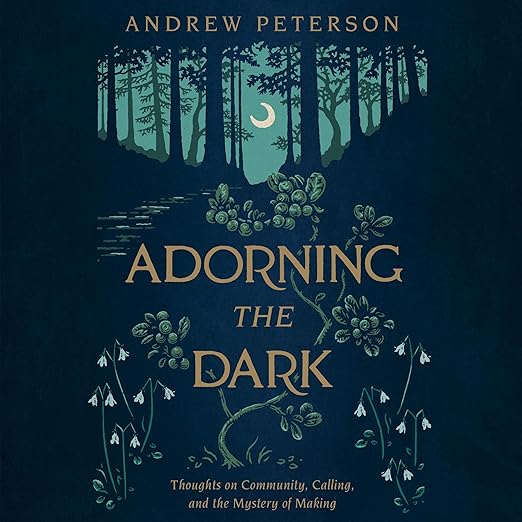
Five hours and one minute is a short runtime for a book trying to be two things at once, and the Adorning the Dark audiobook spends all of it on a single claim: that making something beautiful is ordinary work, usually done badly at first, and never done alone. Andrew Peterson reads it himself, which for this particular title is less a bonus than a structural requirement.
What We Made of It
Peterson's resume arrives early and it is genuinely strange on paper: thousands of concerts across twenty years, four novels, ten albums, college and seminary classes on writing, a nonprofit ministry founded for Christians in the arts, a film he executive-produced. Listed like that, it could read as a boast. It does not, because the organizing admission of the book is that he stumbled along the way and made mistake after mistake, and the mistakes get considerably more airtime than the albums.
Structure is the thing an October 2021 five-star pins down accurately: a mixture of essays and journal entries, part biography and part craft book, covering a wide range of ground while staying organized and on topic within each section. That description doubles as the warning. Anyone hoping for a numbered method with exercises at the end of each chapter has the wrong book.
Six principles hold the material together, and the publisher lists them in order: serving the work, serving the audience, selectivity, discernment, discipline, community. Four of those six describe restraint rather than production. That balance tells you where the pressure sits in this account of a working life, and it is not where a beginner expects it to sit.
Community lands last in that list for a reason. The book opens by insisting that beautiful work in a broken world is harrowing and cannot be done alone, and the closing stretch has argued the point three ways by then: through an encouraging family, through a Christ-centered community of artists inside the church, and through a ministry Peterson founded so that other people would not have to assemble what he assembled himself. Craft advice is what the title sells. The argument about company is what the structure protects.
Author-read nonfiction usually trades polish for warmth. Here the trade runs differently. Every mistake in the book belongs to the man speaking, every song referenced is his, and the emphasis inside any given self-deprecating sentence is chosen by the person who earned the right to make the joke. A hired reader has to guess which half of a line like that is rueful and which half is serious. Peterson does not guess, and across five hours of anecdote that adds up.
One item in the pool looks like performance evidence and is not, so it is worth separating out. An October 2019 response describes hearing Peterson for the first time, disliking what it heard, then returning later and finding the voice more inviting and more sincere. Chronology settles what that means: the response was filed roughly seven weeks before this recording was published, and the voice it praises is the singing voice on the albums, not the reading voice on this file.
What the material actually delivers is closer to encouragement than instruction, and the most recent response on the page reports the effect in practical terms: inspired, moved to laughter and to tears, and pushed back toward unfinished writing immediately. That is a fair account of what five hours here does. The framework is real, but the engine is anecdote, and the anecdotes are specific enough to be useful.
Before You Commit to Adorning the Dark
Counting is where the listing falls apart. The page reports one rating and prints an average of 4.8, and a single vote can only be a whole number of stars, so no lone rating produces that figure. Under the same counter sit five written responses, every one of them at five stars. The population that wrote is five times the population supposedly counted, and the grades it left average an even 5.0, which is not 4.8 either.
Storefront spread accounts for some of the noise. Two of the five responses were filed outside the United States, one in the United Kingdom and one in Canada, and the first of those recommends taking the whole thing in one go, which is a reading instruction more than a listening one. Every verdict on the page reads that way. Buyers arriving from a search for the recording are reading print reactions.
Expect Scripture, and expect it structurally rather than decoratively. The stated aim is to adorn the dark with the light of Christ, the publisher is a Christian house, and the six principles are argued from a theological premise about how the Creator works. The listing files the title under arts and entertainment with a Music tag, which undersells how much of the runtime concerns writing prose and how little concerns performing songs. Somebody searching that shelf for a book about making records will find a book about making anything, told mostly by a novelist.
Best Suited For
Songwriters, novelists, and people making things inside church contexts get the most from it, along with anyone stalled mid-project who needs company more than technique. An April 2020 response filed in Canada is the useful data point for that second group: not artistic in any way by their own account, and still coming away with a sense of a calling to push back the darkness in ordinary work. Church musicians and volunteer worship leaders sit closest to the center of the target, since the book assumes without arguing it that art made for a congregation counts as art.
Give it a pass if you want a craft manual that keeps theology outside the room, or a systematic writing course with drills attached. This is a memoir that teaches by anecdote and asks you to accept its premises before it starts. At five hours it says its piece and stops, which is more than many books in this shelf manage.
In Brief
- Narrator: Author-read across just over five hours, so the songwriter arguing that nobody makes anything alone is also the only voice on the file.
- Subjects: Vocation and calling, creative discipline, faith and art, community over solitary genius
- Tone: Warm, confessional, unhurried
- Bottom line: Worth it if you want company in the work rather than a method for it.
Questions Listeners Ask
Is the Adorning the Dark audiobook a memoir or a book about craft?
Both, deliberately. The publisher frames it as a memoir of one working life and a handbook for artists at the same time, and the structure alternates between story and principle rather than separating them. If you want only one of those two modes, roughly half the runtime will feel like a detour.
How much Christian content should I expect in Adorning the Dark?
A great deal, and it is load-bearing. The stated purpose is adorning the dark with the light of Christ, the publisher is a Christian house, and the six principles rest on a theological account of creativity. Listeners outside that framework can still use the craft material, but nothing is neutral here.
Does the Adorning the Dark audiobook work for people who are not musicians?
Yes, and the publisher argues that case directly, describing the principles as useful to anyone interested in imitating how the Creator works rather than to artists alone. Songwriting supplies the examples, but selectivity, discernment and discipline are described in terms any maker can apply.







