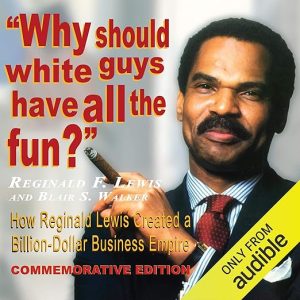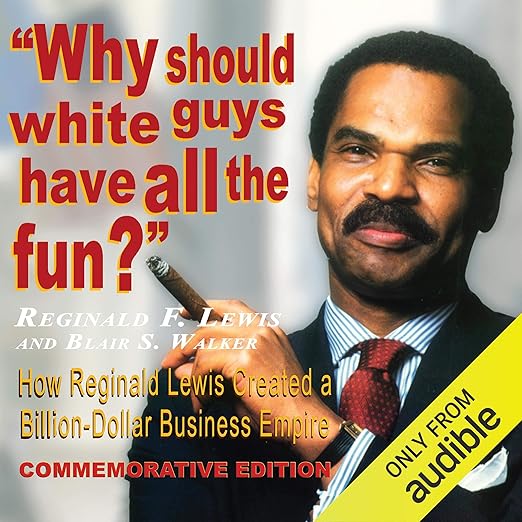
A question asked at six years old ended up as the title of a book, which is either excellent packaging or the most honest thing on the cover. Reginald Lewis overheard his grandparents talking about employment discrimination against African Americans and wanted to know why white guys should have all the fun. By the time he died in 1993 he was running Beatrice International, with a personal fortune the description puts in excess of $400 million and a commercial empire across four continents. JD Jackson reads the whole climb in just under fourteen hours, and this audiobook has the strange distinction of being warmly reviewed by people who never once mention the reading.
Lessons From a Waiter, a Maid, a Hardworking Mother
The construction of the book is worth understanding before you start, because it explains the voice. This was assembled from Lewis's unfinished autobiography plus what the copy calls scores of interviews with family, friends and colleagues. That means the first person and the reported account are braided together, and it also means the byline is doing something unusual: the credit reads as though Lewis wrote it, while the description makes clear that other hands finished it after his death. One reviewer feels the seam without naming it, praising "The Author" in the third person for exposing readers to the life of Reginald F. Lewis.
The portrait that results is not flattering, and it is much better for that. Ike, writing months after the recording appeared, treats "his mercurial attitude" as part of what makes the story interesting rather than a defect to be excused, and points to the no-nonsense account of deals gone good and bad as the appeal. The book declines to sand Lewis down into a mascot, which is the trap that swallows most posthumous business biographies, and it keeps the parts of him that would be uncomfortable to work for.
What sits underneath the deals is Baltimore. Dextra L. Suggs, recommending this book since long before the recording existed, is bluntest about the man, calling him "arrogant, moody, temperamental, elitist and sometimes cruel" before adding "but he was formidable". The same account traces where the steel came from: Lewis was "Raised by poor but principled parents and grandparents" and "took the lessons of a waiter, a maid and a hardworking mother" into a career that made him one of the richest entrepreneurs in the country. The waiter and the maid are not decoration in that sentence; they are where the book locates the discipline everything later runs on, and the early chapters take roughly a third of the running time to build it.
Feel Like You're Inside His World of Business
The strongest reason is recovery. One reviewer admits he had never heard of Lewis before opening the book and finished it wondering why nobody assigned it to him in high school, a reaction that says more about American business curricula than about the writing. Another, a corporate lawyer barred in New York and searching for a way to reinvent a career, describes arriving with questions that had never been asked out loud and leaving with them at least addressed. A biography that functions as a working document for people in the same profession is doing something a straight chronicle does not. That is a strange afterlife for a book, and a strong argument for its accuracy about how the work actually feels from inside.
The second reason is texture. Xzier, who came to the audio before buying a print copy and reading it again, says the book "makes you feel like you're in his world of business and each step of his life", and that step-by-step quality is what suits a long listen. Deal narrative rewards sequence: you follow the reasoning as it happened, without the temptation to skip ahead to the outcome, and a fourteen-hour recording enforces exactly that discipline.
Five People Have Written, None Mention Jackson
Nobody has evaluated the performance. Five people have written about this title at length and not one of them refers to JD Jackson, the delivery, the pacing or the production, even though one of the five states outright that the audio came first and the physical copy second. On a fourteen-hour biography that omission is not trivial, since a reader who cannot hold a business narrative together will lose you somewhere in the third hour. The sample is the only evidence available, and I would run it against a passage of deal mechanics rather than the opening.
The numbers on this listing do not hold together either. A 4.8 average sits above a count of exactly one rating, and a single vote cannot land on 4.8, since one person can only award a whole number of stars. Meanwhile the page shows five people who took the trouble to write, which puts the tally of ratings below the tally of comments. Two of those comments also predate this recording: one from 2010 and one from February 2020, against a September 2020 release. They are describing the book, not the audio, and they are worth reading with that in mind.
A Gap in Your Education If You Skipped Lewis
Anyone who works in law, finance or business development and has never encountered Lewis should treat this as a gap in their education. The same goes for listeners who collect American biographies and have noticed how few of them cover Black wealth at this scale. Readers who like their subjects complicated will be well served: the man on this recording is demanding, sharp-tongued and frequently unpleasant, and the book keeps all of it.
One audience deserves naming beyond the obvious ones: parents and teachers looking for a business story a teenager can get hold of. The case is that this is a career told through decisions rather than through outcomes, which is the shape a young reader can actually learn from. The language is adult and the deal material demands attention, but a motivated sixteen-year-old will follow it, and the argument at the center lands hardest early.
It suits you less if you want a warm portrait or a tidy set of lessons. The description promises a razor-sharp tongue and an intellect to match, and the reviewers who know the material best keep reaching for words like arrogant and elitist, so nobody should expect an inspirational-poster version of this life. Listeners who need a long recording vouched for before committing will also want to wait, because on the evidence available the performance remains entirely unexamined.
Common Questions
Did Reginald Lewis write this book himself?
Partly. The description says it draws on his unfinished autobiography together with many interviews with family, friends and colleagues, which means the account was completed after his death in 1993. The byline shows Lewis alone, and one reviewer refers to the author in the third person while praising the portrait of Lewis.
Do any reviews of this audiobook discuss JD Jackson's narration?
Not one word. Five substantial comments are visible and none of them mentions the reading, the pacing or the production, even though one reviewer confirms the audio came before the print copy. Anyone who cares about the performance will have to judge it from the sample rather than from other listeners.
Why does the rating look inconsistent with the number of reviews?
The listing shows a 4.8 average against a single counted rating, which a lone vote cannot produce because one person can only give a whole number of stars. Five written comments appear alongside it, so the tally of ratings is smaller than the tally of comments. Read the comments, not the arithmetic.
Does the audiobook require any background in finance?
No. Reviewers arriving from very different places, including one who had never heard of Lewis and one practicing corporate lawyer, both report following it comfortably. The interest is in how Lewis made decisions and handled people rather than in technical instruction, so general curiosity about business is enough.