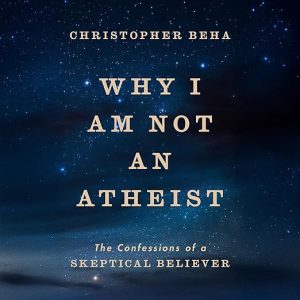
- Read by: Beha self-narrates with genuine intellectual authority; the production lacks professional polish but gains something no hired narrator can provide, the weight of a person who actually lived these questions.
- At its heart: Faith versus atheism, scientific materialism, romantic idealism, the philosophy of Kant, the search for secular meaning after belief lapses.
- Vibe: Dense, honest, and philosophically demanding, closer to extended essay than memoir, best taken in across multiple listening sessions.
- Short version: A serious philosophical memoir that earns its New Yorker recognition by refusing to simplify a genuinely hard argument in either direction.
Picture Christopher Beha in his late twenties, sitting with Bertrand Russell's 'Why I Am Not a Christian' and finding, with the clarity of a person who needed to find it, that belief was no longer available to him. That moment of departure is where this audiobook begins, though it covers much more than the years between that atheism and whatever followed. What Beha has written is not a conversion narrative, and that distinction matters more than any other single thing about the book. It is a philosophical memoir, and in the hands of an author who narrates his own work, it becomes something rarer: an argument you can hear the cost of.
What Can I Know, Must Do, May Hope
Beha organizes the inquiry around Immanuel Kant's three questions: What can I know? What must I do? What may I hope? That framework is doing genuine structural work here. Rather than narrating a simple arc from faith to doubt to faith, Beha moves epistemologically, tracing two coherent atheist positions, scientific materialism and romantic idealism, with enough intellectual seriousness that neither camp feels set up for dismissal. The conclusion, that faith preserves the best of both traditions while offering a more complete picture of reality, arrives not as a triumph but as the most defensible position available after decades of honest engagement.
Readers approaching this expecting either apologetics or anti-religious polemic will be equally disoriented, in a productive way. Beha is not trying to convince you. Named among The New Yorker's best books of 2026 and longlisted for the National Book Award, the work has attracted readers from across the belief spectrum precisely because it refuses to flatten the difficulty of the questions it raises. Reviewers with no religious commitments found it intellectually honest. Reviewers who are believers found it vulnerable and rigorous. That breadth of response reflects genuine quality in the argument.
The youthful brush with mortality that reoriented Beha's search is present in the narrative without being dramatized for effect. It functions as a catalyst, not a climax. The book is interested in what came after, the decades of reading and thinking about suffering, meaning, and what a human life is for, more than in any single revelatory moment. That restraint is one of the book's virtues.
A Voice That Genuinely Lived These Questions
Christopher Beha narrates his own work, and at fourteen hours and eight minutes, that is a significant commitment to sustain. Whether author self-narration is an asset here depends partly on what you want from the format. Beha is not a professional voice actor, and listeners accustomed to polished studio narration will notice the difference in production texture. What Beha brings instead is authority over his own argument and a quality that no hired narrator can replicate: the sense that the person speaking genuinely lived these questions. When he reads passages from Bertrand Russell or walks through Kant's categories, the intellectual investment in the voice is real, not performed.
The Runtime Jumps From Fourteen Hours to Eighteen
For a book this philosophically dense, that authenticity is worth the trade-off in production gloss. The 18-hour runtime will suit listeners who approach philosophical memoir as a form of long-form companionship, the kind of book you return to across multiple listening sessions over days rather than consuming in one sustained push. Beha's measured delivery accommodates that pacing. He does not rush the hard passages, which is exactly the right instinct for this material.
The audio format suits this book more than it might initially seem. Beha is writing in a tradition of intellectual autobiography, drawing on Russell, Kant, and the history of atheism and faith with a literary essayist's hand. Hearing rather than reading these arguments lets the rhythm of the prose work differently. The book thinks aloud, and that process translates naturally to audio.
Sections Dense Enough to Deserve a Replay
This is a demanding book. Beha does not simplify the philosophical history he covers, and listeners without some background in the ideas of scientific materialism, romantic idealism, and the history of secular thought will need to engage actively to follow the argument. This is not a popular science book about belief; it is closer to a work of philosophical autobiography. Readers who want a more accessible introduction to the religion-versus-atheism conversation might find it more rewarding to approach Beha alongside rather than instead of lighter treatments.
The conclusion, favorable to faith, is reasoned rather than evangelical. Readers who are committed atheists and worry the book will feel like an argument aimed at them should know that Beha's respect for the atheist positions he critiques is genuine. He spent decades inside them. The movement toward belief is not presented as a rejection of his atheist years but as an integration of what they taught him.
At just over fourteen hours, pacing in the audio version is worth planning around. The densest philosophical sections benefit from replay. Budget time for that.
Worth Fourteen Hours of Your Listening Time
The ideal listener is someone who has wrestled with these questions personally and wants to think alongside someone who has done the same rigorously and without self-congratulation. Committed atheists who can engage in good faith with a counter-argument will find the book more rewarding than they might expect. Believers looking for sophisticated company in their convictions will find Beha's account more honest about the difficulty of faith than most apologetics literature offers. Literary readers who enjoy philosophical memoir as a form, who have spent time with Augustine, Simone Weil, or Walker Percy, will recognize what Beha is attempting and appreciate how well he executes it.
Why I Am Not an Atheist is not a comfortable book in any direction, which is what makes it worth fourteen hours of your listening time.
Before You Listen
Do I need a philosophy background to follow this audiobook?
Some familiarity with the ideas of Kant, Bertrand Russell, and the basics of scientific materialism and romantic idealism will help. Beha explains the relevant concepts, but he does not slow down significantly for listeners encountering them for the first time. Active engagement is required.
Is this audiobook trying to convert listeners to Christianity?
No. Beha explicitly frames the book not as a polemic but as a record of his personal engagement with Kant's three urgent questions. The argument moves toward faith, but through an honest account of what atheism got right, not through dismissal of it.
Who is the right audience for this audiobook?
Readers who enjoy philosophical memoir, who have personal stakes in questions about belief and meaning, and who can engage generously with a counter-argument to atheism. Both committed atheists willing to be challenged and believers looking for sophisticated company will find value here.