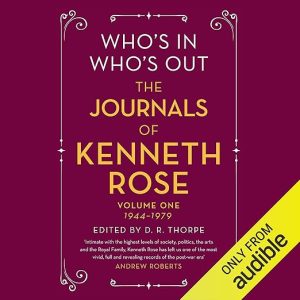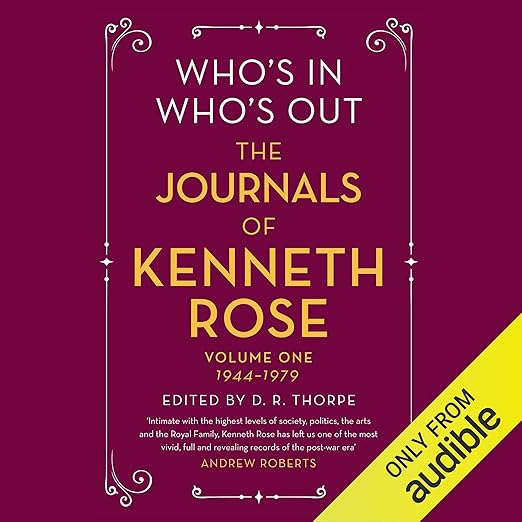
Kenneth Rose spent more than seventy years inside the beating machinery of the British establishment, and Who's In, Who's Out is the audiobook that proves how much turns on who you actually know. This first volume of his journals covers the post-war decades through to Margaret Thatcher's election in 1979, and what emerges is something unusual in historical documentation: a record composed at the level of the dining room rather than the dispatch box, with the Duke of Windsor and the Queen Mother showing up as conversational sources rather than formal subjects of biography.
Edwards Narrates a Man Who Has Known Everyone
Rose's peculiar gift was his position. His social placement let him move between political, clerical, military, literary, and aristocratic circles without becoming entirely identified with any of them. He was close enough to get the real stories - the abdication crisis material he gathered from both the Duke of Windsor and the Queen Mother is remarkable primary-source access available nowhere else - while maintaining enough critical distance to write about those people with something approaching objectivity. That combination doesn't come along often in first-person historical documents.
The journals read as what they are: the observations of someone constitutionally unable, by his own frank admission, to let a good story pass him by. Rose is not a confessional diarist in the manner of Alan Clark or Chips Channon; he's an external observer who happened to be admitted to rooms where history was being shaped. The result is a record of overheard remarks, lunches, country house encounters, and parliamentary conversations that together build a portrait of the British establishment as a social organism with its own very specific rules of admission and exclusion. Reviewer Galla observes that Rose "seems to have known everyone" - prime ministers, archbishops, generals, members of the royal family - and the journals are the evidence of exactly how that web of connection worked in practice.
Barnaby Edwards is an excellent narrator for this material. The journals require someone who can handle Rose's dry, understated wit without pushing it, and who can make twenty-four hours of name-heavy, context-rich anecdote feel like a genuine conversation rather than a recitation. Edwards delivers exactly that. The aristocratic register that could easily become caricature in another reader's hands stays credible here because Edwards understands how to carry English irony without signaling it too loudly.
Abdication Secrets From Both the Duke and the Queen Mother
For listeners interested in mid-twentieth-century British political history, the documentary value here is substantial. Rose was present for or closely adjacent to key events from the Blitz through the post-war consensus years and into the Thatcherite turn. His observations aren't primary political analysis - he's not a Harold Macmillan examining his own power or a Richard Crossman wrestling with Cabinet loyalty - but the lateral view of those power structures is sometimes more revealing than the view from inside them. What you get from Rose is what the principals actually said when the record wasn't being kept, and those unguarded moments accumulate into something that formal political history rarely captures.
The abdication crisis material, gathered directly from both the Duke of Windsor and the Queen Mother at separate points in Rose's long social career, represents exactly the kind of primary source access that historians spend careers hoping to find. Rose had it because he was trusted, and he was trusted because he was discreet - discreet enough that the disclosure of what he knew was calibrated to appear in his journals rather than his journalism. That calibration is itself historically revealing. The journals end in 1979 at a natural break point, but the second volume continues the record into later decades for listeners who want to follow Rose's observations through the Thatcher years.
Only for Dedicated American Anglophones
Reviewer Richard Schnadig is direct: this is "only for dedicated American anglophones." That's not quite as narrow as it sounds, but it's worth taking seriously. The journals presuppose substantial knowledge of British institutional history, the significance of who is or isn't admitted to which rooms, and the names and titles that flow through the pages. The pleasures of the book depend on caring about the difference between what was said publicly and what was said privately about figures who shaped British public life - and caring about that requires knowing who those figures were and why it mattered.
Rose's perspective is also that of a deeply embedded insider, and his documentation is impartial within the bounds of his class and social world. He doesn't engage with Britain from below; the establishment figures he chronicles are presented with genuine respect, which is appropriate to the diary form but worth noting for listeners who want social history from a wider angle. This is insider history by design, not by oversight.
Alongside Nicolson, Channon, and Crossman as Diarists
Serious Anglophiles, students of twentieth-century British political and social history, and readers who've already engaged with diaries like those of Harold Nicolson, Chips Channon, or Richard Crossman will find this a substantial and rewarding addition to that tradition. At twenty-four hours, it's a sustained commitment that rewards listeners who already know the landscape. Reviewer Joe France offers the clearest summary: "an enjoyable read for an Anglophile" - and being an Anglophile here means knowing enough to follow the network Rose moves through. For those who fit that description, Barnaby Edwards' narration makes the full runtime genuinely enjoyable.
Questions Listeners Ask
Does the Who's In, Who's Out audiobook require extensive knowledge of twentieth-century British history to follow?
Yes, meaningfully so. The journals move through a dense web of named figures from British politics, aristocracy, the military, and the Church. Listeners with prior knowledge of the post-war decades through to 1979 will get substantially more from this than those coming without that foundation.
Is this audiobook accessible to American listeners, or primarily for a British audience?
Reviewer Richard Schnadig specifically notes it's 'only for dedicated American anglophones.' Rose's social world is entirely British, and the value of the observations depends on knowing why the people he's describing matter. Dedicated Anglophiles will find it rewarding; casual listeners will likely lose the thread.