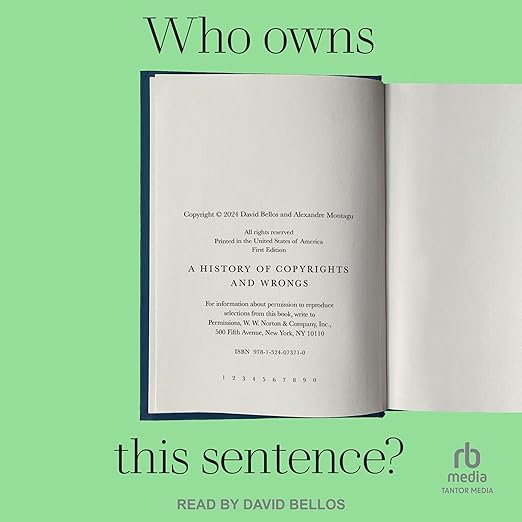
Quick Take
- Narration: David Bellos narrates his own work with a scholar’s precision and occasional dry wit, which suits the material well even if the delivery is not electrifying.
- Themes: Intellectual property history, the enclosure of cultural commons, corporate power and creative ownership
- Mood: Analytically sharp with flashes of genuine outrage, like a very good law school lecture
- Verdict: A history of copyright that is genuinely illuminating about how one area of law quietly restructured the cultural economy, though readers should know the authors have a clear point of view.
I spent an embarrassing amount of time last year wondering whether a photograph I had taken of a well-known painting could be used freely or whether it was somehow someone else’s property. The painting was centuries old, the photographer was me, but the museum’s terms of service told a different story. I filed it under the category of modern life being strange and moved on. Then I listened to David Bellos and Alexandre Montagu’s Who Owns This Sentence? and realized that the strangeness I had experienced was not a bug in the system but a feature, and a historically recent one at that.
Bellos narrates his own book, which is either a point in the production’s favor or a mild liability depending on your tolerance for academic readers. He is precise and occasionally dryly funny, which maps well onto prose that is itself precise and occasionally dryly funny. He does not perform the text so much as deliver it with the confidence of someone who has thought about these questions for years and is now presenting the results. For eleven hours, that steady authority holds.
Our Take on Who Owns This Sentence
The historical argument at the center of the book is genuinely surprising if you have not encountered it before. Copyright did not begin as a moral claim about creators’ rights, it began in eighteenth-century London as a limit on printers’ power, a way to prevent booksellers from monopolizing the trade in texts. The idea that intellectual labor produces property comparable to physical property is a later invention, not a foundational principle, and Bellos and Montagu trace how a handful of small legislative changes in the late twentieth century transformed a limited, bounded protection into something vastly more expansive.
The book is strongest in its historical sections. The account of the Berne Convention, the successive revisions to American copyright law, and the specific mechanisms by which corporate interests extended terms and broadened scope is meticulous and readable in a way that legal history often is not. One reviewer described it as taking meaty but relatively small bites that allow the reader to follow along without losing the thread, and that description is accurate. Bellos’s prose does not condescend, but it also does not assume expertise.
Why Listen to Who Owns This Sentence
Because copyright intersects almost every area of contemporary culture and almost nobody understands how it actually works or how it got this way. The book explains, for instance, why AI-generated content is the latest battleground in a fight that has been running for decades, and it does so by showing what precedents were set and why, not by analyzing the current litigation but by establishing the historical logic that makes the current moment legible.
For anyone who has encountered copyright claims in their own creative or professional life, sampling music, reproducing images, citing texts, building on existing works, the book functions as a guide to the logic and occasional illogic of a system that affects them directly. One reviewer who described himself as a former supporter of strong copyright protections noted that the book had changed his view; the corporate expansion of copyright, Bellos argues, has very little to do with protecting individual creators and a great deal to do with concentrating intellectual property in institutional hands.
What to Watch For in Who Owns This Sentence
The authors have a position, and they hold it clearly. One reviewer’s criticism, that the book editorializes more than it should and builds some arguments on contestable premises, is not entirely unfair. The claim that most writers would write regardless of financial incentive is a sociological assertion that the book does not fully support, and the pharmaceutical patent analogy is handled less rigorously than the literary copyright history. Readers who come looking for a balanced, view-from-nowhere account of intellectual property law will not find it here.
What they will find is a persuasive historical argument with an acknowledged perspective, which is a different and arguably more useful thing. The book is honest about being an argument, which makes it easier to evaluate on its own terms.
Who Should Listen to Who Owns This Sentence
Intellectually curious listeners who want to understand how contemporary intellectual property law arrived at its current state. Writers, artists, musicians, and anyone who has encountered a copyright claim that seemed disproportionate to the creativity involved will find the historical context valuable. Listeners expecting a balanced academic treatise rather than a pointed argument should calibrate expectations accordingly. The book pairs well with Lawrence Lessig’s Free Culture as part of a broader reading on the same subject.
Frequently Asked Questions
Does the book address AI-generated content and copyright specifically, or is that tangential?
The synopsis mentions AI copyright battles as part of the current landscape, and the book provides the historical framework for understanding them, but the primary focus is the legal and legislative history leading to that moment rather than analysis of current AI litigation.
Is David Bellos’s narration of his own work a strength or a limitation for this audiobook?
It depends on what you want. Bellos reads with authority and dry intelligence, which fits the material well. He is not a trained narrator, so listeners who prefer theatrical delivery will notice the difference. For a dense historical argument, the scholarly register is appropriate.
The book has a clear anti-corporate-copyright perspective. Does that undermine its historical reliability?
The historical sections are well-documented and draw on established scholarship. The analysis and conclusions are where the authors’ position is most visible. A critical reader can separate the well-supported history from the more contested interpretive arguments.
Who is Alexandre Montagu, the co-author, and what does he contribute?
Montagu is a legal scholar who collaborated with Bellos on the legal analysis portions of the book. The audio credits Bellos as narrator, and the prose voice is consistent throughout, but the legal-historical depth reflects Montagu’s contribution to the research.