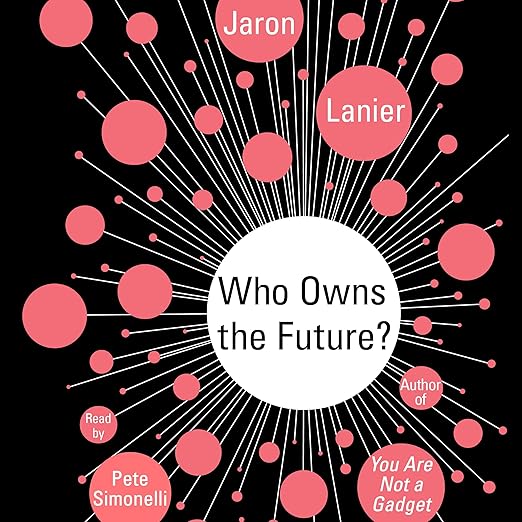
Quick Take
- Narration: Pete Simonelli delivers Lanier’s dense, discursive prose with steady competence, though the material demands active engagement regardless of narrator
- Themes: digital capitalism, information asymmetry, economic displacement through technology
- Mood: Prophetic and unsettling, with moments of genuine idealism
- Verdict: A 2013 book that has aged into something close to prophecy, more urgent on second listen than it was on first publication.
I was halfway through my morning commute the first time I heard Jaron Lanier use the phrase Siren Servers, and I had to pause the audiobook and sit with it for a moment before continuing. The term is precise in a way that most tech criticism is not. A Siren Server, in Lanier’s formulation, is an elite computer or coordinated collection of computers that wins an all-or-nothing contest by exploiting information asymmetry and then inflicts smaller all-or-nothing contests on everyone who interacts with it. He was talking about Google, about Facebook, about the financial algorithms that preceded the 2008 crash. He was also, it turns out, talking about systems that would become considerably more powerful in the decade after he wrote this book.
Who Owns the Future? was published in 2013. Listening to it now is a disorienting experience.
The Argument That Got There First
Lanier’s central claim is that the free sharing of information on digital networks, the thing we were all told was democratizing and liberating, was actually a mechanism for transferring economic value from ordinary people to whoever owned the servers that collected and processed that information. When you search, you train the algorithm. When you post, you provide content. When you share your location, you provide data. None of that activity is compensated. The Siren Server captures the value and the person who generated it gets, at best, the use of a free service.
The reviewer S. Ferguson’s detailed summary of the Siren Server concept captures why this framework is so useful: it names something that many people sense but struggle to articulate. The reviewer Andrea, writing from Germany in 2016, makes the bleaker observation that a single book and a single vision cannot change the game when the powers of an entire industry are arrayed on the other side. That is probably true. It does not diminish the quality of the diagnosis.
What Lanier proposes as an alternative is a system of nanopayments, a way of compensating individuals for the data and content they generate. He is careful to note that he does not have a fully worked-out implementation. The book is stronger as critique than as blueprint. But the critique is thorough enough and specific enough to reward the twelve hours it asks of you.
When Predictions Become History
The reviewer AnAvidReader, writing in 2013, offered a useful caveat: Lanier is probably wrong in many places, but worth reading anyway. That was fair at the time. What is striking about listening to this now is how much of it has proven not wrong. The hollowing out of the middle class through digital disruption. The concentration of wealth in the hands of whoever owns the platform. The way social media shapes personal expectations and external environments in ways that users do not fully perceive. Lanier described all of this in 2013, before much of it had become undeniable.
The sections on financial institutions are particularly worth revisiting. Lanier argues that the same information asymmetry that defines consumer internet platforms was already present in financial algorithms, that the 2008 crash was not an anomaly but a demonstration of what Siren Server logic produces when applied to money. If you listened to this in 2013, some of that felt speculative. It does not feel speculative now.
Pete Simonelli and the Challenge of Lanier’s Prose
Lanier writes in a style that the New York Times blurb quoted in the synopsis accurately calls brilliant, and that another observer might call demanding. He moves between philosophical argument, personal anecdote, technical specificity, and economic theory within single paragraphs. Pete Simonelli navigates this with a reliable evenness that keeps the listener grounded without adding interpretation. Some narrators impose a reading on dense material. Simonelli trusts the text, which is the right call here because the text is doing its own work.
At twelve hours, this is not a light commitment. Lanier is not a writer who makes things easy. He is a writer who makes things clear eventually, through accumulation rather than through elegant summary. The audiobook rewards listeners who are willing to let arguments develop slowly.
Who Belongs in This Conversation
If you work in technology and have never questioned the ideological framework that treats information freedom as an unambiguous good, this book is worth your time as a corrective. If you are interested in the political economy of the internet and want something more substantive than a think-piece and more readable than an academic text, Who Owns the Future? occupies a useful middle ground.
Listeners who want concrete proposals and actionable recommendations will find the nanopayment sections interesting but underdeveloped. Lanier himself acknowledges the incompleteness. This is primarily a book about what is wrong, and only secondarily a book about what might be done. Both halves are worth hearing.
There is a poetic quality to Lanier’s prose that is unusual in technology criticism, a tendency to reach for metaphor when dry analysis would serve more efficiently. Some listeners will find this enriching. Others will occasionally wish he would simply state the argument and move on. Both responses are valid, and both are present in the reviews. What is not disputed is that the argument itself is serious, carefully constructed, and increasingly difficult to dismiss.
Frequently Asked Questions
How well has Who Owns the Future? aged since its 2013 publication?
Considerably better than most technology criticism from that era. Lanier’s predictions about platform concentration, middle-class economic displacement, and the structural dangers of information asymmetry have been borne out in ways that make the audiobook feel more urgent now than it likely did on release.
What exactly is a Siren Server, and why does Lanier think they are dangerous?
Lanier defines a Siren Server as an elite computer or coordinated network characterized by extreme information asymmetry and winner-take-all market dynamics. He argues they are dangerous because they extract economic value from ordinary people’s data and labor without compensation, concentrating wealth and power while providing free services that obscure the transaction.
Does Lanier offer solutions, or is this primarily a critique?
Lanier proposes a system of micropayments that would compensate individuals for the data and content they contribute to digital networks, but he is candid that this is underdeveloped. The book’s strength is its diagnosis. Readers looking for detailed policy prescriptions will find the second half less satisfying than the first.
Is prior technical knowledge required to follow the arguments in this audiobook?
No. Lanier writes for a general audience and explains technical concepts as he introduces them. Familiarity with how platforms like Google, Facebook, and financial trading algorithms work will add context, but the book is designed to be followed without specialist knowledge.