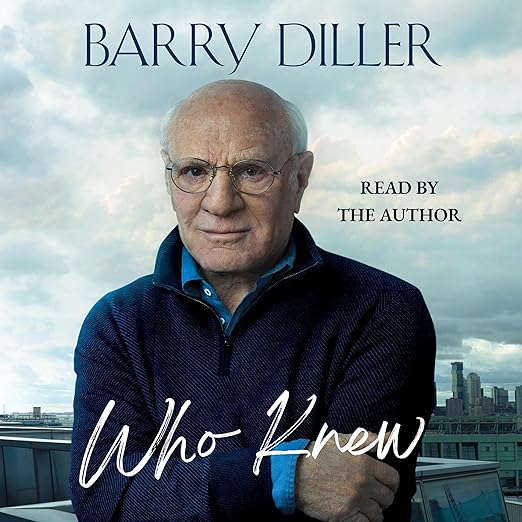
The flap copy for this Who Knew audiobook promises Barry Diller writing in his singular voice, and here that phrase gets to mean something literal rather than just a compliment: the man who built a career on instinct over research is also the one reading the whole thing aloud.
From the Mail Room to Fox at Forty-Four
Genuinely startling is the only way to describe the arc the flap copy lays out here: a mail room job sought at William Morris, an agency Diller describes as resembling a Jewish Vatican, followed by a launch at ABC, the Movie of the Week at twenty-seven, the CEO seat at Paramount Pictures at thirty-two, and the Fox television network at forty-four, all before founding IAC and building Match, Tinder, and Expedia into a single company. Ted Ziegenbusch's review captures the pull of it well, admitting that just one more chapter before I sleep became a nightly refrain while working through the book. Poppytart goes further, calling this one of the best biographies read in years and confessing genuine confusion at the idea that anyone could rate it anything less than five stars, though S. H. Sweet's more measured four-star review still lands on calling Diller a remarkable man, citing charisma, kindness, a relentless desire to learn, and a real fear of letting his own success curdle into boredom. Bob Timberlake's review reads almost like an inventory of everything absorbed while reading, the companies, the charities, the buildings, even the islands, closing simply with Wow, which may be the least analytical but most honest review on the page.
The Claim That Home Alone Saved Murdoch's Career
Cita's review does something none of the others manage: it quotes the book directly, pulling out phrases like a tried and tired summer-seersuckered group and an icy stare as examples of writing so precise it stuck long after the page was turned, alongside a line of Diller's own business philosophy, that data can tell you what has happened, not what can or will happen. Having Diller narrate that same material in person turns those specific phrases from something read into something heard the way they were likely first said out loud in a room, whether pitching a network executive or arguing a point inside one of the creative conflicts the flap copy describes as central to how every business here actually got run. The flap copy backs this up structurally too, promising a business memoir, a look at Hollywood, a media primer, and a coming-of-age story all in one, credits ranging from Saturday Night Fever and Raiders of the Lost Ark to The Simpsons and Cops, plus a personal claim that producing Home Alone helped save Rupert Murdoch's career, a specific, self-reported assertion worth hearing framed in Diller's own words rather than secondhand. The flap copy also credits Diller's championing of Alex Haley's Roots with putting the long-form miniseries format on the map, and frames the entire career as built on instinct and gut feeling rather than research or data, a specific claim about how those programming decisions actually got made.
Only One Vote Sits Behind the 4.6
Poppytart's review is confused by the idea of anyone rating this below five stars, yet the counter above these five glowing reviews claims only one recorded vote, an odd gap that suggests wider reaction exists somewhere beyond what this particular page displays. Treat the 4.6 badge as a rough signal rather than a verified average, since the math behind a single vote and five visible write-ups simply does not reconcile on this page. The flap copy's boldest claims, crediting Home Alone with rescuing Rupert Murdoch's career among them, come directly from Diller's own account of events, which is worth remembering given this is a memoir controlled entirely by its subject rather than an independent biography. Diller's own governing philosophy, encouraging creative conflict and insisting decision-making was never meant to be peaceful, is worth keeping in mind too: this is a subject who built an entire career on argument, encouraging what the flap copy calls creative conflict inside every business run along the way, and that same copy promises a memoir that holds nothing back rather than one that smooths its own edges.
The Rare Access of a Self-Narrated Memoir
Listeners drawn to media and business history, from network television's earlier decades through the founding of IAC's dating and travel empire, and anyone who wants Hollywood anecdotes delivered by someone who was actually in the room for Saturday Night Fever, Roots, and The Simpsons, will find a rich, specific account here. Bob Timberlake's review captures the appeal in miniature: companies, charities, buildings, islands, an entire life recounted in enough detail that even readers who thought they already knew the broad strokes come away knowing considerably more. Poppytart's account of knowing essentially nothing about Diller going in, then coming away impressed by both the writing and the person, is a fair test case for how this plays for a listener without much prior interest in media executives specifically. A warts-and-all outside biography this is not, so look elsewhere if a subject narrating his own carefully chosen version of events bothers you, and the specific media properties named throughout, from William Morris to Fox to IAC, need to hold at least some interest for you beyond the general shape of a rags-to-riches business story. For the right listener, a self-narrated memoir from someone this directly responsible for decades of American media is a rare kind of access.
- Performance: Barry Diller narrates his own memoir, giving quoted lines from the book their original spoken cadence.
- What it covers: instinct over data in business, creative conflict as a leadership philosophy, five decades of American media history.
- Feel: Candid, fast-moving, and unmistakably self-directed.
- Our call: Listeners who want the subject's own voice controlling the account will get exactly that, rich and specific throughout.
Frequently Asked Questions
Does Barry Diller narrating Who Knew change how the memoir comes across?
Yes, according to at least one review that quotes specific phrases from the book directly. Hearing those same lines delivered by Diller himself, rather than read silently or performed by an outside narrator, gives already precise writing an added sense of being spoken exactly as intended by the person who lived it.
Does the Who Knew audiobook cover Barry Diller's founding of IAC and its dating and travel brands?
Yes. The flap copy describes Diller founding IAC and growing it into a billion-dollar constellation of brands, explicitly naming Match, Tinder, and Expedia among them, framed as part of recognizing a digital future well before it became obvious to competitors.
Why does the Who Knew audiobook show only one rating despite five glowing reviews?
That gap sits unexplained on the page itself. The counter claims a single vote, while five different, uniformly positive reviews appear underneath it, one of them explicitly puzzled that anyone could rate the book lower. Treat the 4.6 figure as approximate rather than a verified average of those five.
Is Who Knew an independent biography of Barry Diller or a self-told memoir?
A self-told memoir. Diller narrates the audiobook personally, and the flap copy is explicit that this is his own account of his successes, failures, and business philosophy, which means the more flattering claims, including one about helping save Rupert Murdoch's career, come from Diller's own perspective rather than outside verification.