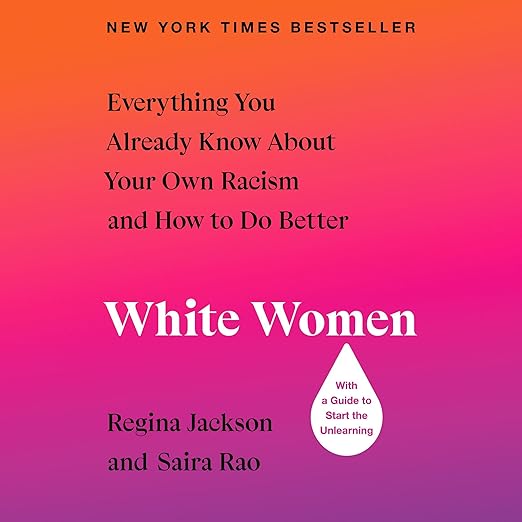
I listened to White Women on a Tuesday afternoon, folding laundry, which felt appropriately domestic for a book that argues the domestic, social performance of niceness is itself a mechanism of oppression. Regina Jackson and Saira Rao are not interested in making you comfortable. About fifteen minutes in, I set down the laundry basket and just sat with it, because it demands that kind of attention.
Jackson and Rao are the founders of Race2Dinner, an organization that brings white women together to talk frankly about racism and white supremacy culture. That context matters. This is not a book written from theory. It is written from the lived experience of thousands of hours in rooms with white women who arrived believing they were already doing the work, and who left, if they were honest, with a longer list of things to confront. That background gives the audiobook its particular texture: it feels less like a lecture and more like a very direct conversation you cannot easily leave.
Niceness as a Tool of White Supremacy
The central argument of the book is elegant and uncomfortable: the very behaviors white women are conditioned to value, being nice, avoiding conflict, striving for perfection, are not neutral personality traits. They are, according to Jackson and Rao, characteristics of white supremacy culture. The book works through nine specific behavioral patterns, from tone-policing to weaponizing tears, and examines how each one functions to protect whiteness rather than disrupt it. The authors are precise here. They are not saying that being kind is bad. They are saying that the performance of niceness in response to racism is a choice that prioritizes your own comfort over the actual harm being caused.
This is the section of the book that reviewers describe as confrontational, and they are right. One Audible reviewer described it as requiring the ability to tolerate discomfort, noting that real learning is impossible when you are busy kicking back against things you do not want to hear. That is an accurate summary of the experience. The book is not cruel, but it does not soften its observations. Jackson's narration helps here: she reads with directness rather than contempt, which keeps the material from feeling punishing even when it is demanding.
Moving from Ally to Accomplice
About halfway through my listen, I noticed something important: Jackson and Rao are not asking white women to feel worse about themselves. They are asking them to stop using the performance of feeling bad as a substitute for action. The distinction between ally and accomplice, which comes up in reader responses, is central to the book's argument. An ally signals support. An accomplice takes risks. The book is essentially a guide to the distance between those two positions and why it matters.
The nine-chapter structure, one chapter per behavioral pattern, is clean and practical. Each section includes not just analysis but some version of a question: what would it actually look like to behave differently here? This makes it more actionable than much of the anti-racism genre, which can get stuck at the level of awareness without moving toward change. The authors are explicitly unimpressed with awareness that produces no friction in one's relationships with other white people. Jackson and Rao argue that if you are not regularly upsetting white people around you, you are not doing anti-racism work in any meaningful sense. That is a demanding standard, and it is stated plainly.
Jackson Reads with the Cadence of Experience
Having the author narrate her own book is often a gamble. Sometimes authors read their prose too slowly or too carefully, losing the rhythm that makes the text work on the page. Regina Jackson does not fall into that trap. She reads with the cadence of someone who has given this argument many times in live settings. There is a directness to it that would be harder to achieve with a professional narrator who did not share the experience. The moments of humor, and there are some, land properly because she delivers them with the same seriousness she brings to the harder passages. At just over six and a half hours, the audiobook is a manageable listen: long enough to develop its arguments fully, short enough to complete over a weekend.
Made for Those Past the Defensive Stage
This book is for white women who have already moved past the stage of wondering whether racism is real and are now trying to figure out why their good intentions have not produced better outcomes. It is also for anyone who works in spaces where white women hold institutional power and wants a clearer vocabulary for what is happening. One reviewer, a licensed clinical therapist, noted that the book provoked the deepest personal reflection she had encountered in twenty-two years of practice. That range, from general listener to professional clinician, tells you something about the book's reach.
This is not the right entry point for someone who is still in the defensive stage. The book does not ease you in. It opens with the assumption that you have already accepted the basic premise and are ready to look at your own behavior specifically. If that is not where you are, the book will likely feel like an attack rather than an invitation. But if you are ready for it, and many readers clearly are, it is one of the more useful and honest books in the conversation about what white women can actually do differently. There are very few books in this space that manage to be both rigorous and specific without becoming either academic or performative, and this one stays on the right side of that line throughout.
Is the audiobook narrated by both authors or only one?
Only Regina Jackson narrates the audiobook, which she co-authored with Saira Rao. Her narration is direct and carries the tone of someone who has given these arguments in live settings many times, which works well for the confrontational style of the material.
How does this book compare to other anti-racism titles like White Fragility or So You Want to Talk About Race?
White Women is more behavior-focused and more specific in its address. Where White Fragility provides a psychological framework and So You Want to Talk About Race covers a broader audience, this book narrows its lens to nine specific behavioral patterns in white women and asks what concrete change looks like. It is less theoretical and more immediate.
At just over six hours, does the book have time to go deep on each of the nine behavioral patterns it covers?
The book is focused enough that six and a half hours is sufficient. Each chapter is devoted to one pattern, and the authors prioritize clarity and real examples over exhaustive academic citation. Several listeners noted they returned for a second listen to absorb what they missed the first time through.