Quick Take
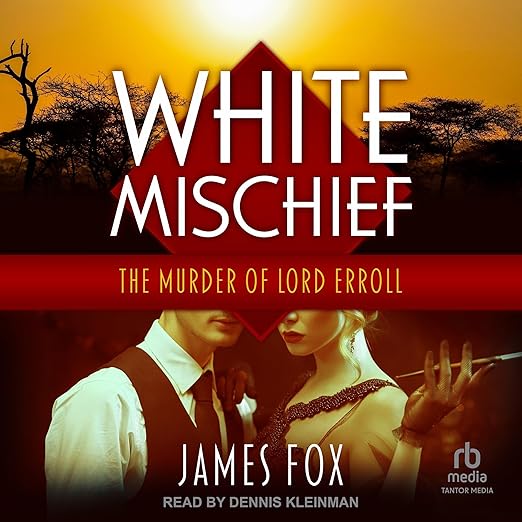
- Narration: Dennis Kleinman handles James Fox’s journalistic-literary prose competently, though the book’s structural shift from social history to cold-case investigation creates tonal demands that test any narrator.
- Themes: Colonial privilege and moral bankruptcy in Kenya, the unsolved murder of Lord Erroll, the decay of the Happy Valley set
- Mood: Louche and atmospheric in the first half, increasingly procedural in the second, the two halves read almost like different books
- Verdict: The first half of White Mischief is brilliant social history of British colonial excess; the second half is a more uneven mystery investigation, the whole is worth the 11 hours, but know what you are getting.
White Mischief has been on my radar for years, I saw the 1987 film adaptation before I read the book, which is probably the wrong order, and it colored my expectations in ways I should probably acknowledge upfront. The film leaned heavily into the glamour and decadence of Kenya’s Happy Valley set in 1941, and it gave the murder of Lord Erroll the atmosphere of a stylish mystery even as it acknowledged the moral bankruptcy underneath. The book is more interesting than the film and more honest about its own limitations, which is what makes it worth 11 hours of your time even though it is genuinely uneven.
The basic facts: in January 1941, Josslyn Hay, the 22nd Earl of Erroll and hereditary Lord High Constable of Scotland, was found dead in his Buick on a road outside Nairobi, a bullet behind his left ear. He was 39, charming, serially unfaithful, and at the time of his death conducting an affair with Diana Broughton, the young wife of Sir Jock Delves Broughton, who had recently arrived in Kenya from England. Broughton was tried and acquitted. The murder has never been officially solved. James Fox, thirty years later, decided to find out what actually happened.
Happy Valley and the Moral Geography of Empire
The first half of this book, the social history of the Happy Valley set, is exceptional. Fox reconstructs the world of British aristocrats and upper-middle-class Europeans who had decamped to the Kenya highlands in the 1920s and 1930s to build farms, consume quantities of drugs and alcohol, and conduct a social life of almost theatrical hedonism at a sufficient distance from English respectability to feel licensed. The morphine, the champagne, the spouse-swapping, the racial condescension toward both Africans and less socially connected Europeans, Fox captures all of it with a tone that is simultaneously fascinated and appalled, which is exactly the right tone for this material.
The context of the war, London burning in the Blitz while this group continued to party in the Kenyan highlands, is not incidental. Fox uses it to sharpen the moral portrait. These were people who had taken themselves out of their country at the moment it needed them most and were living at the expense of an agricultural economy built on a system of land tenure that had dispossessed the Kikuyu, the Masai, and other Kenyan peoples. The murder, when it comes, feels less like a dramatic rupture than like the inevitable consequence of a social world that had become entirely unmoored from any ethical accountability.
Where the Investigation Gets Complicated
One Audible reviewer described the book as half-great, and I understand what they mean. The second half, Fox’s cold-case investigation, conducted decades after the events, is more procedural and less stylistically assured than the social history. Fox is interviewing elderly survivors, tracking down documentary records, building a circumstantial case for a specific suspect that he presents with considerable conviction.
The problem is that Fox is better at writing social history than at writing detective narrative. He knows how to reconstruct a world; he is less sure of how to structure a mystery in a way that builds toward revelation. The conclusion he arrives at, and there is a conclusion, feels simultaneously well-supported and somewhat anticlimactic, which is an odd combination. Whether the murderer was who Fox thinks is still debated; the evidence is circumstantial and the main suspect is dead.
Kleinman’s Navigation of a Two-Register Problem
Dennis Kleinman reads Fox’s prose with appropriate authority. The social history sections, which are the stronger writing, he handles well, finding the dry observational tone that Fox uses to document excess without becoming complicit in it. The investigative sections are somewhat flatter, partly because the writing is somewhat flatter, and Kleinman’s delivery reflects that.
The period detail, the Kenya colony of the 1920s to 1940s, with its particular class hierarchies and agricultural politics and social geography, is rendered clearly in the narration. Kleinman does not overreach for atmosphere and does not underserve the material’s genuine complexity. At 11 hours it is a comfortable length for this type of narrative nonfiction.
Who Should Listen / Who Should Skip
Listen if you are interested in British colonial society in Africa and want a vivid account of its moral peculiarities from someone who did serious original research decades after the events. Listen if you enjoy journalistic cold-case investigation even when the resolution is less than definitive. Listen if the film intrigued you and you want to understand the real complexity behind the stylized version.
Skip if you are expecting a polished mystery narrative with a satisfying resolution, the book is more honest about its own inconclusiveness than a genre mystery would be. And skip if colonial Kenya’s social history feels too specialized; the murder is genuinely interesting but the broader social context is what makes this book worth reading.
Frequently Asked Questions
Does James Fox name a specific person as the murderer, and is his conclusion generally accepted?
Fox does arrive at a specific conclusion and presents the evidence for it at length in the book’s second half. His conclusion has been both accepted and contested by subsequent writers on the case. The murder has never been officially solved, and the main suspect Fox names was never charged. The case remains technically open, and Fox himself acknowledges the circumstantial nature of his evidence even as he makes his argument for it.
Is the 1987 film adaptation faithful to the book, and should I watch it before or after listening?
The film with Greta Scacchi and Charles Dance is fairly faithful to the book’s narrative arc, particularly the social history sections. It simplifies and compresses Fox’s investigative material. Most readers who know both prefer the book for its depth, but the film’s visual rendering of the Happy Valley world is genuinely useful context. If you are going to do both, listen to the book first, the film is a somewhat glamorized condensation.
How much does the book engage with the Kenyan African population, or is it entirely focused on the European expatriates?
Primarily focused on the European expatriates. The African dimension of colonial Kenya, the land dispossession, the labor system, the political subordination of the African majority, is present as context and moral background, but Fox’s investigative focus is on the Happy Valley set itself. Readers wanting a fuller account of colonial Kenya from multiple perspectives will need to supplement with other sources.
Is White Mischief primarily a true crime book or primarily a social history?
It is both, and that duality is both its strength and its structural weakness. Fox is a significantly better social historian than he is a cold-case detective, and the two halves of the book reflect that disparity. Readers who come for the murder investigation may find the first half too long; readers who come for the social history may find the second half too procedural. Both halves are worth reading, but knowing the balance in advance helps calibrate expectations.