Quick Take
- Narration: Amy Landon brings a clear, measured authority to DiAngelo’s arguments, neither prosecutorial nor soothing, which is exactly the right register for this material.
- Themes: Systemic racism, defensive response patterns, white racial socialization
- Mood: Challenging and direct, designed to produce discomfort as part of its argument
- Verdict: A focused, accessible examination of a specific psychological phenomenon, most productive when approached as a prompt for self-examination rather than a comprehensive theory of race.
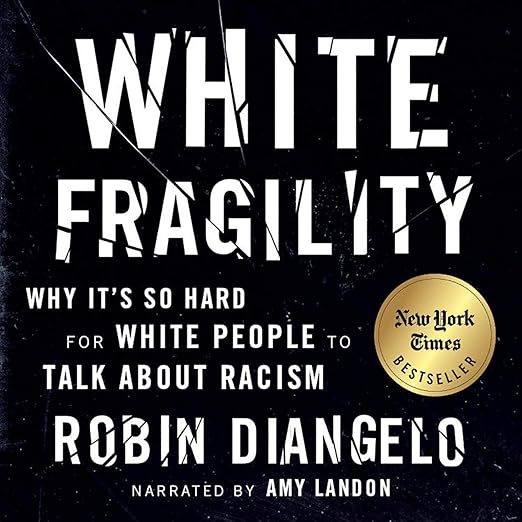
I listened to White Fragility on a long flight from New York to Paris in 2021, somewhere over the Atlantic, about a year after its initial surge of public attention and when I thought I could engage with it with some critical distance. What I found was a book more carefully targeted than its public reputation suggested. Robin DiAngelo is not trying to write a comprehensive theory of American racism. She is not trying to write a history, a policy analysis, or a manifesto. She is trying to do one specific thing: describe a pattern of behavior she has observed in white participants across years of workplace diversity trainings, and explain why that pattern is counterproductive. That focus is both the book’s strength and the source of its limitations.
The phenomenon DiAngelo calls white fragility is specific: the defensive reactions, anger, tears, guilt, argumentation, withdrawal, that white people frequently exhibit when their assumptions about race are challenged. Her argument is that these reactions, whatever the emotional sincerity behind them, function to shut down cross-racial dialogue and restore what she calls white racial equilibrium. The reactions are not presented as conscious bad faith. DiAngelo is explicit that the mechanisms she describes operate largely below the level of individual intention, which is one of the book’s more important distinctions and one that some critics overlook.
Our Take on White Fragility
DiAngelo’s analytical framework is clearest when she is describing the workplace training contexts she has actually observed. Those sections carry the specificity of firsthand documentation, and the patterns she identifies, the white participant who becomes visibly distressed when asked to consider their racial position, the group dynamic that shifts to managing the distressed participant’s feelings rather than continuing the original discussion, are recognizable and consequential. The book is most persuasive as a practitioner’s account of what actually happens in rooms where white Americans are invited to examine racial assumptions.
The book is less convincing when it moves from observed behavior to broader claims about the nature of white consciousness and socialization. DiAngelo’s argument that all white Americans are socialized into racism as a foundational feature of their identity is a significant claim that the book does not develop with the rigor it requires, and readers with social science backgrounds will notice the places where assertion does the work that evidence should be doing. The reviewer who found DiAngelo’s terminology troubling in the first half but ultimately illuminating is describing an experience many readers share: the book’s conceptual vocabulary requires orientation before it becomes useful.
Why Listen to White Fragility
Amy Landon’s narration is a significant asset. She delivers DiAngelo’s arguments with clarity and steadiness, she doesn’t editorialize through inflection, and she doesn’t soften the book’s challenges through a warm or reassuring tone. The delivery treats the material as worth taking seriously, which is the appropriate orientation. At six hours and twenty-one minutes, this is one of the shorter audiobooks in the social science and race discourse space, which makes it manageable as a starting point for listeners who want to engage with the conversation rather than be overwhelmed by it.
The international readership is notable. Reviewers from the UK, Canada, and Italy describe finding the book universally applicable despite DiAngelo’s explicitly American framing, which suggests the patterns she is describing have broader resonance than the US context in which she developed them.
What to Watch For in White Fragility
The book’s audience is explicitly white Americans, and DiAngelo is candid about this. Readers of color may find the book simultaneously validating and frustrating, validating because the behaviors described are recognizable, frustrating because the book’s attention is focused on white psychology rather than on the experiences of people who encounter those behaviors. This is a design choice appropriate to DiAngelo’s stated purpose, but it means the book has real blind spots from other perspectives.
The book also elides meaningful distinctions within whiteness, regional, class-based, generational, that matter considerably for the claims being made about universal white socialization. These are legitimate critical concerns, and listeners who want to engage seriously with the book’s arguments should read responses to it alongside the text itself.
Who Should Listen to White Fragility
White listeners who want a structured framework for examining their own defensive reactions to conversations about race will find this book provides exactly that, a vocabulary and a conceptual map for recognizing patterns that DiAngelo argues operate below conscious awareness. The audiobook format is effective for this kind of material because Landon’s narration maintains the reflective pace that self-examination requires. Those looking for comprehensive racial theory, historical context, or policy analysis should supplement this with other works, Isabel Wilkerson’s Caste, Ta-Nehisi Coates’s Between the World and Me, and Ibram X. Kendi’s How to Be an Antiracist occupy adjacent territory with different emphases. White Fragility is most productive when approached as a practitioner’s intervention on a specific behavior pattern rather than as a foundational text.
Frequently Asked Questions
Is White Fragility intended for readers of all backgrounds, or specifically for white audiences?
DiAngelo states explicitly that the book is written for white readers examining their own participation in racial dynamics. Readers of color may find it validating or frustrating depending on their perspective, the focus is on white psychology rather than on the experiences of people who encounter the behaviors described.
How does Amy Landon’s narration handle the more challenging passages?
With consistency and steadiness. Landon doesn’t soften the material or make it easier to absorb than DiAngelo intends. Her delivery is clear and unhurried, which suits both the conceptual density and the reflective tone the book requires.
Is this a comprehensive theory of racism, or something more focused?
More focused. DiAngelo is documenting a specific pattern of defensive behavior she has observed in workplace diversity training contexts. It is not a historical account of racism, a policy analysis, or a comprehensive social theory, readers expecting those things will find the book narrower than anticipated.
What books should I read alongside or after White Fragility for a fuller picture?
Isabel Wilkerson’s Caste provides historical depth that DiAngelo’s book lacks. Ibram X. Kendi’s How to Be an Antiracist offers a different conceptual framework. Ta-Nehisi Coates’s Between the World and Me centers the experience of being Black in America rather than examining white psychology. Together these form a more complete picture of the conversations DiAngelo is entering.