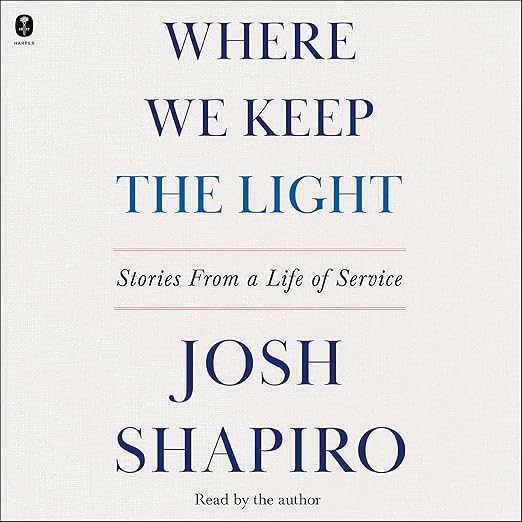
What draws someone to public service at a moment when trust in institutions runs so thin? Pennsylvania Governor Josh Shapiro's Where We Keep the Light is an audiobook that attempts to answer that question from the inside, not through policy argument but through accumulated story. Shapiro narrates this memoir himself, and that choice anchors everything that follows. When a politician explains his own motivations in his own voice, you hear something that a written text or a third-person narrator can't fully provide: the rhythm of a person who has told these stories before and believes them still, the particular cadence of someone who has built a career on direct communication with strangers at their doors.
Servant Leadership Versus the Leader-as-King Model
Shapiro frames the book around a concept of service that is deliberately unglamorous. He isn't writing about the romance of power or the excitement of major legislation; he's writing about knocking on doors, listening carefully, and solving specific problems for specific people. His account of moving from intern to state legislator to attorney general to governor traces a career built around that granular mode of engagement, and he makes a credible case that this accumulated practice of showing up is both more effective and more sustainable than the political charisma model that tends to dominate political memoir.
The faith dimension of the book is genuine rather than performative. Shapiro is Jewish and writes about his religious tradition as a source of ethical orientation rather than as political identity. One reviewer described the book as having "re-ignited my faith in humanity" and praised "a life led with integrity, knowledge and compassion." Another called it a great showcase of servant leadership, contrasting Shapiro's model with the leader-as-king framework that dominates political culture. These responses suggest a book landing as intended: an argument for competent, grounded governance through the evidence of a specific life.
Shapiro Prosecuted Clergy Abuse and Opioid Cases
The self-narration is the audio experience's defining feature. Shapiro reads with the cadence of a practiced public speaker, which he is, but without the oratorical inflation that can make political memoir feel like a permanent campaign event. When he describes the mentors who shaped him, the family stories that formed his values, and the cases he pursued as attorney general, the delivery has an intimacy that suggests genuine reflection rather than premeditated image management.
The stories about his time as Pennsylvania attorney general are the book's most specific and compelling sections. Shapiro prosecuted clergy sexual abuse cases, fought pharmaceutical companies over opioid distribution, and took on utility companies over consumer fraud, and he writes about each of these with the granularity of someone who actually ran the investigations. This specificity is what separates Where We Keep the Light from more aspirational political memoirs that deal primarily in values and vision rather than in concrete work.
Shapiro also addresses what he describes as the exhaustion of divisiveness, the experience of living in a political culture that has made distrust itself into a civic virtue. His argument that "conventional wisdom is rarely wise" and that more connects Americans than separates them will read as either bracing or optimistic depending on your current level of political fatigue. He writes from genuine conviction, which means the book is more persuasive than it would be if written cautiously, and occasionally more confident than the evidence it presents would strictly support.
Four Stars From Someone Who Hadn't Read It
This is a memoir written by a sitting governor who was, at the time of writing, a plausible candidate for higher office. That context doesn't make it dishonest, Shapiro's account of his career feels substantively accurate to public record, but it does mean the book's self-presentation should be read as persuasive argument as well as personal history. The memoir form allows selective emphasis, and Shapiro is skilled at deploying it.
Listeners who are skeptical of institutional politics or who bring significant cynicism about political memoir as a genre will likely find their defenses activated by passages that read as positioning. The book is most rewarding when engaged as a genuine account of what a specific kind of political commitment looks like from the inside, rather than as objective biography or as a policy platform.
The production value is solid, and at eight and a half hours, the listening is substantial but not exhausting. Shapiro's voice has enough variation and warmth to sustain the full arc without tipping into the monotony that self-narration sometimes produces. He's practiced at holding a room, and it shows.
One reviewer gave the book a four-star rating specifically while noting they hadn't yet read it, a reminder that social proof for political memoir often reflects the author's standing as much as the book's content. Listeners should evaluate the actual text rather than the accumulated endorsements.
A Self Instead of a Governing Agenda
Listeners interested in American political memoir, readers drawn to the servant leadership model as a practical and ethical framework, and anyone who wants to understand how a centrist Democrat in a competitive state thinks about governance will find genuine value here. People of faith who want to see religious conviction engaged seriously in a civic context will also connect with Shapiro's framing.
Skip it if political memoir in general doesn't appeal to you, or if you come to the book primarily as a policy evaluation rather than a character study. Shapiro isn't presenting a governing agenda here; he's presenting a self. Whether that self is compelling enough to hold your attention for eight-plus hours will depend significantly on how much you already find his public career interesting, and that's an honest precondition rather than a limitation of the book.