- Voice: John McLain handles the Southern material with appropriate gravity and rhythm, a steady, journalistic voice that suits Deusner's prose style.
- Big ideas: Southern identity and contradiction, music as cultural map, class and race in American rock
- Atmosphere: Thoughtful and road-worn, like a long drive through somewhere complicated
- Worth it?: A geographically inventive approach to band biography that works best as cultural criticism, essential for Drive-By Truckers devotees, genuinely interesting for everyone else.
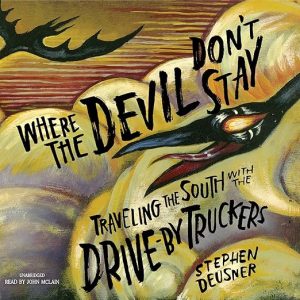
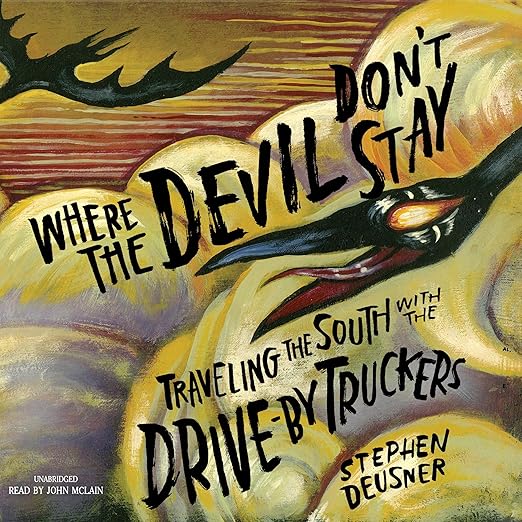
I was somewhere between Muscle Shoals and Nashville in my head when I started Where the Devil Don't Stay, listening during a long evening commute that happened to take me past a stretch of highway I associated, somewhat loosely, with country music history. Stephen Deusner's book about the Drive-By Truckers arrived at me already primed. I had been a peripheral fan of Patterson Hood and Mike Cooley's work for years, one of those listeners who knows the major albums without having followed the band's full arc. This book changed that.
The conceit is immediately interesting: rather than structuring the biography chronologically, Deusner organizes it geographically. The Truckers' albums become road maps. He travels to the places that shaped the band's members and their music, Muscle Shoals, Alabama; Richmond, Virginia; McNairy County, Tennessee, and uses those places to excavate what the songs are actually about. It is a structural bet that pays off.
A Closer Look at Where the Devil Don’t Stay
The Drive-By Truckers are a Southern rock band, but the South they represent is not the shorthand version. Deusner is clear and consistent about this. The band has spent its career insisting on the complexity of a region that American culture tends to collapse into caricature, both the sentimentalized version and the condemning one. Songs like the three-song Southern rock opera on Southern Rock Opera, and the albums that came after it, engage with class, race, religion, and history in ways that require a critical framework to fully appreciate. Deusner provides that framework without becoming academic about it.
The book includes new interviews with past and present band members, including Jason Isbell, who left the band in 2007 and has since become one of the most significant songwriters in American music. Those interview threads are among the most valuable material in the audiobook. Isbell's perspective on both why the Truckers worked and why he needed to leave gives Where the Devil Don't Stay a dimension of internal conflict that pure institutional biography usually lacks.
What Makes Where the Devil Don’t Stay Worth Hearing
John McLain's narration is a good match for the material. He reads with a measured, journalistic quality that suits Deusner's prose, analytically rigorous without being dry. At almost eleven hours, this is a substantial listen, and McLain maintains a consistent pace throughout without becoming monotonous. The Southern context of the material benefits from narration that understands how to handle that register without either overdoing the regional texture or draining it entirely.
One reviewer described the book as exceptionally well written with keen analysis from a seasoned music journalist and culture critic, and called it essential for both Drive-By Truckers fans and music nerds broadly. That assessment is fair. Another reviewer, whose son was a devoted Truckers fan and who read the book in his memory after his death, described it as very good, a testament to what well-done music writing can mean to people whose lives are shaped by a band. That emotional resonance is present throughout the material.
Things to Know Before Starting Where the Devil Don’t Stay
The one honest caveat is worth naming. A dissenting reviewer who characterized himself as a devoted fan found the book sparse on revelations and insight, noting that it left open space for the band members themselves to tell their full story. That criticism is not without merit. Deusner is a music journalist writing about a band, not a band member writing a memoir, and the difference in proximity does show. The book is more interpretation than confession. Readers who want the unfiltered inner history of the band will need to wait for Hood or Cooley to write it themselves.
But as an act of critical interpretation, placing a band's work in the geography and culture that produced it, Where the Devil Don't Stay is exactly what it sets out to be. The Southern rock tradition has produced a lot of mythologizing and very little serious examination. Deusner provides the latter. He is genuinely interested in what it means that the Truckers emerged from a specific place with a specific history, and that interest is sustained across the full runtime.
Who Stephen Deusner Is Writing For
Drive-By Truckers fans will find this essential listening. Readers interested in Southern culture, American class history, or music journalism will find it rewarding even with limited familiarity with the band, the cultural argument stands independently of fandom. Listeners wanting intimate access to the band members' own perspectives, or a conventional chronological biography, may find the geographic structure and critical distance less satisfying. But as a work of music criticism framed through place, it has few peers in this particular corner of American music writing.