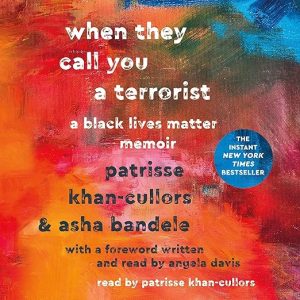
- Performance: Patrisse Cullors narrates her own memoir despite this listing crediting Angela Davis instead, likely reflecting the program's separate bonus conversation rather than the main narration.
- What it covers: Black Lives Matter's founding, police violence and systemic racism, family survival and resilience
- Feel: Urgent, personal, and unflinching
- Our call: A vital, self-narrated testimony best heard in Cullors' own voice, worth confirming the narrator credit before purchase.
Patrisse Cullors narrates her own memoir in this audiobook, and AudioFile Magazine's own assessment, quoted directly in the listing, credits exactly that choice for the book's power: 'pain, frustration, and joy emblazon each word she utters.' Look at the credit block and you'll actually see Angela Davis named as narrator here, which appears to reflect a bonus conversation included with the program rather than the main narration; the synopsis states plainly that 'this program is read by Patrisse Cullors,' so listeners specifically seeking Cullors' own voice can expect to hear it throughout the core memoir. Cullors co-wrote the book with journalist asha bandele, though only Cullors appears in this listing's byline.
Is When They Call You a Terrorist Worth Your Time?
This is the origin story of Black Lives Matter, told from inside the movement by one of its founders, and Cullors resists turning it into either a triumphant political manifesto or a straightforward misery memoir. Instead the book moves fluidly between her childhood in Los Angeles, including a brother's struggle with schizoaffective disorder and a mother working from before dawn until well after dark to hold the family together, and the specific organizing work that grew into a national movement.
Reviewer 'Advocate for the marginalized' calls the writing itself remarkable, saying Cullors and bandele 'can weave a story, so interesting,' while David Southworth, describing himself as 'a 67 year old white man raised in the South,' offers a genuinely useful cross-reference, comparing the book directly to Hillbilly Elegy: both describe childhoods 'hard for a middle class kid to adequately grasp,' with the authors emerging into very different places politically and personally.
The Black Lives Matter movement's roots trace to 2013, when Cullors, Alicia Garza, and Opal Tometi began organizing around a shared hashtag following the acquittal of the man who killed Trayvon Martin; the book gives that specific origin point real weight, situating the movement's founding not as an abstract political strategy but as an immediate, personal response to a verdict that felt like a direct threat to Cullors' own family and community.
Ella Mc's review underscores just how much personal hardship the book carries before the organizing and activism even enter the narrative, calling Cullors' story 'not an easy one,' a reminder that the memoir's personal chapters carry as much weight as its political ones.
Self-narration matters enormously for a memoir built this explicitly around testimony and lived experience; a hired narrator, however skilled, would be performing Cullors' pain rather than simply having it, and that distinction is exactly what AudioFile's review is pointing at when it credits her delivery with genuine emblazoned emotion rather than polished technique.
At six hours and thirty minutes, this is a compact, focused listen that does not pad its narrative with excess detail; the bonus conversation included in the program adds further context beyond the core memoir without extending the main narrative's already tight, purposeful pacing.
asha bandele, Cullors' co-writer, is a poet and journalist with her own history writing about incarceration and its effects on Black families, and that literary sensibility shapes the book's prose throughout; the memoir moves with a rhythm closer to spoken-word poetry in places than standard political nonfiction, which makes Cullors' own narration feel especially suited to material written partly for the ear.
Before You Commit to When They Call You a Terrorist
The narrator credit naming Angela Davis rather than Cullors is worth flagging directly for anyone specifically trying to confirm who they will hear; treat it as a crediting mix-up tied to the bonus material rather than a change in casting, since every piece of descriptive text in the listing itself points to Cullors as the primary narrator.
This book addresses police violence, incarceration, and the deaths of Black Americans at the hands of law enforcement directly and without euphemism; the synopsis itself frames the work as being about a movement labeled a threat by others while insisting its actual roots are in love and survival, and listeners should expect the memoir to hold that framing throughout rather than softening it for a general audience.
Only two written reviews are attached despite the strong 4.7 rating and extensive press quotes included in the synopsis itself, from Publishers Weekly, the New York Times Book Review, and Michelle Alexander; the press reception is substantial even where the raw review count on this listing is thin.
The synopsis's own description of Black Lives Matter leaders as having been 'called terrorists, a threat to America' is the book's central provocation and its title's direct source, with Cullors and bandele making the case throughout that the movement's actual foundation is love and protection of vulnerable lives rather than threat.
Michelle Alexander's blurb, invoking her own influential book The New Jim Crow to frame this memoir as essential reading, places Cullors' account within a specific lineage of contemporary writing on mass incarceration and systemic racism, useful context for listeners deciding where this fits among other nonfiction on the same broader subject.
Should You Listen to When They Call You a Terrorist?
This is essential listening for anyone wanting to understand the Black Lives Matter movement's origins from a founder's own perspective rather than through secondhand media coverage, and for readers of contemporary American memoir who want testimony grounded in specific lived detail rather than abstraction.
Skip it only if you are looking for a detached policy analysis of criminal justice reform rather than a personal account; for listeners ready to sit with Cullors' own voice telling her own story, this delivers exactly the intimacy the format promises.
This pairs naturally with other foundational movement memoirs, from earlier civil rights-era autobiographies to more recent racial justice writing, for listeners building out a fuller picture of how organized movements for Black liberation have been built, sustained, and publicly mischaracterized across different historical moments.
The memoir's influence has extended well past its original publication window, regularly cited in later discussions of how Black Lives Matter's founders have told their own stories in their own words, rather than through the secondhand framing more common in mainstream news coverage of the movement's early years.
Who actually narrates the When They Call You a Terrorist audiobook?
The synopsis and an AudioFile Magazine review both confirm Patrisse Cullors reads her own memoir, though this particular listing shows Angela Davis as the credited narrator, which appears to reflect a separate bonus conversation included with the program.
How long is the When They Call You a Terrorist audiobook?
It runs six hours and thirty minutes, a compact, tightly focused length.