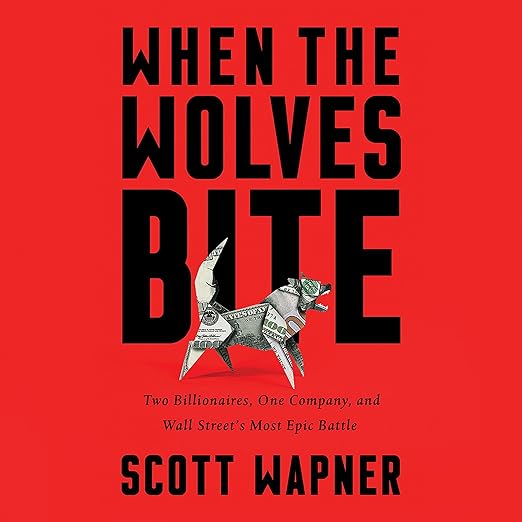
Quick Take
- Narration: Scott Wapner reading his own account gives the story insider credibility no hired narrator could replicate, and his CNBC host instincts keep the pacing brisk.
- Themes: Activist investor warfare, corporate power and ego at scale, the Herbalife pyramid scheme debate
- Mood: Fast-paced and confrontational, occasionally veering into financial procedural territory
- Verdict: The best business book for readers who want their Wall Street drama served with the pacing of a sports rivalry and the detail of a financial investigation.
I had been avoiding When the Wolves Bite for longer than I should have, partly because the Herbalife saga felt, from the outside, like the kind of financial dispute that requires a spreadsheet to care about. I was wrong about that. I put it on one evening expecting to bail out within the first hour, and I found myself deep into the Icahn-Ackman feud well past midnight. The story turns out to be much less about nutritional supplements and much more about what happens when two people with virtually unlimited resources and an unlimited capacity for grievance decide to treat a publicly traded company as the arena for a personal war.
Scott Wapner was the CNBC host who presided over the most theatrical moment in this story: the live television confrontation between Bill Ackman and Carl Icahn that one reviewer called an insult war and that anyone who watched it at the time probably still remembers. That position, inside the room where the drama unfolded in real time, gives him an access advantage that most financial journalists would not have. He uses it well throughout every chapter of this book.
Ackman, Icahn, and What This Fight Was Actually About
The surface narrative is about Herbalife. Ackman, having conducted a lengthy investigation into the company’s business model, took a massive short position and made a very public case that the company was a pyramid scheme. Icahn, whose relationship with Ackman had its own prior history, took the other side. What follows is a saga in which two men with billions of dollars pursue what begins as a financial disagreement and becomes something considerably more personal and considerably more expensive.
Wapner is admirably neutral throughout. One reviewer who followed the saga closely praised his refusal to lead the reader toward a verdict on whether Ackman’s short was justified or Icahn’s support for Herbalife was genuine. That neutrality is harder to maintain than it sounds when you are writing about a story you covered as a journalist with relationships on both sides. The result is that the book reads as investigation rather than advocacy, which gives the financial analysis more credibility and the personal drama more room to breathe without the author’s thumb on the scale.
Who David Einhorn Is and Why He Matters
One reviewer provided the useful clarification that the Herbalife fight began not with Ackman but with David Einhorn, who took an early short position and asked pointed questions at a shareholder meeting before retreating. That history is important context, and Wapner covers it clearly. The book is genuinely informative about the mechanics of activist short-selling, and one of its real contributions is explaining how these positions work, what risks they carry, and what the incentive structure is for the participants without assuming the reader has a background in financial markets.
The reviewer who described herself as not a financial geek and yet enjoying the book thoroughly made the most important point about who this is for. Wapner writes for an intelligent general audience rather than for market professionals. The financial concepts are explained without condescension, and the human drama is vivid enough that readers who never follow Wall Street will find the narrative propulsive. This is genuinely cross-audience financial writing, which is rarer than it should be.
Wapner Narrating Wapner
The decision to have Wapner read his own book pays off in ways a professional narrator could not have replicated. His cadence is the cadence of live television news, which means he delivers financial information at a pace that keeps you engaged rather than at the measured classroom pace that makes some nonfiction audiobooks feel like lectures. The insider quality of the narration, knowing that this is the voice of the person who was literally in the room for some of these events, gives the more dramatic sequences a different texture than reported accounts typically carry.
At eight hours, the runtime is appropriate for the material. The book does not overstay its welcome or pad its account with speculative analysis that the evidence does not support. Readers looking for a deeper investigation into whether Herbalife’s business model was ultimately a pyramid scheme may find the neutrality frustrating, but that was clearly a deliberate editorial choice rather than an oversight. The comparison to current market dynamics, where public figures battle short-sellers through media as much as through the market, makes the Herbalife saga feel less dated than its publication date might suggest.
Who Will Get the Most From This Book
Business readers and market enthusiasts are the obvious audience, but When the Wolves Bite works well beyond that community. Readers who are interested in the psychology of wealth, the performance of ego at the highest levels of financial competition, or the way personal grudges can distort enormous amounts of capital will find the book consistently rewarding. First-time financial nonfiction listeners who are curious about activist investing but have found the genre impenetrable will discover here that the right journalist and the right story can make even complex market mechanics as readable as a good rivalry narrative.
Frequently Asked Questions
Do I need to follow financial markets to enjoy When the Wolves Bite?
No. One reviewer who described herself as not a financial geek found it completely absorbing. Wapner explains activist short-selling and the mechanics of the positions clearly enough for general readers to follow the story without prior market knowledge.
Does Wapner take a side on whether Ackman or Icahn was right about Herbalife?
Deliberately not. Multiple reviewers praised the neutral tone he maintains throughout, allowing readers to reach their own conclusions about whether Herbalife’s business model was a pyramid scheme and whether either investor’s position was justified.
Is the live television confrontation between Ackman and Icahn covered in the book?
Yes, in detail. Wapner hosted that confrontation on CNBC, which gives him a uniquely positioned account of what happened and what the atmosphere in the room was actually like. It is one of the narrative peaks of the audiobook.
How much background on David Einhorn and his role does the book provide?
Wapner covers Einhorn’s early involvement clearly, including his short position and the shareholder meeting questions that preceded Ackman’s larger campaign. Reviewers who followed the saga closely found the historical framing accurate and well-contextualized.