Quick Take
- Narration: Andrew Milburn narrating his own memoir carries the self-effacement and dry humor the text requires, something no professional narrator could replicate.
- Themes: The burden of command, post-combat trauma, leading special operations forces across twenty years of conflict
- Mood: Measured and honest, not the adrenaline-driven tempo of many war memoirs, but something more searching
- Verdict: One of the more thoughtful and unusually candid military memoirs of the post-9/11 generation, covering more ground with more self-awareness than the genre typically allows.
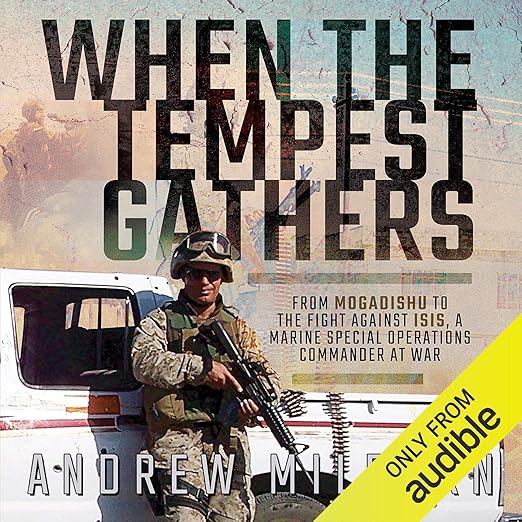
Military memoir occupies a specific space in nonfiction: it has to balance the obligation to document combat experience with the temptation to mythologize it, and very few authors manage both at once. Andrew Milburn’s When the Tempest Gathers is unusual in this genre for several reasons. He covers more than twenty years and more geography, Mogadishu, Baghdad, Fallujah, Mosul, and eventually the ISIS campaign, than most personal accounts attempt. He is a Marine with advanced degrees who writes with structural intelligence about what he saw. And he narrates his own work in a voice that carries the particular register of someone who has been thinking carefully about these experiences for a long time and is not interested in making them more dramatic than they were.
I was about forty minutes into this one, driving back from a weekend trip, when it became clear that this was going to be a different kind of war memoir. The Somalia section, which covers Milburn’s early experience in Mogadishu, is handled without the feverish immediacy of more dramatic combat accounts, but Milburn was there in a different capacity, saw different things, and the quieter register of his account is appropriate to what he actually experienced. By the time he reaches the ISIS campaign, which occupies the book’s final and most substantial section, the accumulated detail of his career makes the command decisions he describes genuinely legible in a way they wouldn’t be without the preceding context.
The Isolation of Command
Milburn is unusually candid about what command actually costs. Reviewer J. Harrison identifies this as the book’s most distinctive quality: the war stories are compelling on their own terms, but the reflection on what it means to hold authority over people in life-or-death situations, the isolation, the weight of decisions that send specific individuals into specific dangers, the difficulty of processing those decisions afterward, is what makes the book valuable beyond its documentary function. This isn’t the boilerplate acknowledgment of sacrifice that closes most military memoirs. Milburn writes about the psychological mechanics of command with the specificity of someone who has thought about nothing else for a significant portion of his adult life.
The ISIS Campaign as Professional Summation
Reviewer Peter K. notes that the ISIS section is the book’s culmination, a campaign complex enough to require the twenty years of preparation the preceding chapters document. Milburn commanded a special operations task force during a period when ISIS was at its most territorially extensive, and the operational challenges he describes, coordinating multinational forces with divergent interests, managing a media environment that could amplify tactical decisions into strategic problems, operating under political constraints the battlefield didn’t respect, are the problems of a genuinely new kind of warfare. His account of how he tried to apply the lessons of his harsh apprenticeship to this environment is the closest the book comes to a strategic argument, and it’s a substantive one. Bing West’s endorsement, quoted in the synopsis, captures it well: Milburn knits individual combat experiences into a coherent understanding of what actually happened in America’s twenty-year engagement with terrorism.
Self-Narration and What It Contributes
Milburn narrating his own memoir is the right call, and not only because memoir generally benefits from the author’s voice. His delivery carries the quality of a man who has told parts of this story before, to fellow officers, to family, to himself, and knows which details matter and which are just atmosphere. The self-effacing humor that reviewers consistently note is present in the narration without being performed; it comes through as a natural quality of how he speaks rather than a stylistic choice. There are passages where the audio occasionally flattens what might be more affecting on the page, but the authenticity of the voice compensates. At twelve hours, this is a well-paced listen, substantial without overstaying its welcome.
Who Should Listen, Who Should Skip
Strong choice for listeners interested in military history of the post-9/11 campaigns, particularly those who want something more analytically rigorous and personally honest than the genre average. Veterans and active military will find Milburn’s treatment of command psychology unusually accurate to their experience; civilian readers will find it a more nuanced window into what those campaigns actually felt like from inside than most popular accounts provide. Skip it if you want combat action in the style of more dramatic war memoirs, Milburn’s pace is deliberate and his interest is in understanding rather than dramatizing. The breadth of the book is its strength; listeners wanting a focused account of a single campaign may find the twenty-year arc ambitious.
Frequently Asked Questions
What campaigns does Milburn cover, and in what order?
The memoir follows his career chronologically from the early 1990s through approximately 2016. Major stops include Mogadishu in Somalia, Baghdad and Fallujah in Iraq, Mosul, and the fight against ISIS as commander of a multinational special operations task force. The ISIS campaign receives the most extended treatment.
Does Milburn’s self-narration work for a twelve-hour listen?
Yes, reviewers consistently note that his voice carries the self-effacing candor the text requires. He doesn’t over-dramatize, which is the main risk of self-narration in military memoir. The authenticity of a senior Marine officer reading his own account of command is something a professional narrator couldn’t replicate.
Is this primarily a combat narrative or a leadership book?
Both, in roughly equal measure. The combat experiences are documented in detail, but Milburn’s consistent interest throughout the book is in the psychology of leadership: the isolation of command, the management of post-combat trauma, the ethical weight of decisions that affect the lives of subordinates. Reviewer J. Harrison identifies this dual focus as the book’s distinguishing quality.
How candid is Milburn about personal struggles, post-combat trauma and family tragedy?
Very candid by the standards of senior military memoir. He addresses post-combat trauma and family tragedy directly rather than euphemistically, and reviewer Peter K. notes that the candor around personal struggles is one of the elements that distinguishes this from more conventional military accounts. It doesn’t read as confessional but as honest.